

Introduction: Seeing a Person Beyond Words
On a quiet evening, imagine sitting across from someone you’ve just met. They don’t say much at first, but their presence fills the room in a way that feels hard to explain. Maybe it’s the calm in their voice, or the way their eyes seem to carry stories older than their words. You try to describe them later—but “nice,” “kind,” or “interesting” don’t feel enough. Something is missing.
This is where metaphors step in like a bridge between feeling and language. A person is never just a list of traits; they are a landscape, a weather system, a book still being written. Metaphors help us capture that depth in vivid, imaginative ways.
In writing, storytelling, or even everyday conversation, metaphors for a person allow us to express personality, emotions, and essence with color and precision. Instead of saying someone is “strong,” we might say they are “an oak tree in a storm.” Instead of “calm,” they become “a still lake at dawn.”
In this article, we’ll explore powerful metaphors for describing a person, how they work, and how you can use them in writing, speech, and creative expression.
What Are Metaphors for a Person? (Meaning & Creative Power)
A metaphor is a figure of speech that describes something by comparing it to something else, without using “like” or “as.” When applied to a person, metaphors transform personality traits into vivid imagery.
Instead of abstract words, metaphors create emotional pictures.
For example:
- “She is a lighthouse.” → She guides others and offers safety.
- “He is a storm.” → He is intense, unpredictable, and powerful.
Metaphors matter because they:
- Make writing more expressive and memorable
- Help readers emotionally connect with a character or person
- Add depth to storytelling and communication
- Turn ordinary descriptions into artistic expressions
In literature, metaphors are often what make characters unforgettable. Think of how poets, novelists, and even filmmakers use symbolic comparisons to bring people to life.
Now, let’s explore some powerful metaphor ideas you can use.
1. The Person as a “Tree in Changing Seasons” (Growth & Resilience)
A person can be beautifully described as a tree that lives through seasons.
Meaning & Explanation
This metaphor represents growth, endurance, and emotional cycles. Like a tree, a person experiences change—blooming in joy, shedding in loss, and standing firm through storms.
Example Sentence
“She is like a tree that has seen many winters—bent by storms, but never broken.”
Alternative Expressions
- A rooted oak of resilience
- A willow bending but not breaking
- A garden that renews itself with every season
Sensory & Emotional Detail
Imagine bark weathered by time, roots gripping deep into the earth, leaves whispering in the wind. This metaphor carries both strength and softness.
Mini Story
There was an old man in a village who rarely spoke. People thought he was quiet because he had nothing to say. But those who sat under the shade of his presence felt peace. Like a tree, he had lived through wars, losses, and joys—and simply stood there offering shelter without words.
2. The Person as “Weather” (Emotion & Personality Shifts)

People often change emotionally, just like weather changes in the sky.
Meaning & Explanation
This metaphor reflects mood, emotional intensity, and unpredictability. A person can be sunshine one moment and a thunderstorm the next.
Example Sentence
“His mood was weather—sunlight one hour, storm clouds the next.”
Alternative Expressions
- A sky full of shifting winds
- A human atmosphere
- A climate of emotions
Sensory & Emotional Detail
Warm sunlight on skin, sudden cold wind before rain, thunder rolling in the distance—this metaphor captures emotional realism.
Cultural Reference
In many poems, especially Romantic poetry, human emotions are described through nature—rain for sadness, sunlight for joy, storms for anger.
Mini Story
A young artist was known for her unpredictable emotions. Some days she painted bright golden fields; other days, dark oceans swallowing ships. People called her “the weather woman,” because no one could ever predict what sky she would bring into the room.
3. The Person as a “Book Still Being Written” (Identity & Life Journey)
One of the most powerful metaphors for a person is that they are a book in progress.
Meaning & Explanation
This metaphor represents growth, unknown future, and evolving identity. No one is finished; everyone is still writing their story.
Example Sentence
“He is not a finished story—just a book with many unwritten chapters.”
Alternative Expressions
- A novel under construction
- A story unfolding page by page
- A manuscript still wet with ink
Sensory & Emotional Detail
Think of pages turning slowly, ink drying on paper, chapters waiting to be discovered. It suggests mystery and potential.
Interactive Exercise
Try writing about yourself as a book:
- What is your title right now?
- What chapter are you in?
- What might the next chapter be called?
Mini Story
A teacher once told her students, “Don’t judge anyone by the chapter you meet them in.” Years later, one student realized how true it was—people who seemed lost in one chapter became heroes in the next.
4. Using Metaphors to Describe Personality in Writing
Metaphors are not just decorative—they shape meaning.
Writers use metaphors to:
- Create emotional depth in characters
- Make descriptions more vivid
- Show rather than tell personality traits
Example in Writing
Instead of saying: “She is brave.”
You could write: “She is a flame that refuses to go out in the wind.”
Bonus Tip
Use metaphors sparingly but meaningfully. One strong metaphor is better than many weak ones.
5. Interactive Exercise: Create Your Own Person Metaphors
Try these prompts:
- If your best friend were a natural element, what would they be? Why?
- If a stranger in a café were a weather pattern, what would describe them?
- If your personality were an object, what would it be and why?
Challenge
Write three sentences:
- “I am like…”
- “He/she is like…”
- “We are like…”
This helps train your creative thinking and emotional expression.
6. The Person as “Light and Shadow” (Dual Nature of Humans)
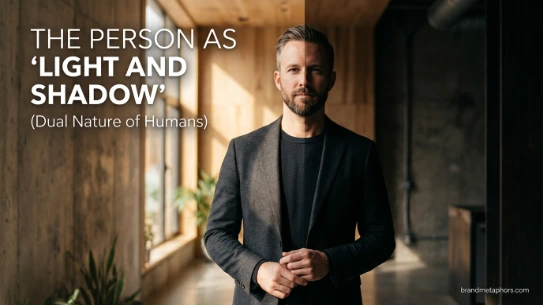
Every person carries contrast—strength and weakness, joy and sorrow.
Meaning & Explanation
This metaphor reflects complexity. No one is purely good or bad; everyone has light and shadow.
Example Sentence
“She was sunlight and shadow at the same time—warm, yet mysterious.”
Alternative Expressions
- A flickering candle
- A sunrise with hidden clouds
- A flame dancing in darkness
Emotional Depth
This metaphor is often used in literature to describe morally complex characters who feel real and human.
7. The Person as “Music or Rhythm” (Energy & Presence)
Some people feel like music when they enter a room.
Meaning & Explanation
This metaphor describes personality through rhythm, tone, and emotional energy.
Example Sentence
“His voice was music—steady like a slow piano melody.”
Alternative Expressions
- A walking symphony
- A heartbeat of sound
- A rhythm that fills silence
Cultural Reference
Writers often compare lovers, artists, or charismatic figures to music because it captures emotional resonance beyond logic.
8. Tips for Using Metaphors in Everyday Life & Social Media
Metaphors aren’t just for literature—they can enrich everyday communication.
Writing
- Use them in storytelling, poetry, essays
- Avoid overloading sentences
- Focus on clarity and emotional impact
Social Media
- “Feeling like a storm trying to become calm skies.”
- “Today I am a book waiting for a better chapter.”
Conversation
Instead of “I’m tired,” you might say:
- “I feel like a phone on 1% battery.”
This makes communication more expressive and relatable.
9. Common Mistakes When Using Metaphors for a Person
Even creative tools need balance.
Mistake 1: Overuse
Too many metaphors can confuse meaning.
Mistake 2: Mixed Imagery
Avoid mixing unrelated ideas:
- “He is a burning ocean of silence” → unclear image
Mistake 3: Lack of Relevance
A metaphor should match the personality trait being described.
Tip
Always ask: “Does this image make the person clearer or more confusing?”
10. Final Creative Challenge: Build a Metaphor Portrait
Now combine everything.
Write a short “metaphor portrait” of a person using 2–3 metaphors.
Example: “She is a tree in winter light, a quiet melody in a crowded room, and a book still waiting for its boldest chapter.”
Try writing one for:
- Yourself
- A friend
- A fictional character
This exercise helps you think in images instead of plain description.
Conclusion
Metaphors for a person open a doorway between language and imagination. They allow us to describe not just how someone looks or acts, but how they feel in the mind and heart.
A person is never just one thing—they are seasons, storms, books, music, and light all at once. Metaphors help us honor that complexity in a way plain words often cannot.
Whether you are a writer, student, storyteller, or simply someone who enjoys expressive language, learning to use metaphors will change the way you see people—and how you describe them.
Because in the end, every person is not just a sentence… but a whole universe of meaning waiting to be written.
FAQs
1. What is a metaphor for a person?
A metaphor for a person is a creative comparison that describes someone using imagery, like calling a person “a tree” or “a storm” instead of using direct traits.
2. Why are metaphors important in describing people?
They make descriptions more vivid, emotional, and memorable, helping others understand personality in a deeper way.
3. Can metaphors be used in daily conversation?
Yes, metaphors can make everyday speech more expressive and relatable, especially when describing feelings or situations.
4. What are some common metaphors for personality?
Common examples include: “a rock” (strong), “a storm” (emotional), “a light” (positive influence), and “a book” (complex or evolving person).
5. How can I improve my use of metaphors?
Practice observing people closely, compare them to natural elements or objects, and write short metaphor descriptions regularly.