

Introduction: When Ordinary Words Aren’t Enough for Extraordinary Moments
There are moments in life that refuse to stay small inside language. A sunrise that feels like the sky is being painted fresh by unseen hands. A performance so powerful it makes an entire room forget to breathe. A simple act of kindness that lands heavier than grand speeches.
In those moments, the word “good” feels childish, and even “great” starts to collapse under the weight of what we’re trying to express. This is where metaphors step in—not as decoration, but as rescue tools for meaning. They stretch language until it can finally hold wonder.
Metaphors for “amazing” are especially powerful because “amazing” itself has become overused. We say it for food, movies, clothes, even weather. But true amazement deserves sharper, more vivid language—language that paints, sings, and sometimes even shocks.
In this article, we’ll explore creative metaphors for “amazing,” how they work, and how you can use them in writing, conversation, storytelling, or even social media captions. You’ll also find practical exercises to make these expressions your own.
1. Metaphors for Amazing as “Fireworks in the Mind”
When something is truly amazing, it doesn’t just sit quietly in the brain—it explodes into thought, memory, and emotion.
Meaning & Explanation
“Fireworks in the mind” suggests sudden bursts of excitement, color, and surprise. It captures the emotional spark that happens when something exceeds expectation.
Example Sentence
“The ending of the film was fireworks in the mind—every twist igniting a new wave of awe.”
Alternative Expressions
- A mental explosion of wonder
- Bursting lights of surprise
- Spark storms in thought
Sensory & Emotional Detail
Imagine standing under a night sky where every idea lights up like gold and crimson sparks. There’s noise, but it’s beautiful. There’s chaos, but it feels intentional.
Mini Storytelling Moment
A student sits in a dull classroom until a science experiment suddenly reacts with glowing colors and crackling energy. That one moment doesn’t just teach—it detonates curiosity.
Cultural Note
Fireworks are often used in festivals across the world to mark celebration. Similarly, in storytelling, this metaphor signals emotional climax.
Practice Prompt
Think of a moment that surprised you deeply. Rewrite it using the phrase “fireworks in the mind.”
2. Metaphors for Amazing as “A Door Opening to a New Universe”
Some experiences don’t just impress you—they change your perspective entirely.
Meaning & Explanation
This metaphor describes amazement as expansion. It suggests discovery, transformation, and mental escape from the ordinary.
Example Sentence
“Reading that book was like a door opening to a new universe where every word reshaped reality.”
Alternative Expressions
- A gateway to wonder
- A portal of possibility
- Reality unfolding into something larger
Sensory & Emotional Detail
You feel a slight pause, like standing in front of something vast. Air seems heavier with possibility. Everything familiar suddenly looks different.
Mini Storytelling Moment
A traveler visits a remote mountain village for the first time. The silence, stars, and simplicity don’t just impress him—they redefine what “life” means.
Literary Reference
This idea echoes classic fantasy literature, where doors, wardrobes, and portals symbolize transformation and awakening.
Practice Prompt
Describe your favorite place as if it were “a door opening to a new universe.”
3. Metaphors for Amazing as “Lightning Striking Still Water”
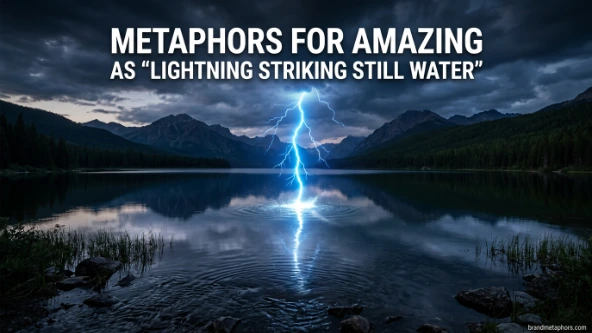
Amazement often arrives suddenly, disrupting calmness with force and beauty.
Meaning & Explanation
Lightning striking still water combines two opposites: calmness and sudden energy. It represents shock, clarity, and emotional impact.
Example Sentence
“Her voice in the choir was like lightning striking still water—silent hearts suddenly alive.”
Alternative Expressions
- A sudden flash through silence
- A shock of brilliance
- Electric awe in stillness
Sensory & Emotional Detail
You can almost feel the air change. The calm surface of thought is disrupted by something bright, fast, and unforgettable.
Mini Storytelling Moment
A quiet library turns electric when a young poet reads a verse so powerful that even the dust feels awake.
Cultural Note
Lightning has long been associated with divine inspiration in mythology, from Greek Zeus to Norse Thor.
Practice Prompt
Rewrite a memorable compliment you’ve received using this metaphor.
4. Why Metaphors for “Amazing” Matter in Language
We often underestimate how much metaphors shape perception. Saying something is “amazing” is flat. But saying it is “fireworks in the mind” makes it alive.
Metaphors:
- Turn abstract feelings into images
- Create emotional memory
- Make writing more persuasive
- Help readers feel instead of just understand
In everyday life, they also improve communication. Instead of saying “I liked it,” you can say “it felt like stepping into a brighter world.”
5. Metaphors for Amazing as “A Symphony You Didn’t Expect”
Not all amazement is loud or explosive—sometimes it’s structured, harmonious, and deeply emotional.
Meaning & Explanation
This metaphor compares amazement to music that builds layer by layer, creating emotional depth.
Example Sentence
“The way the story unfolded was a symphony I didn’t expect, each chapter adding a new emotional note.”
Alternative Expressions
- A harmony of surprise
- Music written in emotion
- Unexpected orchestration of feeling
Sensory & Emotional Detail
You don’t just hear it—you feel it vibrate through memory and mood. It lingers long after it ends.
Mini Storytelling Moment
A street musician plays a simple tune that slowly gathers more instruments from passing strangers, becoming a spontaneous orchestra of wonder.
Practice Prompt
Describe a real-life experience (like a wedding or concert) using musical metaphors.
6. Metaphors for Amazing as “Gold Hidden Inside Ordinary Stone”
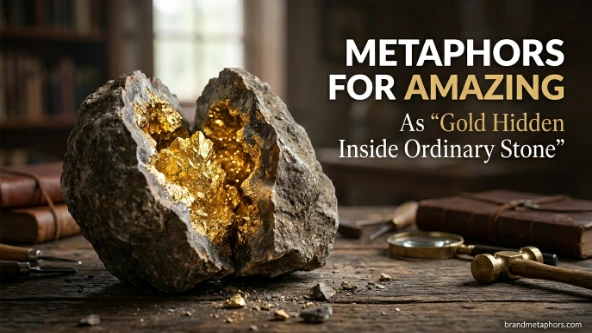
Sometimes amazement comes from unexpected places.
Meaning & Explanation
This metaphor reflects discovery—finding value, beauty, or brilliance where none was expected.
Example Sentence
“That conversation was gold hidden inside ordinary stone—I didn’t expect it to change my thinking.”
Alternative Expressions
- Treasure beneath simplicity
- Diamonds in everyday moments
- Hidden brilliance revealed
Sensory & Emotional Detail
There’s a slow realization, like brushing dust off something that suddenly shines.
Mini Storytelling Moment
A janitor at a school solves a complex math problem on a chalkboard, leaving a teacher speechless—not because it is flashy, but because it is unexpectedly brilliant.
Practice Prompt
Think of an ordinary day that surprised you and describe it as hidden treasure.
7. How to Use Metaphors for Amazing in Writing and Social Media
Metaphors aren’t just for literature—they are powerful tools for digital expression.
In Writing
- Replace “amazing” with imagery-based metaphors
- Use them in storytelling climaxes
- Layer multiple metaphors for emotional depth
In Social Media
Instead of:
“The sunset was amazing”
Try:
“The sunset looked like the sky forgetting all its rules and painting itself in fire and silence.”
In Daily Conversation
Metaphors make speech more memorable:
- “That idea was a door opening in my head.”
- “That moment hit like lightning in still water.”
Pro Tip
Don’t overuse metaphors in one paragraph. One strong image is more powerful than many weak ones.
8. Creative Exercise: Build Your Own “Amazing” Metaphor
Try this simple method:
- Think of something amazing you experienced
- Choose a natural force (fire, ocean, lightning, wind)
- Combine it with a mental or emotional image
Example Formula
“Amazing is like [natural force] meeting [emotion or thought].”
Sample Output
- “Amazement is like ocean waves rewriting the shore of my thoughts.”
- “It felt like wind turning every page of my memory at once.”
This exercise helps train creative expression and emotional precision.
9. Cultural and Literary Inspirations Behind “Amazing” Metaphors
Writers across cultures have always struggled with expressing awe.
- Romantic poets used nature to describe emotional intensity
- Eastern poetry often uses silence, wind, and light
- Modern storytelling uses technology and space imagery
For example, describing awe as “stars collapsing into thought” reflects modern cosmic imagination, while older literature might say “heaven opening.”
This shows one truth: humans always reach for metaphors when reality feels too large for words.
10. Final Tips: Making Your “Amazing” Metaphors More Powerful
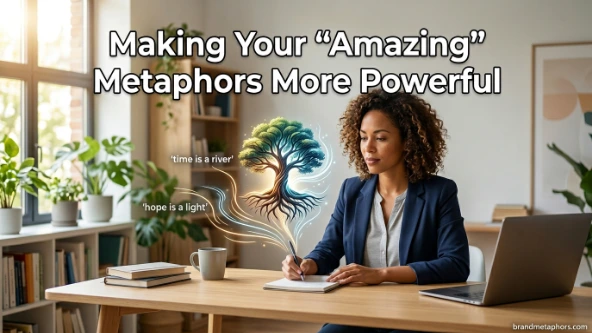
To make metaphors more effective:
- Keep them simple but vivid
- Use sensory language (sound, sight, touch, emotion)
- Avoid clichés like “mind-blowing” unless reinvented
- Connect emotion with image
- Read them aloud to test rhythm
Strong metaphors don’t just describe—they recreate experience inside the reader’s mind.
Conclusion
“Amazing” is one of the most overused words in modern language, yet one of the most important feelings we experience. It marks the boundary between the ordinary and the unforgettable.
Metaphors give us a way to cross that boundary with language that feels alive. Whether it’s fireworks in the mind, lightning in still water, or a door opening to a new universe, each image transforms a simple reaction into something deeply human and expressive.
The more you practice using metaphors, the more naturally your language begins to carry emotion, depth, and originality. You stop saying things are “amazing”—and start showing why they are unforgettable.
FAQs
1. What is a metaphor for amazing?
A metaphor for amazing is a creative comparison that expresses awe or wonder using imagery instead of the word “amazing.”
2. Why should I use metaphors instead of “amazing”?
Metaphors make your language more vivid, emotional, and memorable compared to generic words like “amazing.”
3. Can metaphors improve writing skills?
Yes, they enhance creativity, storytelling ability, and emotional expression in writing.
4. Where can I use metaphors for amazing?
You can use them in essays, poetry, social media captions, speeches, and everyday conversation.
5. How do I create my own metaphor?
Combine a strong emotion or experience with a vivid image from nature, objects, or movement.