
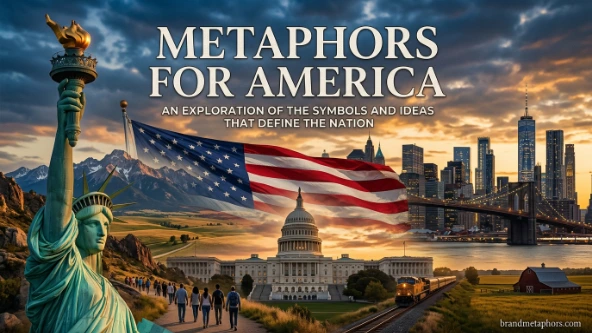
Metaphors for America: A Land That Feels Bigger Than Its Borders
Before you ever step foot in America, you probably already “know” it—at least in images. Neon skylines slicing through night skies, endless highways cutting across deserts, diners glowing like warm memories at 2 a.m., and flags fluttering like a promise that never quite settles.
America is not just a country in most people’s imagination. It is a feeling, a symbol, a contradiction, and a story told in many voices at once.
One traveler once described landing in New York as “walking into a movie that had no pause button.” Another said driving across Texas felt like “reading a novel where every chapter is the same road, but a different sky.”
That is the power of metaphor—it turns geography into meaning. And America, perhaps more than any modern nation, lives inside metaphors.
In this article, we’ll explore vivid, creative metaphors for America, what they mean, and how they help us understand culture, identity, and imagination itself.
Why Metaphors for America Matter in Culture and Writing
Metaphors are not just literary decorations. They are mental shortcuts for understanding complexity.
America is too vast to describe in simple terms. It is:
- Urban and rural
- Rich and struggling
- Traditional and experimental
- Dream-filled and deeply divided
So writers, thinkers, and everyday people rely on metaphors to compress this complexity into images the mind can hold.
When someone says “America is a melting pot,” they are not talking about soup. They are talking about identity.
When someone says “America is a stage,” they are not discussing theater. They are pointing to performance, ambition, and visibility.
Metaphors matter because they shape how we feel about reality before we even analyze it.
Metaphor 1: America as a “Melting Pot of Dreams and Differences”
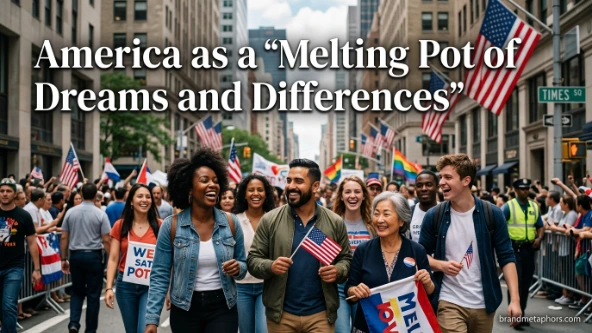
One of the most famous metaphors for America is the melting pot—a place where cultures, languages, and identities blend into something new.
Meaning & Explanation
This metaphor suggests that people from different backgrounds come together and “melt” into a unified national identity.
But modern interpretations also question it: do people truly blend, or do they remain distinct ingredients in a shared bowl?
Example Sentence / Scenario
“Walking through New York City felt like standing inside a melting pot where every language of the world simmered in the same air.”
Alternative Expressions
- Cultural mosaic
- Tapestry of nations
- Patchwork society
- Salad bowl (modern variation emphasizing diversity without blending)
Sensory & Emotional Layer
Imagine the smell of spices from a food truck, the sound of multiple languages overlapping like music, and the sight of festivals from dozens of cultures happening within a single city block.
Mini Story
A young immigrant arrives in California with nothing but a suitcase and a notebook. Years later, she opens a small bakery that sells recipes from her grandmother’s homeland, slightly adapted for American tastes. Her bakery becomes a meeting point where neighbors of every background gather. The melting pot is not just a concept—it is her daily life, kneaded into bread dough and morning coffee.
Interactive Prompt
Think of your own community. What “ingredients” would be in its melting pot? Write a short paragraph describing it using food imagery.
Metaphor 2: America as a “Great Highway of Possibilities”
America is often imagined as a road—long, open, and full of unknown turns.
Meaning & Explanation
This metaphor represents freedom, mobility, and opportunity. It suggests that life in America is about movement—social, economic, and personal.
Example Sentence / Scenario
“For many, America feels like a highway stretching endlessly ahead, where every exit might lead to a new version of yourself.”
Alternative Expressions
- Road of opportunity
- Journey of ambition
- Open road nation
- Asphalt dreamscape
Sensory & Emotional Layer
The hum of tires on hot asphalt, roadside diners glowing at dusk, gas station neon signs flickering like small promises in the dark.
Mini Story
A college student drives across Route 66 after graduation, unsure of his future. Each stop becomes a lesson: a mechanic in Arizona teaches him patience, a waitress in Oklahoma tells him stories of resilience, and a stranger in Missouri shares advice about failure. The highway becomes his teacher, not just his path.
Interactive Exercise
Write a “road diary” entry imagining yourself traveling across America. What do you see, hear, and learn at each stop?
Metaphor 3: America as a “Theater of Ambition and Identity”
Another powerful metaphor is America as a stage where people perform their dreams, struggles, and reinventions.
Meaning & Explanation
This metaphor emphasizes visibility, self-expression, and the idea that identity in America is often “performed” through career, lifestyle, and achievement.
Example Sentence / Scenario
“In America, every person feels like both actor and audience on a vast stage of ambition.”
Alternative Expressions
- National stage
- Theater of dreams
- Performance society
- Spotlight culture
Sensory & Emotional Layer
Bright city lights like stage spotlights, the constant noise of applause or criticism in social media feeds, the pressure of always “being seen.”
Mini Story
A young actor moves to Los Angeles. At first, she waits tables and auditions in small rooms with peeling paint. Years later, she lands a role in a national series. But even then, she feels like she is always “on stage,” even off-camera. America, for her, is not just where she lives—it is where she performs becoming herself.
Interactive Prompt
Write a short dialogue between two “versions” of yourself: one on stage (public self) and one backstage (private self). What differs?
Metaphors for American Identity: A Mosaic of Contradictions

America resists a single definition. That is why metaphors often come in pairs or contradictions:
- Freedom and discipline
- Innovation and tradition
- Wealth and poverty
- Unity and division
One writer once said America is “a sentence still being written.” That captures its unfinished, evolving nature.
This metaphor reminds us that identity is not fixed—it is edited daily by millions of people.
Metaphors for American Cities: Skyscrapers, Storms, and Symphony Lights
Cities like New York, Chicago, and Los Angeles inspire their own metaphors.
Common Imagery
- Skyscrapers as “stone forests”
- Traffic as “flowing rivers of metal”
- Subways as “underground veins of the city”
Each city feels like a living organism rather than a static place.
Example Reflection
Standing in Manhattan at night feels like standing inside a circuit board of light—electric, fast, and alive.
Exercise
Pick an American city and describe it as if it were a living creature. What would it eat, feel, or dream about?
Metaphors for the American Dream: Ladder, Horizon, and Mirage
The American Dream itself is one of the most debated metaphors.
Three Key Interpretations
- The Ladder: upward mobility, success through effort
- The Horizon: always visible, never fully reached
- The Mirage: promising from afar but difficult to grasp
Mini Story
A factory worker saves money for years to start a business. Some years bring success; others bring loss. For him, the American Dream is not a destination—it is a shifting horizon that keeps him walking forward.
Writing Prompt
Which version of the American Dream resonates most with you—the ladder, horizon, or mirage? Explain in a short paragraph.
Metaphors for American History: River of Time and Layers of Stone
America’s history can be seen as layered rather than linear.
- Indigenous histories like ancient bedrock
- Colonial history like foundation stones
- Modern history like rapid river flow
This creates tension between what is built and what is remembered.
Sensory Image
Imagine digging into soil and finding different eras stacked like pages in the earth.
Exercise
Write a metaphor comparing your own personal history to a landscape.
Metaphors for American Freedom: Wind, Fire, and Open Skies
Freedom in America is often described through natural forces.
- Wind: invisible but powerful
- Fire: transformative but dangerous
- Open sky: limitless but exposed
Example Sentence
“Freedom in America feels like standing under an open sky where every direction is possible, but none are guaranteed.”
Bonus Tip for Writers
Use nature-based metaphors when writing about abstract ideas like freedom, identity, or justice. They make emotional meaning more accessible.
Metaphors for America in Modern Media and Social Life
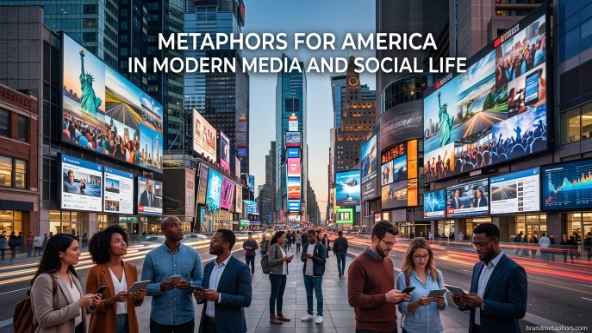
In the digital age, America is also described through technology metaphors:
- A “network of voices”
- A “digital marketplace of ideas”
- A “mirror of global culture”
Social media intensifies the theatrical metaphor—everyone has a stage, a spotlight, and an audience.
Interactive Reflection
Think about your social media feed. What metaphor best describes it?
- A crowded marketplace?
- A noisy stadium?
- A glowing museum of personalities?
Metaphors for America: How to Use Them in Writing and Daily Life
Metaphors are not just for essays—they shape communication everywhere.
In Writing
- Use them to create emotional depth
- Avoid overuse of clichés like “melting pot” without explanation
- Combine metaphors for layered meaning
In Social Media
Instead of saying “busy day,” say:
- “Today felt like a highway with no exits.”
In Daily Speech
Metaphors make conversation more vivid:
- “That meeting was a storm.”
- “My week is a marathon, not a sprint.”
Pro Tip
The best metaphors are specific, sensory, and slightly surprising.
Conclusion
America is not one metaphor—it is many, overlapping, and sometimes conflicting.
It is a melting pot and a mosaic. A highway and a maze. A stage and a mirror. A dream and a question.
And perhaps that is the point.
A nation so large, diverse, and complex cannot be reduced to a single image. Instead, it lives in the imagination of those who describe it.
Every metaphor adds another layer—not of definition, but of understanding.
FAQs: Metaphors for America
1. Why are metaphors important when describing America?
Because America is complex and diverse, metaphors help simplify and emotionally express its identity.
2. What is the most common metaphor for America?
The “melting pot” is one of the most traditional, symbolizing cultural blending.
3. Are modern metaphors different from older ones?
Yes. Modern metaphors often focus on diversity, technology, and complexity rather than unity alone.
4. Can metaphors influence how people see America?
Absolutely. Metaphors shape perception before logic does, influencing cultural understanding.
5. How can I create my own metaphors for America?
Focus on sensory experiences, contradictions, and everyday observations, then compare them to familiar images.
If you want, I can also turn this into a blog-ready SEO post with meta description, keywords, and internal linking structure.