
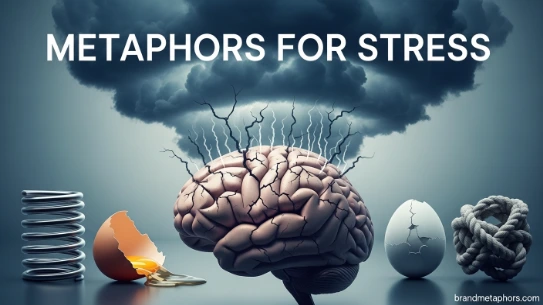
The room is quiet, but your mind isn’t. It hums like an overworked machine—whirring, clicking, overheating. You feel it in your shoulders first, then behind your eyes, then everywhere at once.
Stress is like that: invisible, yet deeply physical. It creeps into ordinary moments, reshapes your thoughts, and leaves you searching for words that can capture something so intangible.
That’s where metaphors come in.
Metaphors for stress are more than poetic devices—they’re tools. They help us understand, express, and even manage the weight we carry. By transforming stress into something we can visualize—a storm, a tightrope, a tangled knot—we gain clarity and, sometimes, a sense of control.
In this article, you’ll explore vivid metaphors for stress, learn how to use them effectively, and discover creative ways to apply them in writing and everyday life. Whether you’re a writer, a student, or simply someone trying to make sense of your inner world, these ideas will give you language that feels both powerful and personal.
Why Metaphors for Stress Matter
Stress is abstract. You can’t hold it in your hands or see it in the mirror, yet it shapes your decisions, moods, and even your body. Metaphors bridge that gap between feeling and understanding.
When you say, “I’m under pressure,” you’re already using a metaphor. But imagine saying, “I feel like a glass about to shatter under invisible weight.” Suddenly, the emotion becomes vivid, relatable, and real.
Using metaphors for stress can:
- Improve emotional awareness
- Enhance creative writing and storytelling
- Help communicate feelings more clearly
- Offer new perspectives for coping
In short, metaphors don’t just describe stress—they reshape how we experience it.
Storm Inside the Mind: Stress as a Weather System
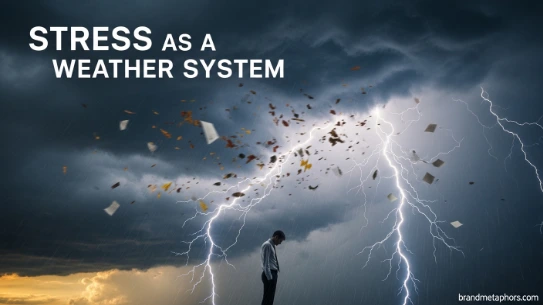
One of the most powerful metaphors for stress is comparing it to a storm. Storms are unpredictable, overwhelming, and often temporary—just like stress.
Meaning and Explanation
Stress as a storm captures the chaos and intensity of emotional overwhelm. It suggests turbulence, lack of control, and the feeling that something powerful is passing through you.
Example Scenario
You’re preparing for an important presentation. Deadlines are closing in, expectations are high, and your thoughts feel scattered.
Example sentence: “My mind was a thunderstorm—thoughts crashing like lightning, each louder than the last.”
Alternative Ways to Express It
- “A whirlwind of worries”
- “A brewing storm beneath the surface”
- “Emotional lightning striking without warning”
Sensory and Emotional Details
Think of the smell of rain before it falls, the sound of thunder rolling across the sky, the sudden darkness at midday. Stress often feels just like that—something building, something about to break.
Mini Storytelling Element
A student sits at their desk at midnight. The house is silent, but inside, a storm rages. Each unread page is a gust of wind. Each ticking second, a drop of rain. And yet, just like real storms, morning will come—and with it, calm skies.
Walking a Tightrope: Stress as Fragile Balance
Another compelling metaphor for stress is walking a tightrope. It highlights the delicate balance between responsibilities, expectations, and emotional limits.
Meaning and Explanation
This metaphor emphasizes pressure, focus, and the fear of failure. It suggests that one wrong move could lead to consequences, making every step feel crucial.
Example Scenario
You’re juggling work, family, and personal goals, trying not to let anything slip.
Example sentence: “I felt like I was walking a tightrope, every step measured, every breath controlled.”
Alternative Ways to Express It
- “Balancing on a razor’s edge”
- “Juggling too many fragile pieces”
- “One misstep away from falling”
Sensory and Emotional Details
Imagine the height beneath your feet, the tension in your muscles, the silence of the crowd waiting for you to either succeed or fall. Stress often carries that same quiet intensity.
Real-Life Reflection
In today’s fast-paced world, many people live on this metaphorical tightrope—especially professionals, parents, and students. Recognizing this can help you step back and ask: Do I need to keep balancing everything, or can I let something go?
A Tangled Knot: Stress as Mental and Emotional Entanglement
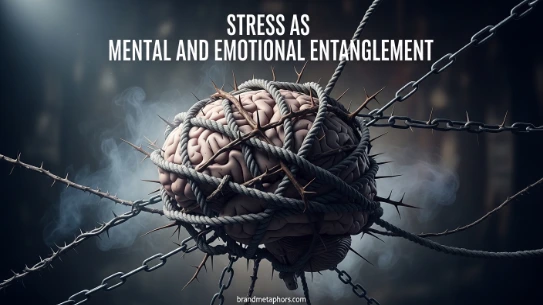
Stress can also feel like a knot—tight, complex, and difficult to unravel.
Meaning and Explanation
This metaphor reflects confusion, overthinking, and emotional buildup. It suggests that stress isn’t always explosive—it can be quietly persistent.
Example Scenario
You’re overanalyzing a problem, replaying conversations, and struggling to find clarity.
Example sentence: “My thoughts were a tangled knot, tightening every time I tried to loosen them.”
Alternative Ways to Express It
- “A web of worries”
- “A maze with no clear exit”
- “Threads twisted beyond recognition”
Sensory and Emotional Details
Picture rough rope digging into your hands as you try to untie it. The more you pull, the tighter it becomes. That’s how stress often behaves—resistant, stubborn, and frustrating.
Cultural or Literary Touch
Knots have long symbolized complexity in literature—from ancient myths to modern storytelling. In many traditions, untangling a knot represents solving a deep problem. Stress, too, asks for patience, not force.
Interactive Exercises: Practice Using Metaphors for Stress
Exercise 1: Describe Your Stress
Take a moment and ask yourself: What does my stress feel like today?
Complete this sentence:
- “My stress is like __________ because __________.”
Try to be as specific and sensory as possible.
Exercise 2: Transform the Metaphor
Now, rewrite your metaphor in three different ways:
- A poetic version
- A simple, everyday version
- A dramatic or exaggerated version
This helps you explore tone and creativity.
Exercise 3: Story Snapshot
Write a short paragraph (3–5 sentences) where your metaphor becomes part of a scene.
Example prompt: A character sits alone, feeling their stress as [your metaphor]. What happens next?
Bonus Tips: Using Metaphors for Stress in Writing and Daily Life
Make It Personal
Generic metaphors are useful, but personal ones are powerful. Instead of saying “I’m stressed,” describe how your stress behaves.
Use Sensory Language
Add sight, sound, touch, smell, or taste. This makes your metaphor more immersive.
Keep It Relatable
Even creative metaphors should connect with real experiences. If readers can’t visualize it, it loses impact.
Apply in Social Media
Metaphors work brilliantly in captions and posts:
- “Today feels like carrying a backpack full of invisible bricks.”
- “My thoughts are buffering like a slow internet connection.”
Short, vivid, and relatable—that’s the key.
Use for Emotional Release
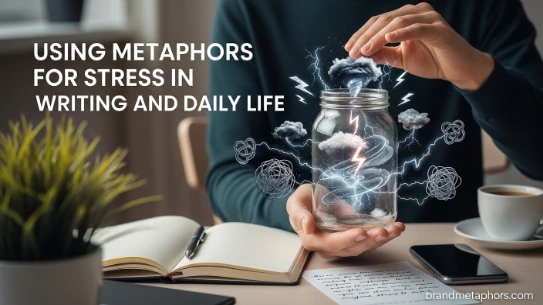
Writing your stress as a metaphor can be therapeutic. It gives shape to something that often feels shapeless.
Expanding Your Metaphor Toolbox
Here are a few quick additional metaphors for stress you can explore:
- Stress as a ticking clock – constant pressure of time
- Stress as a heavy backpack – carrying unseen burdens
- Stress as a cage – feeling trapped and restricted
- Stress as a fire – consuming energy and attention
- Stress as noise – constant mental chatter
Try combining them for richer imagery: “My stress was a storm trapped inside a cage, roaring with nowhere to go.”
Using Metaphors for Stress in Real Life
Metaphors aren’t just for writing—they’re for living.
When you say, “I feel like I’m drowning,” it signals urgency. When you say, “I’m carrying too much,” it suggests the need to let go.
By naming your stress through metaphor, you:
- Externalize it
- Understand it better
- Communicate it more clearly
And sometimes, that’s the first step toward easing it.
Conclusion
Stress may be unavoidable, but silence about it isn’t. Metaphors give us a language that is both expressive and healing. They turn pressure into imagery, confusion into clarity, and emotion into something we can share.
Whether your stress feels like a storm, a tightrope, or a tangled knot, remember this: metaphors don’t just describe your experience—they help you reshape it.
So the next time stress creeps in, pause and ask yourself: What does this feel like?
Then turn that feeling into words—and watch how it changes everything.
FAQs
What are metaphors for stress?
Metaphors for stress are figurative comparisons that describe stress in vivid, relatable ways—such as comparing it to a storm, a knot, or a heavy weight.
Why are metaphors useful for describing stress?
They make abstract emotions easier to understand, communicate, and process by turning them into concrete images.
Can metaphors help reduce stress?
Yes, expressing stress through metaphors can provide emotional clarity and act as a form of creative release.
How can I create my own metaphor for stress?
Think about how stress feels physically or emotionally, then compare it to something familiar—like weather, objects, or experiences.
Where can I use metaphors for stress?
You can use them in writing, journaling, social media, conversations, or even therapy to better express your feelings.