
The wind howled against the old wooden door, rattling it like a restless ghost. Inside, a small candle flickered—not extinguished, not defeated, but bending, swaying, adapting. It didn’t fight the wind head-on; it endured it. And somehow, it stayed lit.
That fragile flame is strength.
We often imagine strength as something loud, unbreakable, and immovable—like iron or stone. But true strength is often quieter, more complex. It bends, persists, and sometimes even breaks—only to rebuild stronger.
This is where metaphors for strength become powerful tools. They help us express resilience, courage, and endurance in ways that facts alone cannot.
In writing, conversation, and even personal reflection, metaphors allow us to feel strength, not just define it. Whether you’re crafting poetry, telling a story, or finding words for your own struggles, these metaphors can deepen your expression and sharpen your voice.
Let’s explore some vivid and meaningful metaphors for strength—and how to use them creatively.
Why Metaphors for Strength Matter
Strength isn’t one-dimensional. It can be physical, emotional, mental, or even spiritual. A single word rarely captures all its layers. Metaphors, however, open doors to imagination.
They:
- Make abstract ideas tangible
- Create emotional resonance
- Add color and depth to writing
- Help readers connect personally
Think of how different these feel:
- “She is strong.”
- “She is a mountain standing through storms.”
The second lingers. It paints a picture. It tells a story.
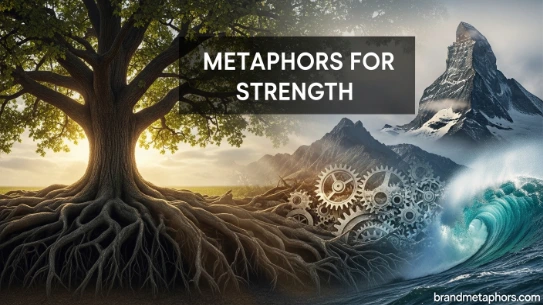
Metaphor #1: Strength as a Mountain

Meaning and Explanation
A mountain symbolizes stability, endurance, and timeless strength. It stands tall despite storms, erosion, and the passage of time. This metaphor emphasizes steadfastness and resilience.
Example Scenario
After losing his job and facing months of uncertainty, Ali didn’t collapse under pressure. He kept showing up, applying, learning, and adapting.
Example Sentence: “He stood like a mountain—unshaken by the storms that tried to wear him down.”
Alternative Ways to Express It
- “Firm as a mountain’s spine”
- “Rooted like ancient rock”
- “Unmoved by the winds of chaos”
Sensory and Emotional Details
Picture cold winds whipping across a rocky peak, snow settling quietly, centuries passing—and still, the mountain stands. There’s a sense of quiet dignity here, a calm strength that doesn’t need to prove itself.
Mini Storytelling Touch
In many cultures, mountains are sacred. They represent connection between earth and sky—between the human and the divine. Think of pilgrims climbing steep paths, not just for the destination, but for the transformation. Strength, in this metaphor, is both physical and spiritual.
Metaphor #2: Strength as a River
Meaning and Explanation
Unlike a mountain, a river represents adaptive strength. It flows, bends, and carves through obstacles rather than resisting them directly.
This metaphor highlights flexibility, persistence, and quiet power.
Example Scenario
A student fails an important exam but doesn’t give up. Instead, they change their study approach, seek help, and try again.
Example Sentence: “She moved like a river—finding a way forward no matter what stood in her path.”
Alternative Ways to Express It
- “Flowing around obstacles”
- “Carving her own path”
- “Soft, yet unstoppable”
Sensory and Emotional Details
Hear the gentle rush of water over stones. Feel its cool persistence. Over time, even the hardest rock yields. This kind of strength isn’t loud—it’s patient and inevitable.
Real-Life Reflection
History shows us that many movements and revolutions weren’t sudden explosions but gradual, persistent efforts. Like rivers, they reshaped the world slowly—but permanently.
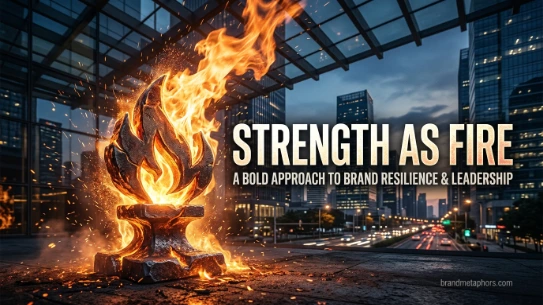
Metaphor #3: Strength as Fire
Meaning and Explanation
Fire represents inner strength, passion, and transformation. It can destroy, but it can also forge and refine.
This metaphor is ideal for emotional resilience and fierce determination.
Example Scenario
After years of doubt and criticism, a writer finally publishes their work, fueled by belief in their voice.
Example Sentence: “There was a fire in her that refused to be extinguished.”
Alternative Ways to Express It
- “Burning with purpose”
- “A spark that became a blaze”
- “Forged in fire”
Sensory and Emotional Details
Feel the heat, see the flicker of flames, hear the crackle of burning wood. Fire is alive, restless, and powerful. It demands attention.
Cultural Reference
Fire has long symbolized rebirth—from the mythical phoenix rising from ashes to rituals of purification. Strength, here, is not just survival—it’s transformation.
Creative Exercises: Practice Using Metaphors for Strength
Exercise 1: Transform a Simple Sentence
Take a basic sentence like: “I am strong.”
Now rewrite it using a metaphor:
- “I am a tree bending but never breaking.”
- “I am a storm learning to calm itself.”
Try creating three variations with different tones—gentle, fierce, and calm.
Exercise 2: Personal Reflection Prompt
Think of a challenge you’ve faced.
- What did your strength look like?
- Were you a mountain, a river, or fire—or something else?
Write a short paragraph describing your experience using a metaphor.
Exercise 3: Metaphor Matching
Match situations to metaphors:
- Losing something important → ?
- Starting over → ?
- Standing your ground → ?
There are no wrong answers. The goal is to explore emotional connections.
Bonus Tips for Using Metaphors in Writing and Daily Life
Use Metaphors in Social Media
Instead of posting:
- “Stay strong.”
Try:
- “Be the river that keeps flowing, even when the path is unclear.”
This makes your message more memorable and shareable.
Blend Multiple Metaphors Carefully
You can combine metaphors, but avoid confusion.
Good: “She was a river with a fire in her heart.”
Confusing: “She was a mountain flowing like fire through the wind.”
Clarity matters.
Keep It Authentic
Choose metaphors that resonate with your personal experience. If you’ve never seen snow, a “blizzard” metaphor may feel distant. Use imagery that feels real to you.
Use Metaphors for Motivation
In daily life, metaphors can reshape how you see challenges.
Instead of thinking:
- “This is too hard.”
Think:
- “This is my storm—and I am built to weather it.”
That shift can be powerful.
Expanding Your Metaphor Toolkit for Strength

Here are a few additional ideas to explore:
- Strength as a Tree: Rooted, growing, bending in storms
- Strength as Steel: Forged under pressure
- Strength as the Ocean: Deep, vast, and powerful beneath the surface
Try creating your own metaphors by asking:
- What does strength feel like?
- What in nature or life mirrors that feeling?
FAQs About Metaphors for Strength
### What is a metaphor for strength?
A metaphor for strength is a figurative comparison that describes strength using imagery or symbolism, such as “strong as a mountain” or “like a burning fire.”
### Why are metaphors useful in writing?
Metaphors make writing more vivid, engaging, and emotionally impactful. They help readers visualize and connect with abstract ideas.
### Can metaphors for strength be used in everyday conversation?
Yes, they can make your communication more expressive and memorable, whether in speeches, social media, or personal conversations.
### How do I create my own metaphor for strength?
Start by identifying what strength feels like to you, then connect it to something tangible—nature, objects, or experiences—that share similar qualities.
### Are there different types of strength metaphors?
Yes. Some emphasize endurance (mountain), adaptability (river), or passion (fire). Each highlights a different aspect of strength.
Conclusion
Strength is not one thing. It is many things—quiet and loud, gentle and fierce, enduring and transforming. At times it stands like a mountain. Sometimes it flows like a river. Sometimes it burns like fire.
Metaphors give us a way to understand and express these layers. They turn simple words into powerful images, helping us communicate not just what strength is, but what it feels like.
So the next time you face a challenge, ask yourself: What kind of strength do I need right now?
And then, perhaps, become it.