
The Buzz That Won’t Quit: A Hook Into Annoyance
It starts as a faint disturbance—a flicker at the edge of your awareness. Then it grows. A repetitive sound, a nagging voice, a relentless interruption. Like a mosquito whining in your ear just as you drift into sleep, annoyance has a peculiar talent for amplifying itself. It crawls under the skin, turning the smallest inconvenience into something almost theatrical.
We’ve all been there: the dripping faucet that becomes a metronome of madness, the coworker who interrupts every sentence, the endless notification pings that fracture your focus. But what if, instead of simply enduring annoyance, you could transform it into something vivid, expressive—even beautiful?
That’s where metaphors come in.
What Are Metaphors for Annoying (and Why They Matter)
Metaphors are more than decorative language—they are bridges between feeling and expression. When something is annoying, it’s often difficult to describe just how it feels. Saying “it’s irritating” barely scratches the surface.
But compare it to a fly trapped in a jar, buzzing endlessly, or a pebble stuck in your shoe during a long walk, and suddenly the emotion becomes tangible.
Metaphors for annoyance help you:
- Express frustration creatively
- Make your writing more engaging and memorable
- Connect emotionally with your audience
- Turn everyday irritation into storytelling gold
In both writing and daily conversation, these metaphors can elevate your voice from plain to poetic.
Why We Need Creative Ways to Describe Annoyance
Annoyance is universal—but describing it well is not. Without vivid language, irritation becomes dull and repetitive. Ironically, talking about annoyance can become… annoying.
Creative metaphors:
- Add humor and relatability
- Diffuse tension by making frustration feel lighter
- Help readers or listeners feel your experience
Think of great storytelling: the difference between “it bothered me” and “it clung to me like damp clothes on a humid day” is enormous.
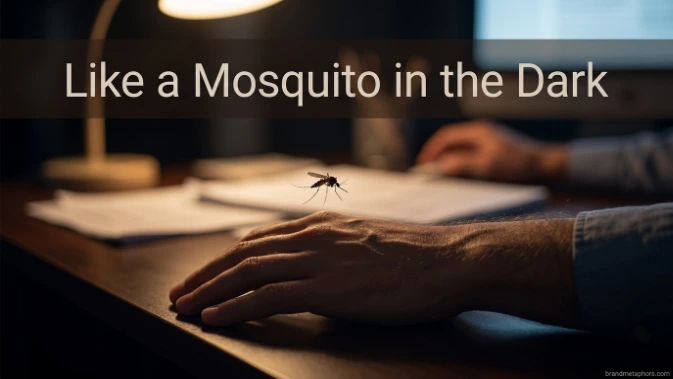
1. “Like a Mosquito in the Dark” – The Classic Irritation
Meaning & Explanation
This metaphor captures persistent, subtle annoyance—something small but impossible to ignore. It emphasizes repetition and helplessness.
Example Scenario
You’re trying to focus on your work, but someone keeps tapping their pen nearby.
Sentence: “It was like a mosquito in the dark—small, but impossible to ignore.”
Alternative Expressions
- Like a buzzing fly at your window
- Like a dripping tap in a silent room
- Like static in a quiet song
Sensory & Emotional Layer
You can almost hear it—the high-pitched whine, the anticipation of the next buzz. It creates tension, unease, and a sense of being hunted by something trivial yet persistent.
Mini Story
Late one summer night, you lie in bed, sweating, half-asleep. Then comes the buzz. You slap the air. Silence. Then again. The irritation becomes a game you can’t win.
2. “A Pebble in Your Shoe” – Small but Unrelenting
Meaning & Explanation
This metaphor represents minor irritation that grows unbearable over time. It’s not dramatic—but it’s constant.
Example Scenario
A colleague who constantly makes small, unnecessary corrections.
Sentence: “His comments were like a pebble in my shoe—tiny, but impossible to ignore over time.”
Alternative Expressions
- Like an itch you can’t scratch
- Like a wrinkle in a perfectly made bed
- Like sand in your socks
Sensory & Emotional Layer
You feel it with every step. It’s not painful at first—but eventually, it dominates your attention.
Real-Life Reflection
Think of a long walk ruined not by distance, but by discomfort. Annoyance often works the same way—it accumulates.
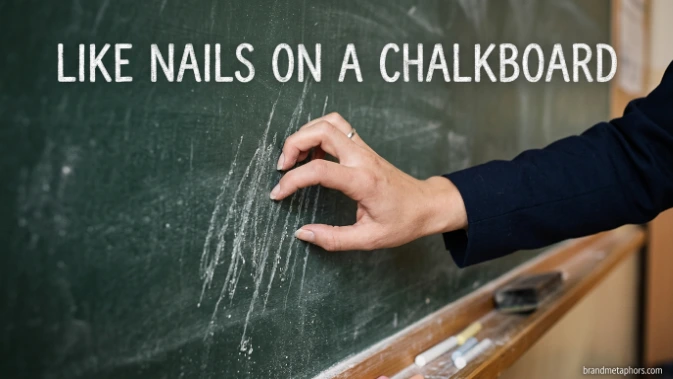
3. “Like Nails on a Chalkboard” – Sharp and Immediate
Meaning & Explanation
This metaphor captures intense, jarring annoyance—something that causes an instant emotional or physical reaction.
Example Scenario
Hearing someone chew loudly.
Sentence: “The sound of his chewing was like nails on a chalkboard.”
Alternative Expressions
- Like metal scraping glass
- Like a siren piercing silence
- Like a scream in a quiet room
Sensory & Emotional Layer
This metaphor is visceral—you can almost feel the discomfort in your teeth and spine.
Cultural Note
This is one of the most universally recognized metaphors for irritation because it triggers a shared sensory memory.
Using Metaphors for Annoyance in Writing
Metaphors are tools, and like any tool, they work best when used thoughtfully.
Tips:
- Match intensity: Choose metaphors that reflect how strong the annoyance is
- Avoid clichés unless you add a twist
- Combine sensory details (sound, touch, sight)
- Use them sparingly for maximum impact
For example: Instead of “He was annoying,” try: “He hovered around me like a cloud that refused to rain or leave.”
Metaphors for Annoying People
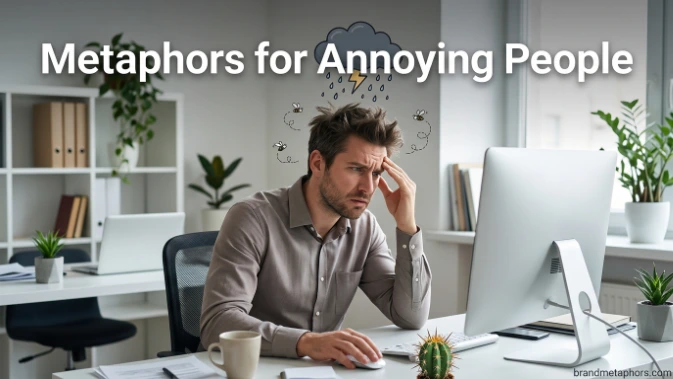
People often inspire the most creative metaphors.
Examples:
- “He’s like a broken record, repeating the same thing endlessly.”
- “She’s like a pop-up ad you can’t close.”
- “He clings like static to a sweater.”
Each metaphor adds personality and humor to frustration.
Metaphors for Everyday Irritations
Daily life is full of metaphor-worthy annoyances:
- Traffic: “Like being trapped in slow-moving glue”
- Notifications: “Like popcorn popping endlessly in your pocket”
- Heat: “Like wearing a blanket you can’t remove”
These comparisons make ordinary frustrations vivid and relatable.
Interactive Exercise: Create Your Own Annoyance Metaphors
Try this:
Exercise 1: Fill in the Blank
“Annoyance is like __________ because __________.”
Example: “Annoyance is like a song stuck on repeat because it refuses to leave your mind.”
Exercise 2: Sensory Focus
Describe an annoying situation using:
- Sound
- Touch
- Sight
Exercise 3: Personal Reflection
Think of something that annoys you daily. Turn it into three different metaphors—one humorous, one poetic, one dramatic.
Bonus Tips for Writers and Creators
as Writing
- Use metaphors to reveal emotion without stating it directly
- Blend metaphors with storytelling for deeper impact
For Social Media
- Short metaphors make great captions
- Example: “Monday feels like a buffering video that never loads.”
For Daily Life
- Humor softens annoyance
- Turning irritation into metaphor can make it easier to cope
Expanding Your Metaphor Toolbox
To get better at metaphors:
- Observe everyday experiences
- Read poetry and descriptive prose
- Practice turning emotions into images
Ask yourself: “What does this feel like in the physical world?”
The Art of Transforming Annoyance into Expression
Annoyance doesn’t have to remain a dull, frustrating experience. Through metaphors, it becomes something vivid, expressive—even entertaining.
Instead of suppressing irritation, you reshape it. You give it texture, sound, and form. And in doing so, you gain control over it.
FAQs
1. What are metaphors for annoying?
They are creative comparisons used to describe irritation in vivid, relatable ways, such as “like a mosquito buzzing in your ear.”
2. Why use metaphors instead of simple descriptions?
Metaphors make your language more engaging, emotional, and memorable.
3. Can metaphors help reduce frustration?
Yes, expressing annoyance creatively can make it feel lighter and more manageable.
4. Are common metaphors like “nails on a chalkboard” still effective?
They are effective, but adding a unique twist makes them more impactful.
5. How can I improve at creating metaphors?
Practice regularly, observe your surroundings, and think in sensory terms.
Conclusion
Annoyance is inevitable—but dull expression is not.
By turning irritation into metaphor, you transform the ordinary into something vivid and meaningful. A buzzing mosquito becomes a symbol. A pebble in your shoe becomes a story. Even the sharp scrape of nails on a chalkboard becomes a shared human experience.
So the next time something gets under your skin, pause. Notice it. Shape it. Turn it into language that resonates.
Because sometimes, the most annoying moments make the most unforgettable metaphors.