
Writing is more powerful when it has rhythm, emotion, and variety. Just like music uses fast and slow notes to create feeling, language also uses different sentence styles to shape meaning. One of the most striking styles is short, sharp, and punchy writing that creates urgency and emotion. Many learners often search for what are staccato sentences when they notice these quick, broken patterns in novels, poems, or speeches. Understanding this style can greatly improve your writing skills, creative writing ability, and overall communication.
This article will explain everything in simple English, with clear examples, tables, exercises, and practical tips so students, writers, and English learners can master this powerful technique.
1. Understanding Staccato Sentences
Staccato sentences are short, abrupt sentences that are written in a quick and broken rhythm. They often create tension, urgency, excitement, or emotional intensity. The word “staccato” originally comes from music, where it means playing notes in a short and separated way.
In writing, this style breaks long ideas into small, sharp pieces. Instead of flowing sentences, you get quick bursts of meaning.
Example:
- He ran. He stopped. He looked back. Silence.
Each sentence is complete but extremely short, creating a strong emotional effect.
This style is widely used in creative writing, storytelling, speeches, and even journalism to grab attention quickly and make readers feel the moment deeply.
2. Origin and Style in Writing
The term “staccato” comes from Italian music terminology. In music, staccato notes are played sharply and separately instead of smoothly connected. Writers borrowed this idea to describe a similar effect in language.
In writing, this style reflects:
- Fast movement
- Emotional pressure
- Sudden thoughts
- Broken or tense situations
It is often used in scenes involving action, fear, conflict, or strong emotions.
For example:
- Rain fell. Thunder cracked. She screamed. The lights went out.
This creates a cinematic effect, like watching a movie scene in fast cuts.
3. Key Features of Staccato Sentence Style
Staccato writing has clear features that make it easy to recognize:
1. Short length
Sentences are usually 1–5 words or very brief.
2. Fragmented rhythm
Ideas are separated instead of connected.
3. Strong punctuation
Full stops are used frequently.
4. Emotional intensity
It creates urgency, fear, excitement, or tension.
5. Fast pacing
The reader moves quickly from one idea to another.
Example:
- Heart racing. Breath shaking. Feet running. No escape.
This style is very different from long, descriptive sentences used in academic writing.
4. Staccato vs Other Sentence Styles
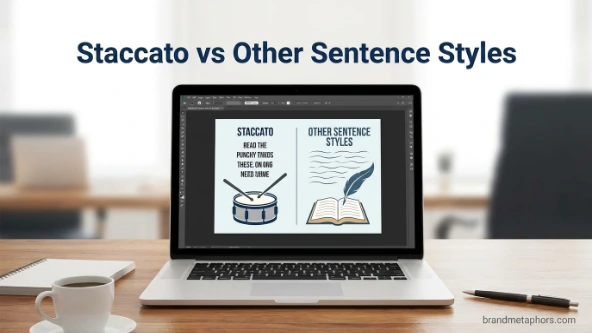
To understand better, let’s compare staccato writing with other sentence structures:
StyleDescriptionExampleStaccatoShort, broken, emotionalHe ran. He fell. He stood again.DescriptiveLong, detailed sentencesHe ran quickly across the field and fell before standing up again.ComplexMultiple ideas in one sentenceAlthough he ran quickly across the field, he fell but managed to stand again.Flowing/PoeticSmooth and rhythmicHe ran across the field, stumbling but rising again with hope.
This comparison shows how staccato writing changes tone and speed dramatically.
5. Why Writers Use Staccato Sentences
Writers use this technique for several important reasons:
1. To create tension
Short sentences make readers feel something important is happening.
2. To increase drama
It makes scenes more powerful and emotional.
3. To control pacing
It slows or speeds up reading rhythm.
4. To highlight key moments
Important actions stand out more clearly.
5. To express emotions
Fear, shock, excitement, or confusion become stronger.
For example:
- She opened the door. Empty room. Cold air. Something wrong.
This instantly creates suspense.
6. Examples in Literature and Creative Writing
Staccato style is widely used in novels, scripts, and storytelling.
Action Scene Example:
- Gunshot. Silence. Running footsteps. Shouting. Darkness.
Emotional Scene Example:
- She left. No goodbye. No note. Just silence.
Suspense Example:
- The phone rang. Once. Twice. Then stopped.
Dialogue Effect:
- “Where are you?”
- No answer.
- “Please…”
- Still nothing.
These examples show how sentence structure changes emotional experience.
7. Staccato in Figurative Language and Poetry
Staccato writing also connects deeply with figurative language and poetic expression. Even though it is simple, it can carry strong imagery and emotion.
It works well with:
- Metaphor examples
- Simile examples
- Descriptive language
- Idiom meaning in emotional context
Example with metaphor:
- Life stopped. A broken clock. No time left.
Example with simile:
- Her heart broke. Like glass. Sharp. Silent.
Poetic expression:
- Night fell. Stars blinked. The world slept.
This style enhances creative writing by adding rhythm and emotional depth.
8. How to Use Staccato Sentences in Your Writing
Here are practical tips to use this technique effectively:
1. Use in emotional moments
Do not use it everywhere. Use it when emotions are high.
2. Mix with long sentences
Balance is important for good writing skills.
3. Use for dramatic effect
Save it for key scenes or turning points.
4. Keep it simple
Avoid complicated words.
5. Focus on rhythm
Read your sentences aloud to check flow.
Example improvement:
Normal:
- He was very scared as he slowly walked into the dark room.
Staccato:
- He walked in. Darkness. Cold air. Fear.
9. Common Mistakes Learners Make
Many students misuse this style. Here are common errors:
1. Overusing staccato sentences
Too many short sentences make writing feel broken and unnatural.
2. Losing meaning
Sometimes sentences become too short and unclear.
3. Using it in formal writing
It is not suitable for academic essays or reports.
4. No variation in rhythm
Good writing needs a mix of sentence lengths.
5. Forcing emotion
Not every line needs intensity.
Bad example:
- I went. I saw. I ate. I slept. I woke. I left.
This feels flat and repetitive.
10. When to Use and When to Avoid
SituationUse Staccato?ReasonAction scenesYesCreates urgencyEmotional scenesYesAdds intensityAcademic writingNoToo informalStory climaxYesBuilds tensionFormal reportsNoReduces clarityPoetryYesEnhances rhythm
Knowing when to use this technique is key to mastering writing skills.
11. Practice Exercises
Try these exercises to improve your understanding:
Exercise 1: Convert sentences
Rewrite in staccato style:
- He was running very fast through the dark forest.
- She felt very sad after hearing the news.
- The car suddenly stopped in the middle of the road.
Exercise 2: Create your own
Write 3 staccato sentences for:
- A scary moment
- A happy moment
- A surprise moment
Exercise 3: Mix styles
Write one paragraph that includes:
- 1 long sentence
- 3 staccato sentences
- 1 descriptive sentence
These exercises improve vocabulary enhancement and descriptive language skills.
12. Quick Summary Points

- Staccato sentences are short and broken sentences.
- They create emotion, tension, and fast rhythm.
- Common in creative writing and storytelling.
- Should be balanced with longer sentences.
- Useful for action, drama, and emotional expression.
- Not suitable for formal or academic writing.
- Strong tool for improving writing skills and literary devices understanding.
13. FAQs
1. What are staccato sentences in simple words?
They are very short sentences written in a broken style to create emotion or urgency.
2. Where are staccato sentences used?
They are used in stories, poems, movies, speeches, and creative writing.
3. Are staccato sentences grammatically correct?
Yes, they are correct but stylistically different from normal writing.
4. Can I use staccato sentences in essays?
It is better to avoid them in formal essays unless used sparingly for effect.
5. How can I practice staccato writing?
You can rewrite normal sentences into short, sharp ones and practice storytelling.
Conclusion
Staccato writing is a powerful technique that helps writers control emotion, rhythm, and intensity. It turns simple ideas into dramatic moments by breaking language into short, sharp pieces. When used correctly, it improves creative writing, enhances figurative language, and makes storytelling more engaging.
However, balance is important. Overuse can make writing feel incomplete, while proper use can make your work feel alive, cinematic, and emotionally rich. For students and English learners, mastering this style is a great step toward stronger communication and advanced writing skills.