
Introduction
Clear writing begins with choosing the right words. Whether you’re writing a school essay, a creative story, a business email, or a social media post, using accurate vocabulary helps readers understand your message. While figurative language adds color and emotion to writing through metaphors, similes, imagery, and descriptive language, precise word choice ensures your ideas remain clear.
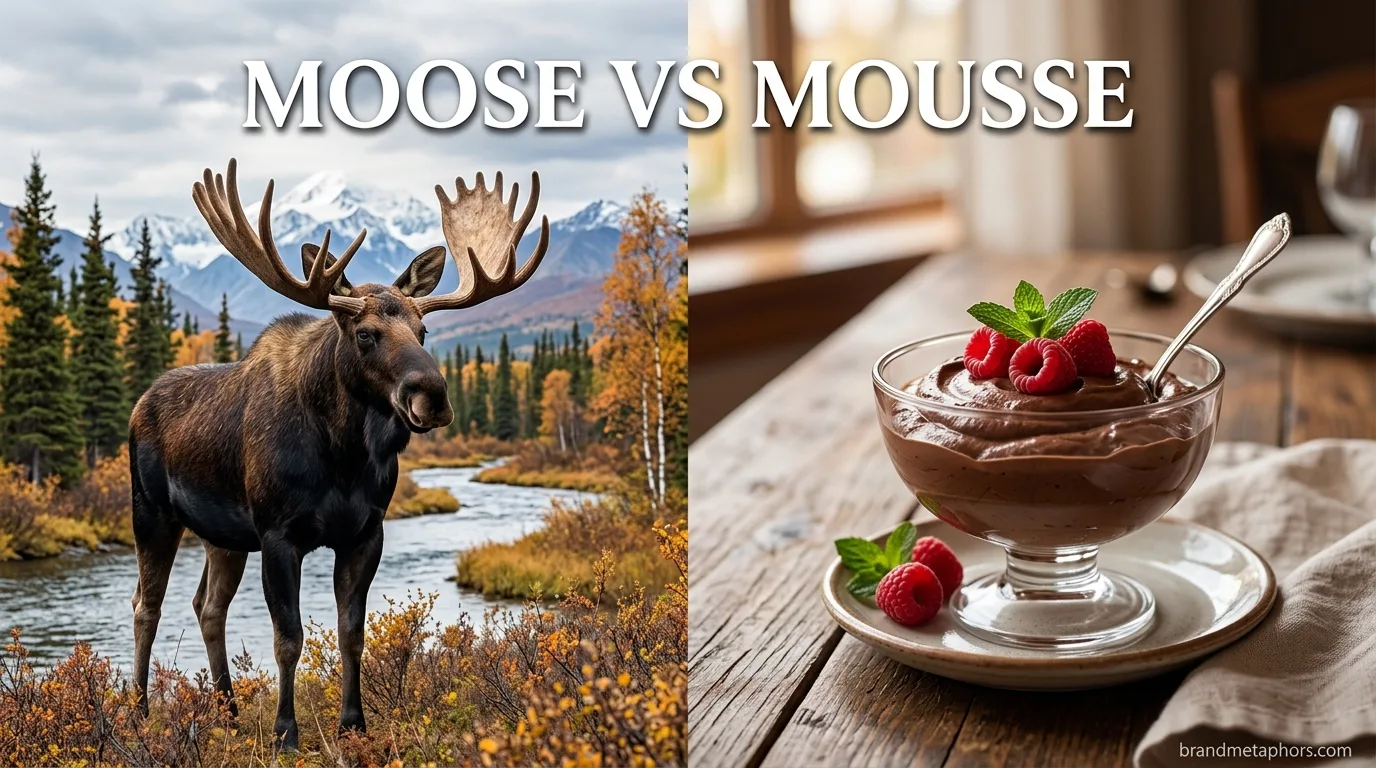
Many English learners confuse similar-looking words because English contains countless homophones, near-homophones, and commonly mixed-up terms. One classic example is moose vs mousse. Although these words look similar, they have completely different meanings, pronunciations, and uses.
Understanding the difference improves your vocabulary, strengthens your writing skills, and prevents embarrassing mistakes. This guide explains everything you need to know, including definitions, pronunciation, comparison examples, sentence examples, memory tricks, common mistakes, creative writing applications, literary devices, figurative language examples, and practical exercises.
What Does “Moose” Mean?
A moose is the largest member of the deer family. It is a large wild animal found mainly in North America, Scandinavia, and parts of northern Europe and Asia.
Definition
Moose (noun): A very large deer with long legs and wide antlers (on males).
Pronunciation
Moose /muːs/
It rhymes with:
- Goose
- Juice
- Loose
Characteristics
- Huge body
- Long legs
- Large antlers (males)
- Lives in forests and wetlands
- Eats plants and shrubs
Sentence Examples
- We spotted a moose near the lake.
- A giant moose crossed the road.
- The park is home to hundreds of moose.
- The photographer waited hours to capture a moose.
- Children were excited to see a wild moose.
What Does “Mousse” Mean?
Mousse is a French word adopted into English. It has more than one meaning depending on the context.
Meaning 1: A Dessert
The most common meaning is a light, fluffy dessert made with whipped cream, chocolate, fruit, or eggs.
Examples include:
- Chocolate mousse
- Strawberry mousse
- Lemon mousse
- Coffee mousse
Sentence Examples
- We enjoyed chocolate mousse after dinner.
- She made a delicious raspberry mousse.
- The restaurant serves homemade mousse.
Meaning 2: Hair Product
Hair mousse is a styling foam that adds volume and hold.
Sentence Examples
- She applied mousse before drying her hair.
- Hair mousse makes curls look fuller.
- Use a small amount of mousse for extra volume.
Quick Comparison Table
FeatureMooseMoussePart of SpeechNounNounMeaningLarge deerDessert or hair productOriginNative EnglishFrenchPronunciation/muːs//muːs/CategoryAnimalFood / BeautyCountableYesUsually Yes (dessert), Sometimes Uncountable (hair product)
Why People Confuse Moose and Mousse
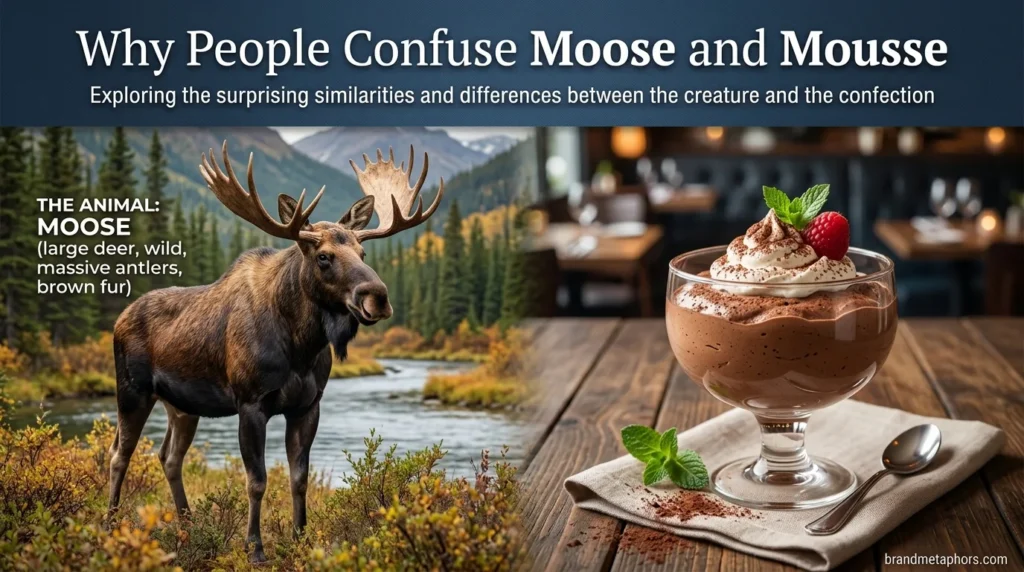
Several factors make these words easy to confuse.
1. Same Pronunciation
Both words sound exactly alike.
This makes them homophones.
Example:
“I ate moose.”
“I ate mousse.”
The pronunciation is identical, but only one sentence makes sense.
2. Similar Spelling
The only spelling difference is the extra “s.”
Moose
Mousse
Many learners accidentally omit or add one letter.
3. Spell Check Doesn’t Catch It
Because both are correctly spelled English words, spell check often misses the mistake.
Example:
❌ I put chocolate moose in the refrigerator.
The spelling is correct—but the meaning is wrong.
Moose vs Mousse: Side-by-Side Comparison
MooseMousseAnimalDessertLives in forestsServed in restaurantsEats plantsPeople eat itCan have antlersCan contain chocolateWild mammalSoft creamy foodLarge sizeLight texture
Sentence Examples in Different Contexts
Moose
- A moose stood quietly beside the river.
- We watched a moose eat leaves.
- The ranger warned us not to approach the moose.
- Artists often paint majestic moose in wilderness scenes.
- A baby moose is called a calf.
Mousse (Dessert)
- Chocolate mousse is my favorite dessert.
- The chef decorated the mousse with berries.
- The vanilla mousse tasted rich and creamy.
- We served mousse at the birthday party.
- Mango mousse is popular during summer.
Mousse (Hair Product)
- She uses mousse before curling her hair.
- The stylist recommended lightweight mousse.
- Hair mousse helps reduce frizz.
- Apply mousse evenly.
- The mousse gave her hairstyle extra volume.
Figurative Language and Creative Writing Applications
Although moose and mousse are literal words, they can appear in figurative language to create vivid imagery and memorable descriptions.
Metaphor Examples
- He was a moose in the meeting, impossible to ignore.
- Her confidence was chocolate mousse, soft but satisfying.
- The athlete charged like a moose through defenders.
These metaphors compare people or qualities without using “like” or “as.”
Simile Examples
- He was as strong as a moose.
- The dessert was as smooth as mousse.
- Her curls felt like soft mousse.
Similes make descriptions more vivid and relatable.
Descriptive Language
Creative writers often rely on descriptive language to paint clear pictures.
Example:
A towering moose emerged from the mist, its massive antlers glowing in the morning sun.
Example:
The chocolate mousse melted on her tongue like a sweet cloud.
Imagery
Good imagery appeals to the senses.
Visual
- Giant moose with enormous antlers
Taste
- Rich chocolate mousse
Touch
- Smooth mousse texture
Sound
- Heavy footsteps of a moose
Using sensory details strengthens creative writing and poetic expression.
When to Use Each Word
Use moose when discussing:
- Wildlife
- Nature
- Animals
- Forests
- National parks
- Biology
- Hunting
- Outdoor adventures
Use mousse when discussing:
- Desserts
- Cooking
- Baking
- Restaurants
- Hair styling
- Beauty products
- Fashion
When to Avoid Each Word
Avoid moose when referring to:
- Chocolate desserts
- Hair products
- Cosmetics
Incorrect:
❌ I ordered chocolate moose.
Correct:
✅ I ordered chocolate mousse.
Avoid mousse when discussing wildlife.
Incorrect:
❌ A giant mousse walked across the road.
Correct:
✅ A giant moose walked across the road.
Common Mistakes
Mistake 1
❌ Chocolate moose
✅ Chocolate mousse
Mistake 2
❌ Hair moose
✅ Hair mousse
Mistake 3
❌ We photographed a mousse.
✅ We photographed a moose.
Mistake 4
❌ The chef cooked a moose for dessert.
✅ The chef prepared chocolate mousse for dessert.
Mistake 5
❌ A mousse has giant antlers.
✅ A moose has giant antlers.
Memory Tricks
Simple memory aids can help you remember which word to use.
Moose
Think of the double “o” as the large eyes of a giant forest animal.
Or remember:
Moose = Mammal
Both start with M.
Mousse
The extra “s” can remind you of:
- Sweet
- Soft
- Smooth
- Styling
All relate to dessert or hair foam.
Tone and Writing Style
Choosing the correct word also depends on tone and context.
ToneMooseMousseAcademic✔✔Scientific✔RareCulinaryNo✔BeautyNo✔Creative Writing✔✔Children’s Stories✔✔
Vocabulary Enhancement
Learning similar words expands your vocabulary.
Related Animal Words
- Deer
- Elk
- Caribou
- Reindeer
- Antlers
- Mammal
- Wildlife
- Herd
Linked Dessert Words
- Pudding
- Custard
- Soufflé
- Cream
- Ganache
- Whipped cream
- Pastry
- Truffle
Related Hair Styling Words
- Gel
- Wax
- Pomade
- Spray
- Foam
- Curl cream
- Conditioner
- Styling cream
Expanding your vocabulary helps improve reading comprehension, descriptive language, and communication.
Literary Devices Using These Words

Writers may use these words in several literary devices.
Symbolism
A moose can symbolize:
- Strength
- Solitude
- Wilderness
- Independence
A mousse may symbolize:
- Luxury
- Comfort
- Celebration
- Sweetness
Personification
- The proud moose guarded the forest.
- The silky mousse welcomed every spoonful.
Hyperbole
- That moose was as big as a truck.
- The mousse was lighter than a cloud.
Alliteration
- Mighty moose marched.
- Marvelous mango mousse.
These literary devices make writing more expressive and memorable.
Practice Exercises
Exercise 1: Choose the Correct Word
- We saw a giant ______ near the river.
- Chocolate ______ is served cold.
- She applied hair ______ before styling.
- A ______ has long legs.
- The chef prepared raspberry ______.
Answers
- Moose
- Mousse
- Mousse
- Moose
- Mousse
Exercise 2: Correct the Mistakes
- I ate chocolate moose.
- The mousse crossed the highway.
- Hair moose gives volume.
- We photographed a giant mousse.
Correct Answers
- I ate chocolate mousse.
- The moose crossed the highway.
- Hair mousse gives volume.
- We photographed a giant moose.
Exercise 3: Write Your Own Sentences
Write:
- Two sentences using moose correctly.
- Two sentences using mousse as a dessert.
- One sentence using mousse as a hair product.
- One metaphor using moose.
- One simile using mousse.
Frequently Asked Questions
1. Are moose and mousse pronounced the same?
Yes. They are homophones and share the same pronunciation, even though they have different meanings and spellings.
2. What is the easiest way to remember the difference?
Remember that moose is the large wild animal, while mousse has an extra s, which can remind you of sweet, soft, or styling.
3. Can mousse refer to more than one thing?
Yes. It commonly refers to a fluffy dessert and also to a foam used for styling hair.
4. Why do people confuse these words?
People confuse them because they sound identical, have similar spellings, and both are valid English words, so spell-check tools often fail to catch mistakes.
5. How can I avoid mixing them up in writing?
Think about the context before choosing the word. If you’re discussing wildlife, use moose. If you’re writing about desserts or hair products, use mousse. Reading your sentence aloud and checking whether the meaning fits can also help.
Final Comparison Table
QuestionMooseMousseIs it an animal?YesNoIs it edible?No (in the usual sense of the word’s meaning)Yes (dessert)Used for hair?NoYesCommon in wildlife writing?YesNoCommon in recipes?NoYesUsed in beauty writing?NoYesFrequently confused?YesYes
Conclusion
Although moose and mousse sound exactly alike, they belong to entirely different worlds. One refers to a majestic wild animal roaming forests and wetlands, while the other describes either a light, airy dessert or a styling foam for hair. Understanding this distinction helps students, writers, and English learners communicate with greater confidence and precision.
Building a strong vocabulary goes beyond memorizing definitions. It involves recognizing context, mastering descriptive language, and using words appropriately in both literal and figurative language. Whether you’re crafting creative writing filled with imagery and literary devices, composing academic assignments, or simply improving everyday communication, knowing the correct choice between these two commonly confused words will make your writing clearer and more effective.
The next time you encounter these look-alike terms, remember: moose belongs in the forest, while mousse belongs on the dessert menu—or in your hair-care routine. Mastering small distinctions like this is an important step toward richer vocabulary enhancement, stronger writing skills, and more polished English.