
Introduction
The room was quiet except for the soft ticking of a clock. Outside, rain tapped against the window like gentle fingers searching for a way inside. For some people, emotional pain can feel so overwhelming that ordinary words seem too small to describe it. That is why writers, speakers, counselors, and everyday people often turn to metaphors. A metaphor can give shape to feelings that seem impossible to explain.
When discussing suicide, metaphorical language can help us understand experiences of hopelessness, isolation, emotional exhaustion, and recovery. It can create empathy, encourage conversation, and help people express emotions that may otherwise remain hidden. At the same time, it is important to use such language carefully and responsibly. The goal is not to romanticize suffering but to better understand it and support healing.
This article explores meaningful metaphors connected to suicidal thoughts and emotional despair. You will discover examples, writing tips, creative exercises, and practical ways to use these expressions in literature, personal reflection, and everyday communication.
Understanding Metaphors for Suicide and Emotional Despair
Why Metaphors Matter
A metaphor compares one thing to another without using “like” or “as.” It creates a vivid image that helps readers and listeners understand a difficult experience.
When discussing emotional pain, metaphors can:
- Make complex feelings easier to explain.
- Create empathy and understanding.
- Add depth to writing and storytelling.
- Help people reflect on their emotions.
For example, someone may describe hopelessness as “a tunnel without light.” The image immediately communicates darkness, uncertainty, and struggle.
The Storm at Sea Metaphor
Meaning and Symbolism
One common metaphor describes suicidal thoughts as a storm at sea.
The storm represents overwhelming emotions. The waves symbolize challenges that crash one after another. The person becomes a sailor trying to survive rough waters.
Example Scenario
A young woman faces grief, financial stress, and loneliness. She says:
“Every day feels like I’m sailing through a storm that never ends.”
Readers immediately understand the intensity of her struggle.
Alternative Expressions
- A hurricane of emotions
- Turbulent waters
- A ship battling giant waves
- Lost in a raging ocean
Sensory Details
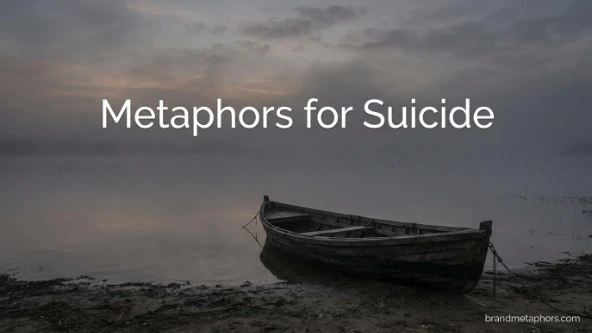
Imagine cold rain, dark clouds, and waves striking a small boat. The imagery creates a powerful emotional connection.
The Endless Tunnel Metaphor
Meaning and Symbolism
The tunnel metaphor represents despair and uncertainty.
People experiencing severe emotional pain may feel trapped in darkness with no visible exit.
Example Sentence
“He felt as though he had been walking through an endless tunnel for years.”
This metaphor captures hopelessness without explicitly describing every emotion.
Alternative Expressions
- A road without signs
- A cave without an opening
- A corridor of shadows
- A path hidden by darkness
Mini Story
A student struggles with anxiety and depression during university. Every challenge feels like another step through a dark tunnel. Eventually, counseling and support become small lights ahead, showing that the tunnel does have an end.
The Heavy Backpack Metaphor

Meaning and Symbolism
Emotional burdens are often compared to carrying a heavy backpack.
Each difficult experience adds another weight.
Example Scenario
A person dealing with grief, debt, and isolation may say:
“I’ve been carrying a backpack full of stones.”
The image suggests exhaustion and emotional strain.
Alternative Expressions
- Carrying the world on my shoulders
- Dragging chains behind me
- Carrying invisible weights
- Hauling a mountain uphill
Real-Life Relevance
Many therapists encourage people to identify the “stones” in their emotional backpack. Naming problems can make them easier to address.
The Broken Bridge Metaphor
Meaning and Symbolism
A bridge often symbolizes connection, hope, or a path forward.
A broken bridge can represent feeling disconnected from others or unable to see a future.
Example Sentence
“It felt as though the bridge to tomorrow had collapsed.”
Alternative Expressions
- A shattered pathway
- A road cut in half
- A missing connection
- A bridge lost in fog
Literary Reflection
Throughout literature, bridges frequently symbolize transition and change. A damaged bridge can represent interrupted dreams or emotional isolation.
The Drowning Metaphor
Meaning and Symbolism
Many people describe intense emotional pain as drowning.
The person may feel overwhelmed by thoughts, responsibilities, or suffering.
Example Scenario
“Every new problem felt like another wave pulling him underwater.”
Alternative Expressions
- Sinking beneath pressure
- Pulled under by sadness
- Lost beneath the surface
- Submerged in grief
Emotional Impact
This metaphor communicates urgency and struggle. It also highlights the importance of support from family, friends, counselors, and communities.
The Empty House Metaphor
Meaning and Symbolism
An empty house can symbolize loneliness and emotional numbness.
Even when surrounded by people, someone may feel emotionally vacant inside.
Example Sentence
“Her heart felt like an abandoned house with dark rooms and closed windows.”
Alternative Expressions
- A silent building
- A deserted village
- A vacant room
- A house without light
Sensory Imagery
Picture dusty floors, quiet hallways, and echoes bouncing off empty walls. Such imagery can help readers understand emotional isolation.
The Eclipse Metaphor
Meaning and Symbolism
An eclipse temporarily blocks the light.
Similarly, depression and despair can hide hope without permanently destroying it.
Example Scenario
“He believed the sun had disappeared forever, not realizing it was only hidden behind an eclipse.”
Alternative Expressions
- Clouds covering the sun
- A shadow over the day
- Temporary darkness
- Light hidden behind mist
Positive Perspective
Unlike some metaphors that focus solely on pain, the eclipse reminds us that darkness can be temporary.
The Maze Without an Exit
Meaning and Symbolism
A maze represents confusion, frustration, and feeling trapped.
People experiencing severe emotional struggles may feel unable to find solutions.
Example Sentence
“Life felt like a maze where every turn led to another dead end.”
Alternative Expressions
- A puzzle without answers
- Endless winding corridors
- A labyrinth of worries
- A map with missing pieces
Mini Story
A man loses his job and faces uncertainty. Each choice seems wrong. Over time, advice from trusted friends helps him discover pathways he could not previously see.
The Flickering Candle Metaphor
Meaning and Symbolism
A candle represents hope, resilience, and inner strength.
A flickering candle symbolizes hope that feels fragile but still exists.
Example Scenario
“Even in his darkest moments, a small candle continued to flicker inside him.”
Alternative Expressions
- A spark in the darkness
- A glowing ember
- A tiny lantern
- A distant light
Emotional Significance
This metaphor reminds readers that hope can survive even during difficult times.
Using Metaphors Responsibly in Writing

Avoid Romanticizing Pain
When writing about suicide or emotional suffering:
- Focus on understanding rather than glorification.
- Emphasize support and recovery.
- Use respectful language.
- Avoid portraying self-destruction as heroic or beautiful.
Encourage Human Connection
Strong writing often highlights:
- Friendship
- Community support
- Counseling
- Personal growth
- Resilience
Balance Darkness with Hope
Powerful stories acknowledge suffering while also recognizing the possibility of healing.
Creative Exercises for Practicing Metaphors
Exercise 1: Describe an Emotion
Choose an emotion and complete this sentence:
“My sadness is a ______.”
Examples:
- My sadness is a locked garden.
- My anxiety is a buzzing hive.
- My hope is a rising sunrise.
Exercise 2: Create a Journey Metaphor
Imagine emotions as a journey.
Ask yourself:
- Where does the path begin?
- What obstacles appear?
- What helps the traveler continue?
Exercise 3: Rewrite a Simple Statement
Original:
“I felt hopeless.”
Metaphorical version:
“I stood in a valley where every horizon seemed hidden by fog.”
Compare the emotional impact of both versions.
Bonus Tips for Writers, Social Media Creators, and Daily Life
For Creative Writing
Use sensory details:
- Sound
- Sight
- Touch
- Temperature
- Movement
These details strengthen metaphors.
For Social Media
Keep metaphors concise:
- “The clouds were heavy, but the sun remained.”
- “Every storm eventually runs out of rain.”
For Personal Reflection
Journaling with metaphors can help people explore emotions more deeply and recognize patterns in their experiences.
For Storytelling
Combine metaphor with narrative.
Instead of saying a character feels isolated, show them walking through an empty city street at dawn.
For Building Empathy
Metaphors can help readers understand experiences different from their own, creating compassion and meaningful conversations.
Conclusion
Metaphors offer a powerful way to discuss difficult emotions, including despair, hopelessness, and suicidal thoughts. Images such as storms, tunnels, mazes, eclipses, and flickering candles transform abstract feelings into experiences readers can understand. Used thoughtfully, these comparisons encourage empathy, reflection, and meaningful dialogue.
The most effective metaphors do more than describe darkness. They also reveal resilience, connection, and the possibility of light returning after difficult seasons. Whether you are a writer, student, educator, or reflective thinker, metaphorical language can help you communicate emotional experiences with greater clarity, sensitivity, and depth.
FAQs
What are metaphors for suicide?
Metaphors for suicide often describe intense emotional pain, hopelessness, or despair through symbolic images such as storms, tunnels, drowning, or broken bridges.
Why do writers use metaphors when discussing emotional struggles?
Metaphors help readers understand complex emotions by transforming abstract feelings into vivid and relatable images.
Can metaphors help people express difficult emotions?
Yes. Many people find it easier to discuss painful experiences through symbolic language rather than direct descriptions.
What is a hopeful metaphor for emotional recovery?
A flickering candle, sunrise after a long night, or light at the end of a tunnel are common symbols of hope and recovery.
How can I create my own emotional metaphors?
Think about the feeling you want to describe and connect it to an image, place, object, or journey that shares similar qualities.
If you or someone you know is struggling with suicidal thoughts, reaching out to a trusted person, mental health professional, or local crisis service can provide immediate support and help.