
Fear is not always loud. Sometimes it arrives like a whisper behind your ear, sometimes like a thunderclap in your chest, and sometimes like a shadow that refuses to leave even when the sun is high. Everyone has felt it—before an exam, in the dark, waiting for news, or standing at the edge of something unknown.
But what makes fear especially powerful in writing and communication is not just feeling it—it’s how we describe it. That’s where metaphors for scared become essential. They transform an invisible emotion into something tangible, vivid, and relatable. Instead of simply saying “I was scared,” we can paint the feeling so clearly that the reader can almost feel it breathing beside them.
In this article, we’ll explore creative and expressive metaphors for fear, break down their meanings, and learn how to use them in storytelling, writing, and everyday speech. You’ll also find mini-stories, exercises, and practical tips to help you bring emotion to life in your own words.
Understanding Metaphors for Scared: Why They Matter in Writing and Expression
A metaphor is a figure of speech that describes one thing in terms of another, helping us understand abstract emotions through concrete images. Fear, in particular, is difficult to define directly because it is internal and subjective.
Instead of saying:
- “I was scared,”
writers might say:
- “My heart was a trapped bird beating against my ribs.”
This doesn’t just tell us about fear—it lets us feel it physically.
Metaphors for scared are important because they:
- Make storytelling more emotional and immersive
- Help readers connect with characters or experiences
- Improve creative writing, poetry, and speeches
- Give language to feelings we struggle to express
Now let’s explore three powerful metaphors for fear and how to use them effectively.
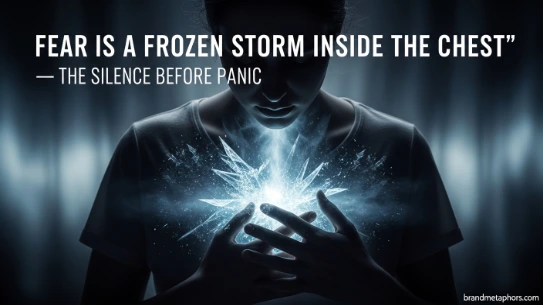
1. “Fear is a Frozen Storm Inside the Chest” – The Silence Before Panic
Meaning and Explanation
This metaphor compares fear to a storm—but not an active one. Instead, it is frozen. That stillness reflects the way fear can paralyze a person. It is not always chaos; sometimes it is immobility, where thoughts feel trapped and movement becomes difficult.
Sensory and Emotional Detail
- Tight chest like ice forming around the lungs
- Silence in the mind, like snow covering all sound
- A strange stillness before something might explode
Example Sentence or Scenario
Standing alone in the empty hallway, she didn’t scream or run. She simply stood there, as if a frozen storm had locked itself inside her chest.
Alternative Expressions
- “Fear turned me into ice from the inside.”
- “My body became winter, silent and still.”
- “Panic froze in my veins like cold lightning.”
Mini Storytelling Moment
Imagine a child lost in a crowded market. People move around, shouting, bargaining, laughing—but inside the child, everything goes quiet. No tears, no sound, just stillness. That frozen storm becomes more terrifying than any noise around them.
Why It Works
This metaphor is powerful because it challenges the idea that fear is always loud. It shows that fear can also be silent paralysis.
2. “Fear is a Shadow That Learns Your Shape” – The Feeling of Being Followed
Meaning and Explanation
This metaphor suggests that fear is not just present—it evolves. It follows you, mirrors you, and becomes personal. It feels like something that knows exactly who you are and refuses to leave.
Sensory and Emotional Detail
- A shadow stretching behind even in light
- The feeling of being watched or tracked
- Unease that grows with every step
Example Sentence or Scenario
He walked faster, but the fear didn’t fade. It was a shadow that learned his shape, matching every move he made.
Alternative Expressions
- “Fear clung to me like a second silhouette.”
- “It walked behind me in silence.”
- “My fear wore my outline like a coat.”
Mini Storytelling Moment
Think of walking home alone at night. Every streetlight stretches your shadow behind you. At first, it’s just light physics. But fear transforms it into something alive—something that mimics you too perfectly, as if it’s studying you.
Cultural or Literary Connection
This metaphor echoes gothic literature, where shadows often symbolize inner fears, secrets, or guilt. Writers like Edgar Allan Poe often used darkness and doubling imagery to represent psychological terror.
Why It Works
It externalizes fear, making it feel like a separate entity rather than just an emotion inside the mind.
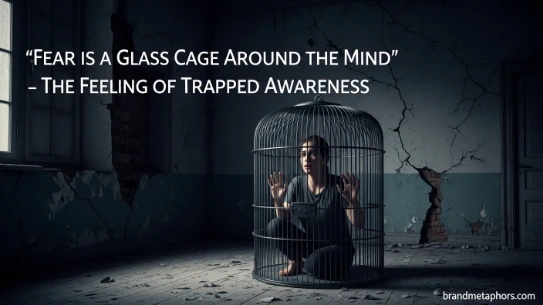
3. “Fear is a Glass Cage Around the Mind” – The Feeling of Trapped Awareness
Meaning and Explanation
This metaphor describes fear as something transparent but restrictive. You can see everything around you, but you feel unable to act freely. It’s a powerful image for anxiety, panic, or social fear.
Sensory and Emotional Detail
- Clear walls but invisible confinement
- Pressing silence despite visible surroundings
- Awareness without control
Example Sentence or Scenario
She could hear the voices in the room, but fear built a glass cage around her thoughts, and no words could escape.
Alternative Expressions
- “My thoughts were locked in a clear box.”
- “I could see the world, but not reach it.”
- “Fear made me visible but silent.”
Mini Storytelling Moment
Imagine standing on stage for a speech. You can see the audience clearly—faces, lights, movement—but your body refuses to obey. Your mind screams instructions, yet nothing comes out. That is the glass cage of fear.
Why It Works
It captures the contradiction of fear: full awareness paired with helplessness.
Interactive Exercise: Create Your Own Metaphor for Fear
Try this simple creative exercise:
- Think of a moment when you felt scared (real or imagined).
- Ask yourself: What did it feel like physically?
- Choose a natural object or situation (storm, animal, object, weather, space).
- Combine emotion + object.
Example Practice
- Fear + ocean = “Fear is a drowning tide pulling thoughts under.”
- Fear + fire = “Fear is a spark racing through dry grass in my mind.”
Challenge Prompt
Write one sentence describing fear without using the words “scared,” “afraid,” or “fear.” Instead, use metaphor only.
Bonus Tips: Using Metaphors for Scared in Writing and Daily Life
1. In Storytelling
Use metaphors to show character emotion instead of stating it directly. This makes your writing more immersive.
Example: Instead of “He was scared,” write:
- “His courage folded like paper in the rain.”
2. In Social Media Writing
Metaphors help your posts feel poetic and memorable:
- “Anxiety is a thundercloud that follows me without rain.”
3. In Daily Expression
Even in conversation, metaphors make emotions easier to share:
- “I felt like my thoughts were running in circles in a locked room.”
4. In Journaling
When writing personal reflections, metaphors help you understand emotions more deeply by giving them shape.
Metaphors for Scared in Literature and Human Experience
Across cultures and literature, fear has always been described in physical and imaginative ways. Ancient myths often portrayed fear as monsters, spirits, or darkness. Modern psychology, however, understands fear as an internal response—but metaphor still bridges the gap between science and feeling.
From Shakespeare’s trembling characters to modern film scenes where silence says more than dialogue, fear is rarely described plainly. Instead, it is shaped into imagery that lingers in memory.
Conclusion
Fear is universal, but language gives it shape. Without metaphors, fear remains invisible and difficult to share. With them, it becomes something we can hold, examine, and even transform.
Whether it is a frozen storm in the chest, a shadow that learns your shape, or a glass cage around the mind, metaphors help us not only describe fear—but understand it.
And perhaps that is their greatest power: they turn something overwhelming into something expressible. Once fear can be expressed, it becomes less mysterious—and sometimes, a little less powerful.
FAQs
What is a metaphor for scared?
A metaphor for scared is a figurative expression that describes fear using imagery, such as comparing fear to a storm, shadow, or cage.
Why are metaphors important for describing fear?
They make emotions more vivid and relatable, helping readers or listeners understand internal feelings through physical imagery.
Can metaphors improve creative writing?
Yes. Metaphors enhance storytelling by making descriptions more engaging, emotional, and memorable.
What are common metaphors for fear?
Common ones include fear as darkness, a storm, a shadow, a cage, or freezing cold.
How can I create my own fear metaphor?
Combine an emotion with a physical object or natural phenomenon and describe how it behaves, feels, or moves.
Are metaphors used in everyday speech?
Yes. People often use metaphors unconsciously, like saying “I froze up” or “I was shaking like a leaf.”