
The Quiet Magic Hidden in Every Grain of Sand
Close your eyes and imagine standing barefoot on a vast shoreline. The sand is warm beneath your feet, yet unstable—each step slightly sinking, shifting, resisting in a soft surrender. A breeze passes, lifting fine grains that shimmer briefly before disappearing into the air like forgotten thoughts.
Sand is ordinary at first glance. It is everywhere—beaches, deserts, riverbanks, playgrounds. But the more you observe it, the more it becomes something else entirely: a language of change, time, fragility, and endless motion. That is why metaphors for sand have long fascinated writers, poets, and thinkers. Sand becomes more than matter—it becomes meaning.
In writing, metaphors for sand help us express ideas that are hard to hold still: time slipping away, memories dissolving, life constantly reshaping itself. Sand is not just a substance; it is a feeling of impermanence you can almost touch.
This article explores powerful sand metaphors, their meanings, and how you can use them creatively in writing, storytelling, and everyday expression.
Why Metaphors for Sand Matter in Writing and Thought
Metaphors are bridges between the seen and the felt. Sand, with its shifting, granular nature, becomes an ideal symbol for experiences that are unstable, delicate, or constantly changing.
We use sand metaphors because:
- They capture impermanence and time slipping away.
- They express emotional fragility or instability.
- They help describe complexity made of tiny parts.
- They connect nature to human experience in a relatable way.
From ancient poetry to modern novels, sand has always carried emotional weight. In Persian literature, deserts symbolize longing and distance. In modern films, desert landscapes often reflect isolation or spiritual searching. Sand becomes a mirror—reflecting what we feel but cannot easily say.
Let’s explore three powerful metaphors for sand and how they can transform your writing.
1. Sand as Time Slipping Through Fingers
Meaning and Explanation
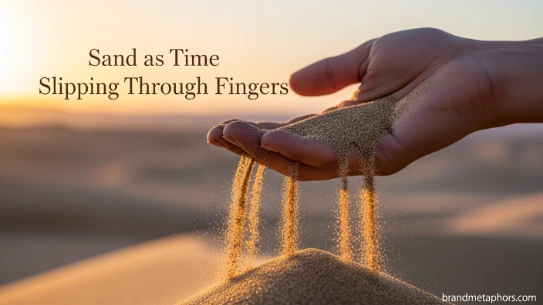
One of the most universal metaphors for sand is its connection to time. Just like sand slipping through your fingers, time feels impossible to hold. No matter how tightly you try to grasp it, it keeps moving.
This metaphor appears in hourglasses, where sand measures life in quiet, irreversible motion.
Example Sentence or Scenario
“Her childhood felt like sand slipping through her fingers at the beach—beautiful, warm, and impossible to keep.”
Alternative Expressions
- Time is grains falling from an unseen hourglass
- Life trickling away like desert sand in the wind
- Moments dissolving like sand in water
Sensory and Emotional Detail
Imagine holding a handful of dry sand. The grains are warm, slightly rough, and alive with movement. You squeeze your fist tighter, but the sand escapes anyway—soft streams slipping between your fingers. There is a quiet sadness in that loss, but also a strange peace: nothing was ever meant to stay.
Mini Storytelling Moment
A grandfather sits on a wooden bench by the sea, watching his grandson build a sandcastle. Every wave steals a piece of it. The child rebuilds, laughing. The old man doesn’t interrupt. He knows the lesson already: time is not lost—it is simply reshaped, like sand returning to the ocean again and again.
2. Sand as Memory Fragmenting and Rebuilding
Meaning and Explanation
Sand can represent memory—how it breaks apart, scatters, and reforms differently every time we recall it. Memories are not solid stones; they are grains that shift depending on emotion, perspective, and time.
Example Sentence or Scenario
“Her memories of the city were like sand after a storm—scattered, blurred, and constantly reshaped by forgetting.”
Alternative Expressions
- Memory like dunes shifting in unseen winds
- The past dissolving into fine grains of recall
- Thoughts scattered like footprints erased by sand
Sensory and Emotional Detail
Think of walking through a desert after a windstorm. There are no clear paths, only soft ripples where shapes used to be. Memory works the same way—some parts sharp and visible, others erased, leaving only impressions in your mind.
Cultural Reference
In many Middle Eastern and Central Asian storytelling traditions, deserts symbolize forgotten histories and wandering identities. Sand becomes a keeper of stories that are never fully stable—always rewritten by time and telling.
Mini Storytelling Moment
A woman returns to her childhood beach after twenty years. She kneels, picking up sand and letting it fall slowly. She tries to remember the exact color of her father’s voice, the sound of her mother’s laughter—but everything feels rearranged, like dunes after a storm. Yet, strangely, the feeling remains.
3. Sand as Infinite Possibility and Small Beginnings
Meaning and Explanation
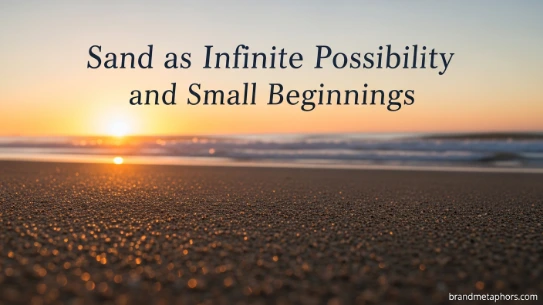
While sand often represents loss or impermanence, it can also symbolize endless possibility. Each grain is small, but together they form entire landscapes—beaches, deserts, islands. Sand reminds us that greatness is built from tiny beginnings.
Example Sentence or Scenario
“Her dreams were like sand—countless grains waiting to become mountains, shores, and new worlds.”
Alternative Expressions
- Infinite futures hidden in grains of sand
- Small beginnings forming vast landscapes
- Potential scattered like gold dust on the earth
Sensory and Emotional Detail
Hold sand in your hand under sunlight. Each grain glitters briefly—tiny, insignificant alone, but dazzling as a whole. There is hope in that image: what feels small is actually part of something vast.
Mini Storytelling Moment
An architect stands at a construction site where a new library will rise. She picks up a handful of sand from the foundation soil. “Everything starts like this,” she says softly. “Not steel, not glass—just this.” Years later, children will read books where she once saw only dust.
Interactive Exercises: Using Sand Metaphors Creatively
Try these exercises to deepen your understanding and use of metaphors for sand:
1. Time in Your Hands Exercise
Write a paragraph describing your day using sand as a metaphor for time. Focus on moments “slipping,” “piling,” or “blowing away.”
2. Memory Dune Exercise
Think of a childhood memory. Rewrite it three times:
- As a clear photograph
- As shifting sand dunes
- As scattered grains in the wind
Notice how meaning changes.
3. Tiny Worlds Exercise
List five small things in your environment (salt, dust, rice, crumbs, grains). Turn each into a metaphor for something big—hope, fear, love, ambition.
Bonus Tips for Using Sand Metaphors in Writing and Social Media

- Use sand metaphors in captions about time, travel, or reflection.
- Combine sensory language (warmth, texture, movement) for stronger imagery.
- Pair sand with contrast words like “stone,” “steel,” or “ice” to highlight instability vs. permanence.
- In storytelling, use sand to show emotional transition (loss, growth, change).
- In poetry, let sand represent both endings and beginnings in the same line.
Example social media caption: “Some days feel like sand—slipping through my fingers, yet building something I can’t yet see.”
Frequently Asked Questions (FAQs)
What do sand metaphors usually represent?
Sand metaphors often represent time, change, impermanence, memory, and emotional fragility, depending on context.
Why is sand a powerful literary symbol?
Because it is both stable in mass and unstable in form. It can build deserts or vanish in wind, making it ideal for contrasting ideas.
Can sand metaphors be used in modern writing?
Yes. They work well in poetry, fiction, personal essays, and even social media storytelling due to their emotional and visual strength.
How do I create my own sand metaphor?
Start by identifying an idea (like time or memory), then connect it to a property of sand such as slipping, scattering, or building.
Are sand metaphors only used in poetry?
No. They appear in novels, films, speeches, and everyday language because they are simple yet deeply expressive.
Conclusion
Sand is not silent. It speaks in movement—in the shifting of dunes, the erosion of stone, the gentle collapse of footprints at the shoreline. Through metaphors for sand, we learn to understand life not as something fixed, but as something always becoming.
Time slips like sand. Memory scatters like wind over dunes. Possibility gathers like countless grains waiting to become a world.
And maybe that is the quiet truth sand teaches us: nothing is ever truly lost—it is simply reshaped, endlessly, beautifully, into something new.