
Introduction
Imagine standing at a train station late in the evening. The platform is half-lit, the air slightly cold, and the distant sound of an approaching train echoes faintly—but it never seems to arrive. Around you, people check their phones, shift their weight, sigh softly, and glance again toward the tracks. Time feels heavier here, almost stretching itself. In moments like these, patience is no longer just a virtue we talk about; it becomes something we must physically inhabit.
Metaphors for patience help us understand this invisible experience in a more meaningful way. Patience is not simply waiting—it is how we endure waiting, how we interpret delay, and how we grow inside moments of uncertainty. Across cultures, literature, and everyday life, patience is often described through powerful images like rivers carving stone, seeds growing underground, or mountains climbed step by step. These metaphors do more than decorate language—they reveal emotional truth.
This article explores those metaphors in depth, uncovering how they shape our understanding of patience in real life. Each image carries a lesson about time, resilience, and inner strength. By the end, patience will no longer feel like passive waiting, but like an active, meaningful process unfolding quietly beneath the surface of life.
The Meaning Behind Metaphors for Patience
Metaphors for patience are more than poetic expressions—they are mental bridges that connect abstract emotion to tangible experience. Patience itself is invisible. You cannot touch it, measure it, or photograph it. Yet everyone recognizes it when they see it in action: a calm parent guiding a child, a student studying for years, or a farmer waiting for rain.
Because patience is abstract, humans naturally explain it through imagery. We compare it to things we can see and feel—slow rivers, growing trees, or burning candles. These metaphors help us understand not just what patience is, but how it behaves in real life.
At its core, patience represents the relationship between time and endurance. It is the ability to remain steady while something important is still unfolding. Metaphors allow us to explore this relationship emotionally. For example, a “waiting seed” suggests hidden progress, while a “tightrope walk across time” suggests balance and tension.
Without metaphors, patience can feel like empty waiting. With them, it becomes a dynamic process filled with meaning, movement, and transformation.
The River That Slowly Carves Stone
One of the most powerful metaphors for patience is the river shaping stone. At first glance, water seems too soft and weak to change anything solid. Yet over time, rivers carve deep valleys, smooth cliffs, and reshape entire landscapes.
This metaphor teaches that patience is not about force—it is about consistency. Just as water does not rush or fight the rock, patient effort does not rely on intensity alone. Instead, it relies on persistence.
The Lesson of Continuous Flow
A river does not stop when it meets resistance. It adapts, flows around obstacles, and continues its path. Similarly, patience in life means continuing forward even when progress feels invisible.
Real-Life Reflection
Think of learning a new skill, like writing or playing an instrument. Progress often feels slow at first. But like water on stone, small daily efforts eventually create visible change. The transformation may be so gradual that you only notice it after a long time has passed.
This metaphor reminds us that patience is not passive waiting—it is quiet persistence that reshapes reality over time.
Gardening and the Rhythm of Seasons
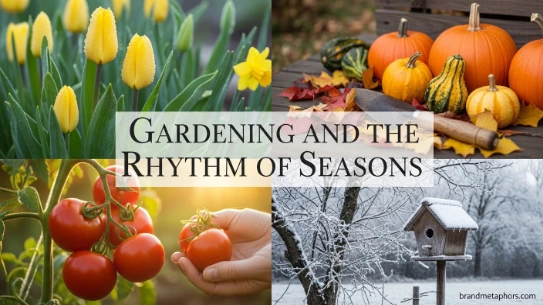
Gardening is one of the most grounded metaphors for patience because it reflects the natural rhythm of growth. A seed planted today does not become a flower tomorrow. It requires soil, sunlight, water, and most importantly, time.
H3: The Invisible Work Beneath the Soil
Before anything appears above ground, roots are already spreading underground. This unseen phase is crucial, even though it offers no immediate reward. Patience here means trusting what cannot yet be seen.
H3: Seasons as Emotional Lessons
Gardening also teaches that growth follows cycles. There are seasons of planting, waiting, blooming, and resting. Not every phase is productive in the visible sense, but each is necessary.
In life, this translates to periods where effort feels unrewarded. A job search, a healing process, or personal development often mirrors this slow seasonal rhythm.
Gardening reminds us that patience is not about rushing toward results—it is about respecting timing. Nature never hurries, yet everything gets done.
The Waiting Room of Life
Another relatable metaphor for patience is the waiting room. Whether in hospitals, stations, or offices, waiting rooms represent suspended time. People sit quietly, uncertain of when their turn will come.
In these spaces, patience becomes emotional endurance. You cannot speed up the process, only accept it. This makes waiting rooms powerful symbols of life’s uncertainties—job interviews, medical results, or important decisions.
The Psychology of Waiting
In a waiting room, time feels different. A five-minute delay can feel like half an hour. This distortion reflects how patience is deeply psychological, not just physical.
Finding Control in Uncertainty
Even when we cannot control outcomes, we can control our response. Reading, breathing calmly, or observing surroundings becomes an act of reclaiming inner stability.
The waiting room metaphor teaches that patience is not about eliminating discomfort, but about learning to sit with it without losing composure.
Brewing Tea: The Art of Slow Transformation
Tea brewing is a subtle yet powerful metaphor for patience. When hot water meets tea leaves, nothing dramatic happens instantly. The flavor slowly spreads, deepens, and transforms the water into something entirely new.
H3: Timing Matters
If tea is rushed, it tastes weak. If left too long, it becomes bitter. Patience here is about balance—knowing when to wait and when to act.
H3: Transformation Through Steeping
Steeping represents how change often happens quietly. Emotional healing, personal growth, and understanding often require time to “infuse” meaning into experience.
Like tea, human development cannot be forced. It must be allowed to unfold naturally.
This metaphor teaches that patience is not just about delay—it is about allowing depth to develop.
Climbing a Mountain Step by Step

Mountains symbolize long-term goals that require sustained effort. No one reaches the summit instantly. Every climber must move step by step, resting, adjusting, and continuing forward.
H3: The Illusion of Distance
At the base, the peak may look impossibly far. But patience turns distance into manageable stages. Each step becomes meaningful in itself.
H3: Endurance Over Speed
Climbing teaches that slow progress is still progress. Resting is not failure—it is part of survival. In life, this applies to careers, education, and personal ambitions.
The mountain metaphor reframes patience as endurance with direction. It is not about standing still—it is about continuing upward, even when progress feels slow.
Cooking on a Slow Flame
Cooking offers one of the richest metaphors for patience, especially slow-cooked meals. A dish simmering over low heat develops deeper flavors than one cooked quickly.
H3: Pressure vs. Patience
Fast cooking under pressure may produce results, but often lacks depth. Slow cooking, on the other hand, allows ingredients to blend gradually, creating richness.
H3: Time as an Ingredient
In this metaphor, time itself becomes an ingredient. Without it, the dish remains incomplete. Similarly, many life experiences—relationships, skills, healing—require time to fully develop.
Cooking reminds us that patience enhances quality. The best outcomes often come from allowing processes to unfold gently.
Seeds Growing Beneath the Surface
A seed buried in soil looks inactive, but it is actually undergoing intense transformation. Roots expand first, anchoring the plant before anything becomes visible.
This metaphor captures one of the most important truths about patience: progress is often invisible before it becomes visible.
What appears as “nothing happening” may actually be foundational growth. In life, this applies to emotional healing, learning, or building habits. The surface may look unchanged, but deep change is already underway.
Patience here means trusting unseen processes and resisting the urge to judge progress too early.
Bridges Under Construction
A bridge under construction is another strong metaphor for patience. Before it is complete, it may look messy, unfinished, or even unstable. Yet each piece is essential to the final structure.
Patience in this metaphor is about trusting the process of assembly. No bridge is built in one moment—it requires planning, materials, labor, and time.
In personal life, this reflects how identity and success are built gradually. Careers, relationships, and skills are all “under construction” at different stages.
The lesson is clear: unfinished does not mean broken. It simply means in progress.
Sculpting Marble: Shaping Over Time
Sculpting marble requires removing material slowly and carefully. The final artwork is not created by adding, but by subtracting what does not belong.
This metaphor shows patience as precision. Each strike of the chisel must be controlled. Rushing would destroy the form.
In life, this represents self-improvement—removing habits, thoughts, or distractions that do not serve growth. Change is not always about doing more, but about refining what already exists.
Patience here is about trusting gradual refinement rather than expecting instant transformation.
Time, Clocks, and Delayed Rewards
Clocks are constant reminders of time passing, but they also symbolize delayed outcomes. The ticking second hand shows movement even when results are not visible.
Patience in this metaphor is about trusting time’s structure. Not everything happens immediately, but everything moves forward.
This applies strongly to goals and rewards. Effort today may only show results months or years later. The clock reminds us that timing is part of the process.
Patience is learning to respect that timing, even when it feels inconvenient.
Tides, Waves, and Natural Cycles

Ocean tides rise and fall in predictable cycles. No wave remains forever, and no calm lasts permanently. This rhythm reflects emotional and life cycles.
Patience here is about understanding change. Just as tides cannot be forced, many life situations cannot be rushed or stopped.
Emotions, opportunities, and challenges all move in waves. Recognizing this helps reduce frustration during difficult phases.
The ocean metaphor teaches acceptance: everything changes, but not on our schedule.
Living in a Fast World
In the modern digital age, patience is increasingly rare. Information arrives instantly, messages are delivered in seconds, and expectations for speed are higher than ever.
This makes metaphors for patience even more important. They remind us that not everything meaningful can be rushed.
Whether it is the slow river, the growing seed, or the climbing mountain, these images resist the pressure of instant gratification. They teach that depth requires time.
In a world of speed, patience becomes a form of strength. It is the ability to slow down internally even when everything outside moves quickly.
Conclusion
Patience is not simply waiting—it is how we experience time while waiting. Through metaphors like rivers carving stone, seeds growing underground, mountains climbed step by step, and tea slowly steeping, we begin to see patience as an active, living process rather than passive delay.
Each metaphor reveals a different dimension of patience: persistence, trust, endurance, and transformation. Together, they show that meaningful change rarely happens instantly. It unfolds quietly, often beneath the surface, before it becomes visible.
In everyday life, these metaphors help us reframe frustration into understanding. They remind us that delays are not empty spaces but stages of development. Patience, then, becomes not just a virtue but a way of interpreting life itself—with steadiness, depth, and quiet confidence in the process of becoming.