
Introduction (The Quiet Moment When You Feel Unanchored)
There are moments in life when everything looks normal on the outside, but inside, something feels missing. You may be walking through a crowded street, sitting in a room full of noise, or scrolling through familiar places on your phone, yet still feel strangely distant from everything.
It is not always about physical direction. Sometimes, it is about emotional direction—like you are moving, but not sure where you are going or why.
This is where the idea of being “lost” becomes more than just a word. It becomes a feeling that is hard to explain but deeply understood. People often use metaphors for lost to describe this experience in a way that makes sense to the heart. These metaphors help us give shape to confusion, sadness, change, or uncertainty.
In this article, we will explore powerful metaphors for lost and what they reveal about human emotions. Each metaphor offers a different way of understanding confusion, transition, and searching. More importantly, they help us see that feeling lost is not the end—it is often the beginning of finding meaning again.
Understanding “Lost” as a Human Feeling
Being lost is not only about geography. It is also about identity, purpose, and emotional direction. A person can feel lost after a breakup, a job change, a big failure, or even during quiet times when life feels unclear. It is a state where certainty fades and questions become louder than answers.
When people say they feel lost, they often mean they cannot recognize their own path anymore. The future feels blurry, and the past no longer gives comfort. It is like standing in a space where familiar signs are missing. You still exist, you still move, but direction feels broken.
This feeling is deeply human because life is always changing. We grow, we lose, we start again. Each change can shake our inner compass. Metaphors help us understand this emotional shift by turning invisible feelings into images we can imagine. Instead of just “feeling bad,” we see ourselves as travelers, ships, or seekers in a larger journey.
Understanding this helps reduce fear. Being lost is not a flaw. It is a signal that something inside is shifting and looking for a new direction.
Why Metaphors Matter for Feeling Lost
Metaphors are powerful because they translate emotions into pictures. When someone says, “I feel lost,” it is abstract. But when they say, “I feel like I am walking in fog,” it becomes easier to understand. The mind can visualize fog, paths, and distance.
This matters because emotions that are hard to describe often feel heavier. When we cannot explain what we feel, we may feel even more alone. Metaphors reduce that distance. They connect inner experience with shared human understanding.
They also help in healing. When we describe our confusion as a “maze” or “storm,” we can also imagine ways out. Mazes have exits. Storms pass. This creates hope inside the image itself.
Metaphors also help communication. Friends, teachers, or counselors can better understand emotional states when they are expressed in images instead of only words like “sad” or “confused.”
In short, metaphors for lost do not just describe feelings. They organize them, soften them, and sometimes even guide us through them.
Lost as Being in a Fog
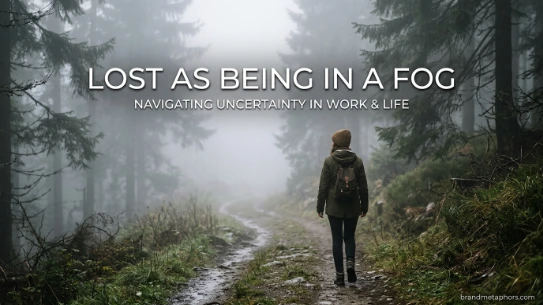
One of the most common metaphors for lost is walking through fog. Fog is thick, silent, and hides what is ahead. You can still move, but you cannot see far.
In emotional terms, this represents confusion. You know you are on a path, but you cannot clearly see where it leads. Decisions feel uncertain. Even simple choices become difficult because the outcome is unclear.
Emotional Fog
Emotional fog often happens during stress, grief, or major life changes. A person may wake up and feel disconnected from their usual thoughts. Nothing feels sharp or clear. Everything feels slightly out of reach.
Decision Fog
Decision fog happens when choices multiply and none feel right. You may think, “Which direction is correct?” but every answer feels blurry. This creates hesitation and self-doubt.
Fog metaphors are powerful because they also suggest change. Fog does not last forever. It lifts slowly. This reminds us that confusion is temporary, even if it feels endless in the moment.
Lost as a Broken Compass
A compass is supposed to guide direction. When it breaks, even movement becomes uncertain. This metaphor reflects moments when internal guidance feels unreliable.
People often rely on values, goals, or instincts to make decisions. But during emotional struggles, these guiding systems may feel weak or unclear. What once felt right may no longer feel true.
This creates inner conflict. A person may ask, “What do I even want now?” The broken compass represents this loss of inner certainty.
However, this metaphor also carries hope. A broken compass can be repaired, recalibrated, or replaced. Similarly, personal direction can be rediscovered through reflection, time, and experience.
It reminds us that losing direction does not mean losing the ability to find it again. It simply means the old system is being updated for a new stage of life.
Lost as a Ship Without a Shore
Imagine a ship floating in open sea with no land in sight. This is a strong image of emotional isolation and uncertainty. The ocean is vast, and the ship moves, but without clear destination.
This metaphor often reflects long-term confusion. It is not just a moment of doubt, but a deeper feeling of drifting through life without anchor points.
The waves represent emotions—sometimes calm, sometimes overwhelming. Without a shore, there is no fixed reference point for safety or direction.
Yet even this image is not entirely hopeless. A ship is still built to move. It can change direction, explore, and eventually find land again. The sea may be wide, but it is not endless.
This metaphor teaches that being lost does not mean being stuck. It can also mean being in motion without clarity, which is still part of a journey.
Lost as a Maze With No Map
A maze represents confusion filled with choices. You turn left, then right, only to find yourself back where you started. It feels endless, especially when there is no map.
Dead Ends
Dead ends represent failed attempts. These can be emotional decisions, relationships, or plans that did not work out. Each dead end can feel like proof that progress is impossible, even though it is not.
Looping Paths
Looping paths represent repeated patterns. A person may feel they are facing the same problems again and again. This creates frustration and emotional fatigue.
But mazes are designed to be solved. Every wrong turn still teaches something about the structure. Over time, patterns become clearer.
This metaphor helps people understand that confusion is not wasted effort. It is part of learning how to move forward in a complex situation.
Lost as a Phone Without Signal
In modern life, a phone without signal feels disconnected. You can still hold it, but you cannot reach anyone or access updates.
This metaphor reflects emotional disconnection. A person may feel like they cannot communicate their thoughts clearly or connect with others in a meaningful way.
It also represents internal silence. Thoughts may feel blocked or unclear, like messages that never get sent.
However, signal loss is often temporary. Moving to a different place, adjusting settings, or waiting can restore connection. This reminds us that emotional disconnection is not permanent either.
Sometimes, rest and space are needed before connection returns.
Lost as a Falling Leaf in the Wind
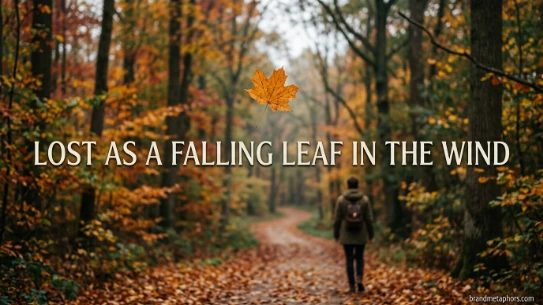
A falling leaf does not control where it goes. It moves with wind, directionless but still graceful. This metaphor reflects moments when life feels out of personal control.
People often experience this during sudden changes—loss of job, ending of relationships, or unexpected events. It feels like being carried by forces beyond control.
Yet the leaf still has purpose in its journey. It may land in soil, become part of new growth, or simply complete its cycle.
This metaphor teaches acceptance. Not all moments of being lost are about control. Some are about movement through change.
Lost as a Dark Room Searching for Light Switch
A dark room creates uncertainty. You can move, but you cannot see clearly. You feel your way forward, hoping to find a switch.
This metaphor represents searching for clarity. The solution exists, but it is not immediately visible. You must explore carefully.
It also reflects patience. You cannot force light instantly. You must move step by step, trusting that the switch is there.
This image is comforting because it suggests that clarity is already present—it just needs to be found.
Lost in a Crowd but Alone
One of the most emotional forms of being lost is feeling alone in a crowd. You are surrounded by people, yet feel invisible or disconnected.
This is not physical isolation. It is emotional distance. Conversations may happen, but they do not feel meaningful. Presence does not equal connection.
This metaphor is common in modern life, especially in busy cities or digital spaces. It shows that being surrounded does not always mean being understood.
It reminds us that connection is not about numbers but about depth.
How Language Shapes Recovery from Being Lost
The way we describe being lost affects how we experience it. If we call it “failure,” it feels heavy. If we call it “transition,” it feels temporary.
Language can either trap us or guide us. Metaphors play a key role in this shift. They help reframe confusion into something meaningful.
For example, fog suggests clearing. A maze suggests solution. A storm suggests passing. These images change emotional tone.
This is why choosing words carefully matters. It does not erase difficulty, but it changes how we move through it.
Finding Meaning While Still Feeling Lost
It is possible to feel lost and still grow at the same time. In fact, many people discover meaning during uncertain periods. When old directions fade, new questions appear.
This stage is uncomfortable but important. It opens space for reflection. Instead of rushing to “fix” being lost, sometimes it helps to understand it.
Meaning is not always found at the end of clarity. Sometimes it is built inside confusion.
Being lost is not a failure of direction. It is often the beginning of deeper awareness.
Conclusion
Feeling lost is a deeply human experience that appears in many forms—fog, mazes, broken compasses, or silent signals. Each metaphor helps us understand confusion in a way that feels familiar and easier to hold. Instead of seeing being lost as something negative, these images show it as part of movement, change, and growth.
Life is not a straight path. It shifts, bends, and sometimes disappears into fog. But even in uncertainty, there is motion. And motion means possibility. When we use metaphors for lost, we give shape to what feels unclear and make space for understanding.
In the end, being lost is not the opposite of finding. It is often the space where finding begins.