
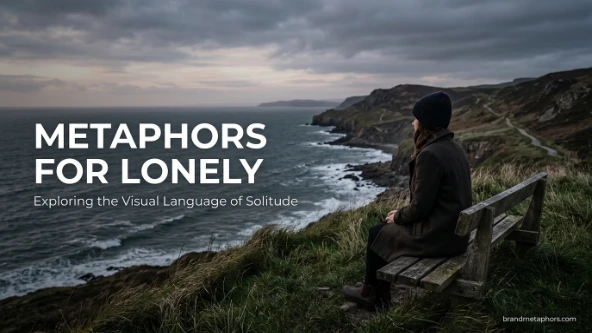
1. Introduction: The Quiet Language of Loneliness
Loneliness is not always loud. Sometimes it arrives like a room after the guests have left—chairs still warm, echoes still hanging in the air, but no one remains to speak. It can feel like standing on a train platform long after the last train has disappeared into the dark, leaving only the flicker of distant lights and the sound of your own breathing.
Yet loneliness is not just emptiness. It is also language—rich, symbolic, and deeply human. Writers, poets, and everyday storytellers often rely on metaphors for lonely moments to give shape to something that otherwise feels invisible. We don’t just say “I feel lonely”; we say “I am a lighthouse with no ships,” or “I am a song no one remembers.”
This article explores powerful metaphors for loneliness, showing how they can deepen emotional expression in writing, storytelling, social media captions, journaling, and even self-reflection. You’ll also learn how to create your own metaphors and use them creatively in daily life.
2. Why Metaphors for Loneliness Matter in Language and Emotion
Metaphors are not just decorative language—they are emotional bridges. When feelings are too heavy or too abstract, metaphors carry them across into something understandable.
Loneliness, in particular, is difficult to describe directly because it is both emotional and physical. A metaphor transforms it into something visual or sensory, making it easier to express and share.
For example:
- Instead of saying “I feel lonely,” a metaphor might say, “I am an island no one sails to anymore.”
This does three things:
- It creates imagery
- It invites empathy
- It gives emotional clarity
In literature, loneliness often becomes a symbol of identity, transformation, or longing. In real life, metaphors help people process emotions they cannot fully explain.
3. Metaphor Example 1: “An Empty House with Open Windows”
Meaning & Explanation
This metaphor represents loneliness as a place that is physically present but emotionally unoccupied. The “house” symbolizes the self, while the “open windows” suggest exposure without connection.
It captures the idea of being visible to the world but still alone inside.
Example Sentence
“After moving to a new city, she felt like an empty house with open windows—seen by everyone, but lived in by no one.”
Alternative Expressions
- A house with no footsteps inside
- A home without voices
- A structure filled with echo instead of conversation
Sensory & Emotional Details
You can imagine curtains moving slightly in the wind, doors creaking without purpose, and sunlight falling on untouched furniture. There is beauty—but also abandonment.
Mini Story
A young artist once moved into a small apartment in a crowded city. Outside, life was loud—vendors shouting, buses honking, neighbors laughing. But inside her room, silence thickened like dust. She began painting her loneliness as rooms without people, filling canvases with doors that opened into more doors. Over time, those paintings became her way of speaking to the world.
Writing Tip
Use this metaphor when describing emotional isolation in familiar environments—homes, workplaces, or cities.
4. Metaphor Example 2: “A Lighthouse Without Ships”

Meaning & Explanation
A lighthouse is meant to guide others, but without ships, its purpose feels unfulfilled. This metaphor expresses loneliness as usefulness without connection.
It suggests someone who still shines, still exists with purpose—but has no one receiving their light.
Example Sentence
“He kept writing messages into the world like a lighthouse without ships—bright, steady, and unanswered.”
Alternative Expressions
- A signal no one reads
- A beacon facing an empty sea
- Light without a traveler
Sensory & Emotional Details
Imagine waves crashing against rocks, wind howling through a tall tower, and a rotating beam of light sweeping across nothingness. There is motion, effort, and persistence—but no response.
Literary Reference
This metaphor echoes themes often found in maritime poetry and existential literature, where human effort continues even in absence of recognition.
Mini Story
An old radio operator once kept transmitting messages long after the war ended. No replies came, only static. Yet every night, he still sent signals, believing someone, somewhere, might still be listening. He was not broken—just unheard.
Writing Tip
Use this metaphor for emotional states involving effort, communication, or creativity that feels unreceived.
5. Metaphor Example 3: “A Song No One Remembers”
Meaning & Explanation
This metaphor captures loneliness as emotional invisibility—something once meaningful but now forgotten.
It is especially powerful because it connects identity with memory and recognition.
Example Sentence
“Walking through the crowded street, he felt like a song no one remembers, playing softly in the background of a world that had moved on.”
Alternative Expressions
- A melody fading into silence
- Lyrics without listeners
- A tune lost in time
Sensory & Emotional Details
You can almost hear faint music drifting through empty halls, notes dissolving before they are fully formed. There is nostalgia mixed with sadness, like something beautiful slipping away.
Cultural Reference
Many folk songs across cultures explore themes of forgotten voices—songs passed down but slowly fading, much like human memories.
Mini Story
An elderly woman once hummed the same lullaby every evening. She could no longer remember who first sang it to her, but the melody remained. She felt like the last keeper of a song the world had already stopped singing.
Writing Tip
Use this metaphor when expressing emotional fading, memory loss, or social invisibility.
6. How to Create Your Own Metaphors for Loneliness
Creating metaphors is a creative process that blends observation with imagination.
Try this simple method:
- Identify your emotion (lonely, disconnected, unseen)
- Think of a physical object or place
- Ask: What feels similar about them?
Examples of transformation
- Lonely → “a chair at a table set for many”
- Lonely → “a phone with no notifications”
- Lonely → “a streetlight on an empty road”
The goal is not perfection, but emotional truth.
Exercise Prompt
Write three metaphors for loneliness using:
- Nature (rain, ocean, wind)
- Objects (mirror, clock, window)
- Places (station, desert, bridge)
7. Cultural and Literary Views of Loneliness
Across literature and culture, loneliness is rarely simple—it is often symbolic.
In poetry, it becomes:
- A winter landscape
- A distant star
- A broken compass
In storytelling traditions, lonely characters often represent wisdom, exile, or transformation. Think of wandering travelers, isolated poets, or silent guardians.
These cultural metaphors show that loneliness is not only suffering—it is also reflection.
8. Interactive Writing Exercises: Turn Feelings into Images

Try these exercises to practice metaphor creation:
Exercise 1: Emotional Snapshot
Write a single sentence describing your current mood using a metaphor.
Exercise 2: Object Transformation
Choose an object in your room. Turn it into a metaphor for loneliness.
Exercise 3: Scene Building
Describe a lonely place without using the word “lonely.”
Example: “The café cup cooled untouched while the chairs remained perfectly aligned, waiting for a conversation that never arrived.”
9. Using Loneliness Metaphors in Writing, Social Media, and Daily Life
Metaphors are powerful tools beyond literature.
In Writing
- Enhance emotional depth in stories
- Build atmosphere in poetry
- Show rather than tell emotions
On Social Media
- Create relatable captions
- Add aesthetic depth to posts
- Express feelings subtly
Example caption: “I feel like a lighthouse without ships tonight—still glowing, still waiting.”
In Daily Life
- Journaling emotions becomes easier
- Self-reflection becomes more creative
- Communication becomes more expressive
10. Transforming Loneliness into Creative Expression
Loneliness does not always have to feel like absence. Sometimes it becomes the starting point of creativity.
Many artists, writers, and musicians transform solitude into:
- Poems
- Paintings
- Songs
- Personal reflection
When reframed through metaphors, loneliness becomes less of a void and more of a canvas.
It shifts from: “I am alone” → “I am a space where something is still forming.”
That shift is powerful.
FAQs: Metaphors for Loneliness
1. What is a metaphor for loneliness?
A metaphor for loneliness is a symbolic comparison that expresses isolation through imagery, such as “an empty house” or “a lighthouse without ships.”
2. Why are metaphors useful for expressing loneliness?
They help turn abstract emotions into visual or sensory images, making feelings easier to understand and communicate.
3. Can metaphors help in writing poetry?
Yes, metaphors add emotional depth, imagery, and creativity, which are essential in poetry and storytelling.
4. How do I create my own loneliness metaphor?
Combine your feeling with a physical object, place, or natural element that reflects similar emotional qualities.
5. Are loneliness metaphors always sad?
Not always. Some metaphors can show reflection, strength, or transformation through solitude.
Conclusion
Loneliness is one of the most universal human experiences, yet it often feels deeply personal and difficult to express. Metaphors give it shape, color, and voice. They turn silence into imagery and isolation into meaning.
Whether it is an empty house, a lighthouse without ships, or a song no one remembers, these metaphors remind us that even loneliness can be beautifully expressed.
And perhaps most importantly, when we learn to describe loneliness, we also learn to understand it—and sometimes, to soften it.