
Imagine standing beneath a sky so clear that the stars seem close enough to touch. The air is quiet. The world below feels far away, and for a moment, everything seems lighter—your worries, your fears, even the weight of time itself. That feeling of peace is one reason people have searched for words to describe heaven for thousands of years.
Heaven is difficult to explain because it represents something beyond ordinary human experience. Different religions, cultures, writers, poets, and families have imagined it in different ways. Rather than describing heaven literally, people often use metaphors for heaven to express ideas such as eternal peace, perfect beauty, divine love, freedom, hope, and belonging.
A good metaphor gives an abstract idea a shape we can imagine. It turns something distant into something familiar. Heaven might become a garden, a home, a sunrise, a peaceful shore, or a place where every broken thing is made whole.
These metaphors are useful in poetry, stories, speeches, spiritual writing, sympathy messages, social media captions, and everyday conversations about hope and loss. They can also help readers explore their own understanding of what heaven means.
What Are Metaphors for Heaven?
Metaphors for heaven are imaginative comparisons that describe heaven using familiar images, sensations, or experiences. Instead of defining heaven directly, they evoke its essence through analogy.
For example:
- “Heaven is a garden that never withers.”
- “Heaven is a song that never ends.”
Each metaphor emphasizes a different quality—eternity, peace, beauty, or fulfillment.
Why They Matter
- They make abstract ideas relatable
- They enrich storytelling and poetry
- They help express emotional or spiritual experiences
- They connect readers to deeper meaning
Why Use Heaven Metaphors in Writing and Life

Heaven metaphors are not just for religious texts or poetry—they appear in everyday language more often than we realize:
- “That meal was heaven.”
- “This place feels like heaven.”
- “Being with you is heaven.”
These expressions help us:
- Capture intense happiness
- Describe serenity or escape
- Communicate emotional depth quickly
In writing, they elevate tone, add imagery, and create resonance. In life, they help us articulate moments that feel too profound for plain words.
Heaven as an Endless Garden
Meaning & Explanation
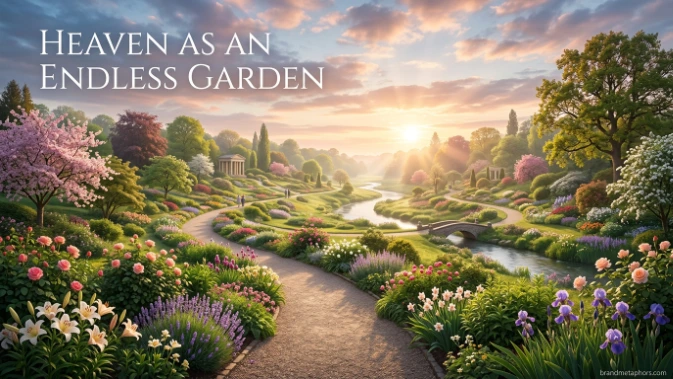
This metaphor presents heaven as a lush, eternal garden—overflowing with life, beauty, and harmony. It emphasizes growth without decay, abundance without scarcity, and peace without interruption.
Example Scenario
A writer describing a peaceful afterlife might say:
“She walked through an endless garden where every flower bloomed at once, and no petal ever fell.”
Alternative Expressions
- A garden untouched by seasons
- A meadow where time forgets to pass
- A forest that never loses its leaves
Sensory & Emotional Details
- The scent of jasmine and rain
- The warmth of sunlight without heat
- A gentle breeze carrying birdsong
Mini Storytelling Element
Imagine a weary traveler who has wandered through deserts and storms. At last, they arrive at a gate. Beyond it lies a garden—quiet, glowing, alive. No hunger. No fear. Just rest.
Why It Works
Gardens symbolize life, care, and renewal. By removing decay and struggle, the metaphor transforms them into a vision of perfection.
Heaven as a Symphony Without End
Meaning & Explanation
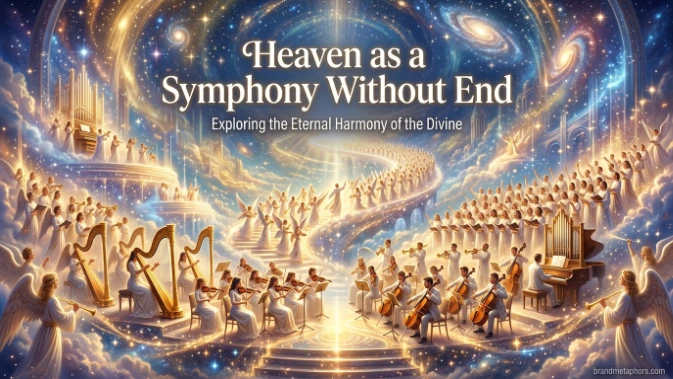
This metaphor imagines heaven as a continuous, harmonious piece of music—perfectly balanced, emotionally rich, and eternal.
Example Sentence
“Heaven is a symphony that never fades, each note rising into the next like waves of light.”
Alternative Expressions
- A song that never reaches its final note
- A melody that echoes forever
- A choir woven from starlight
Sensory & Emotional Details
- The swell of violins
- The deep hum of a cello
- A chorus that feels like warmth in your chest
Mini Storytelling Element
Think of a musician who has spent their life chasing the perfect note. In heaven, they finally hear it—not once, but endlessly, evolving, deepening, never losing its beauty.
Why It Works
Music is deeply emotional and universal. By equating heaven with music, we emphasize harmony, continuity, and transcendence.
Heaven as a Boundless Ocean of Light
Meaning & Explanation
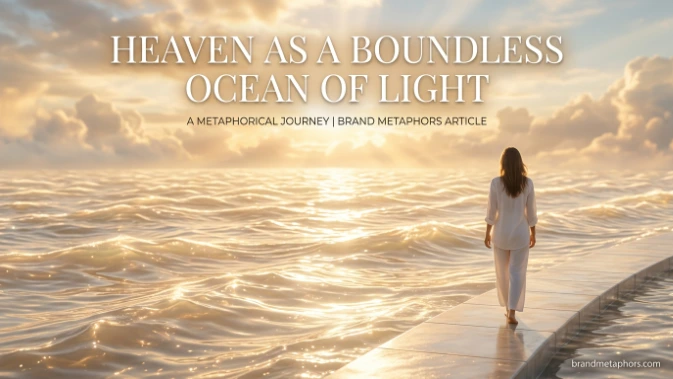
This metaphor envisions heaven as an infinite ocean—not of water, but of light. It suggests vastness, depth, and a sense of immersion in something greater than oneself.
Example Sentence
“Heaven is an ocean of light where every wave carries peace.”
Alternative Expressions
- A sea made of dawn
- A horizon that never ends
- A tide of golden stillness
Sensory & Emotional Details
- Gentle waves that glow instead of crash
- A warmth that surrounds rather than burns
- A silence that feels full, not empty
Mini Storytelling Element
A soul steps into this ocean—not sinking, but floating effortlessly. There is no edge, no fear of drowning—only the sensation of being held.
Why It Works
The ocean represents infinity and mystery. Replacing water with light transforms it into something divine and comforting.
Practice Heaven Metaphors
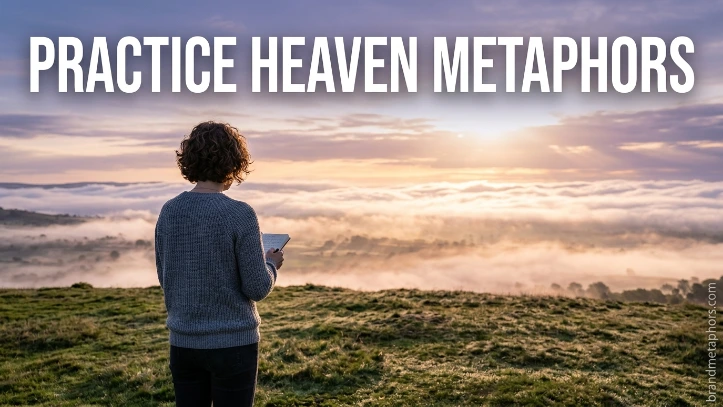
Try these exercises to develop your own metaphors:
The Unexpected Heaven
Describe heaven using something ordinary:
- A kitchen
- A library
- A train station
Challenge: Make it feel extraordinary.
Sensory Heaven
Write a paragraph describing heaven using all five senses:
- What does it smell like?
- What sounds fill the air?
- What textures can be felt?
Personal Heaven
Describe what heaven would look like specifically for you:
- A place from childhood
- A dream location
- A feeling rather than a place
Tips for Crafting Powerful Heaven Metaphors
Focus on Emotion First
Ask: What feeling am I trying to convey? Peace? Joy? Freedom? Let that guide your imagery.
Use Familiar Anchors
Compare heaven to things people already understand:
- Nature
- Music
- Light
- Home
Add Sensory Layers
The more senses you engage, the more vivid your metaphor becomes.
Instead of:
“Heaven is peaceful.”
Try:
“Heaven is the hush after snowfall, where even your thoughts move softly.”
Using Heaven Metaphors in Social Media and Daily Life

You don’t need to be a poet to use these ideas. Try them in:
Captions
- “This sunset feels like a doorway to heaven.”
- “Moments like this are little pieces of heaven.”
Journaling
Reflect on moments that felt “heavenly”:
- A quiet morning
- A meaningful conversation
- A place that felt safe
Conversations
Instead of saying “I’m happy,” try:
- “I feel like I’m floating.”
- “This feels like a dream I don’t want to wake up from.”
Cultural and Literary Echoes of Heaven Metaphors
Across cultures and literature, heaven has been described in metaphorical ways:
- As a paradise garden
- As a celestial city of light
- As a reunion of souls
These metaphors reflect shared human desires:
- Peace
- Belonging
- Eternity
They show that while definitions vary, the feeling of heaven is universal.
Elevating Your Writing with Metaphors
- Layer metaphors carefully: Don’t overload a sentence
- Stay consistent in tone: Avoid mixing unrelated imagery
- Revise for clarity: Beautiful doesn’t mean confusing
Build Your Own Heaven Metaphor

Fill in the blank:
“Heaven is like ______ because ______.”
Now expand it:
- Add sensory details
- Add a short scene
- Add emotion
Example:
“Heaven is like a quiet library because every story feels complete, and every silence feels full.”
Why Heaven Metaphors Matter
Metaphors for heaven are more than literary tools—they are emotional maps. They help us navigate the intangible, express the inexpressible, and connect with something larger than ourselves.
Whether you’re writing poetry, crafting a story, or simply trying to describe a beautiful moment, these metaphors give you a language of wonder.
FAQs About Metaphors for Heaven
What is the best metaphor for heaven?
There’s no single “best” metaphor—it depends on the emotion you want to convey. Gardens suggest peace, music suggests harmony, and light suggests divinity.
Can heaven metaphors be personal?
Absolutely. The most powerful metaphors often come from personal experiences and emotions.
Are heaven metaphors only religious?
No. They can be spiritual, emotional, or purely poetic without religious meaning.
How can I make my metaphors more vivid?
Use sensory details, specific imagery, and emotional context.
Can I use multiple metaphors together?
Yes, but use them carefully to avoid confusion. Keep a consistent theme.
What would heaven look like to someone who spent their life traveling?
Maybe it would be a road with no destination.
What would heaven look like to a gardener?
Perhaps an endless spring.
What would heaven look like to a musician?
Maybe a melody that never resolves because it never needs to end.
What would heaven look like to a child?
Perhaps a place filled with familiar faces, laughter, sunlight, and endless games.
This exercise can help writers avoid generic descriptions and create imagery that feels personal.
Conclusion
Heaven is one of those ideas that language can approach but never completely contain. Perhaps that is why metaphors are so useful. They allow us to speak about the mysterious through things we already understand.
Heaven can be a garden because gardens bloom.
It can be a home because home means belonging.
It can be a song because music can express what words cannot.
And it can be an open door because some mysteries are more beautiful when they remain partly unknown.
The most meaningful metaphor is not necessarily the grandest one. Sometimes it is the simplest.
A quiet room.
A warm light.
An open door.
A familiar voice.
A garden in spring.
Choose an image that carries the emotion you want to express, and let that image do the work.
Quick Bonus Tip
When creating your own metaphor for heaven, remember this formula:
Heaven + familiar image + meaningful emotion = memorable metaphor.
For example:
Heaven + garden + peace = “Heaven is a garden where every restless heart can finally rest.”
Your metaphor does not have to describe heaven perfectly.
It only needs to give the reader a beautiful place to begin imagining it.