
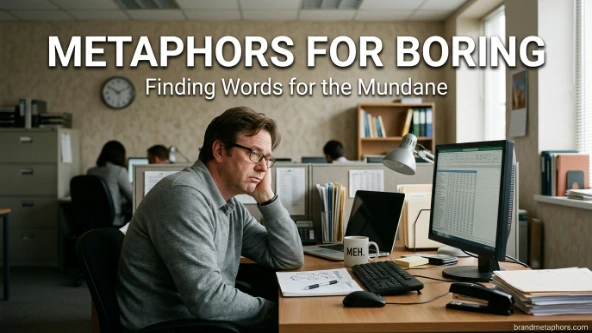
Introduction: When Time Starts Moving Like Cold Honey
There are moments when time doesn’t just pass—it drags itself across the floor. Like a tired animal refusing to move. The clock ticks, but each sound feels exaggerated, almost mocking. A pen taps the desk. A ceiling fan spins with mechanical indifference. And your thoughts? They start wandering like passengers waiting for a train that may never arrive.
This is boredom—not just emptiness, but a strangely heavy kind of stillness. Everyone experiences it, whether during a long lecture, a dull meeting, a slow afternoon, or even an uneventful conversation that refuses to end.
But boredom is not just a feeling; it is also a powerful creative tool in language. Writers, poets, and speakers often rely on metaphors for boring to bring this invisible emotion to life. Instead of saying “it was boring,” they paint it as something tangible: a broken clock, a grey fog, or a desert with no wind.
Understanding and using these metaphors is important because they:
- Enrich storytelling and emotional expression
- Help readers feel rather than just understand
- Make writing more vivid, memorable, and engaging
In this article, we’ll explore powerful metaphors for boredom, break them down into meaning and usage, and learn how to apply them creatively in writing, conversation, and even social media storytelling.
Metaphors for Boring: Why We Need Creative Language for Emptiness
Boredom is difficult to describe because it is often the absence of excitement rather than its presence. That’s why metaphors become essential—they fill the gap left by dullness with imagery.
Instead of saying:
“The lecture was boring.”
We can say:
“The lecture felt like watching paint dry in a room with no windows.”
The second version creates a mental image. It gives boredom shape, texture, even temperature.
Metaphors for boring are especially useful in:
- Creative writing and storytelling
- Blogging and content creation
- Humor and sarcasm
- Personal reflection and journaling
Now let’s explore some of the most vivid and expressive metaphors you can use.
1. “Like Watching Paint Dry” – The Slow Collapse of Time
Meaning & Explanation
This is one of the most classic metaphors for boredom. It suggests extreme slowness and lack of stimulation—so uneventful that even watching drying paint would feel more engaging.
Example Sentence
“The meeting was like watching paint dry under a flickering office light.”
Sensory & Emotional Detail
You can almost feel the dryness in the air, the stiffness of your posture, the weight of waiting.
Alternative Expressions
- “Like counting grains of sand one by one”
- “Like waiting for grass to grow in winter”
- “Like listening to silence stretch itself thin”
Mini Story
A student sits in a classroom where the teacher’s voice blends into a low hum. Outside, birds fly freely. Inside, the wall clock refuses to move. He realizes later that he spent ten minutes staring at a single crack in the wall—studying it like it was the most interesting thing in the world.
Writing Tip
Use this metaphor when describing meetings, lectures, or anything painfully slow-paced.
2. “A Desert With No Wind” – Emotional Emptiness and Stagnation
Meaning & Explanation
A desert is already empty, but adding “no wind” intensifies the stillness. It represents not just boredom, but motionless boredom—nothing changes, nothing arrives.
Example Sentence
“The afternoon stretched like a desert with no wind, endless and unmoving.”
Sensory & Emotional Detail
Dry air. Static heat. A silence so deep it feels physical.
Alternative Expressions
- “Like a frozen ocean with no waves”
- “Like a sky without clouds or birds”
- “Like a clock stuck at the same second”
Cultural Reference
In literature, deserts often symbolize isolation and time distortion. Many travel writers describe desert journeys as places where “time forgets to move.”
Interactive Prompt
Think of your last boring moment. Was it more like a desert or a frozen room? Rewrite it using this metaphor.
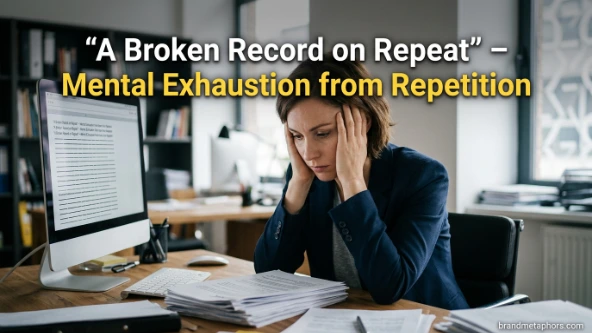
3. “A Broken Record on Repeat” – Mental Exhaustion from Repetition
Meaning & Explanation
This metaphor comes from old vinyl records that would skip and repeat the same sound. It symbolizes boredom caused by repetition or predictable cycles.
Example Sentence
“His explanation was a broken record on repeat, looping the same idea again and again.”
Sensory & Emotional Detail
Monotony builds like background noise. Attention fades. Frustration grows quietly.
Alternative Expressions
- “Like a looped video with no end button”
- “Like déjà vu with no meaning”
- “Like a song stuck on one note”
Mini Story
During a training session, the instructor repeats the same safety rule for the fifth time. The participants begin finishing his sentences. One person quietly draws shapes on a notepad that resemble escape routes.
Writing Tip
Perfect for describing repetitive speeches, routines, or conversations that go nowhere.
Metaphors for Boring in Daily Life: Why They Matter
Boredom isn’t just an inconvenience—it’s a shared human experience. When we describe it creatively, we transform something dull into something meaningful.
Metaphors allow us to:
- Communicate emotional nuance
- Add humor or exaggeration
- Make storytelling more relatable
- Turn everyday complaints into expressive art
Even social media captions become more engaging when boredom is described creatively.
4. “A Room With No Doors” – Trapped in Stillness
Meaning & Explanation
This metaphor suggests being stuck in a situation where escape or change feels impossible. It reflects mental confinement caused by boredom.
Example Sentence
“The long afternoon felt like a room with no doors—silent, sealed, and endless.”
Sensory & Emotional Detail
Claustrophobic stillness. No sound of movement. Time feels trapped too.
Alternative Expressions
- “Like a cage made of silence”
- “Like a hallway that never ends”
- “Like being paused in a forgotten film”
Cultural Reference
Many existential writers describe boredom as a form of “soft imprisonment,” where nothing actively harms you, but nothing frees you either.
Interactive Exercise
Write a short paragraph describing your last boring experience using the idea of confinement.
5. “Fog That Refuses to Lift” – Mental Dullness and Disconnection
Meaning & Explanation
Fog symbolizes unclear thinking and emotional dullness. When it “refuses to lift,” boredom becomes persistent and heavy.
Example Sentence
“My thoughts were wrapped in fog that refused to lift during the lecture.”
Sensory & Emotional Detail
Blurred vision. Slowed thinking. A soft mental heaviness.
Alternative Expressions
- “Like mental static on a broken radio”
- “Like thinking through thick glass”
- “Like walking in clouds that never clear”
Mini Story
A writer sits at her desk trying to work, but every idea dissolves before becoming words. Outside, sunlight breaks through the window. Inside, her mind remains weatherless and grey.
Writing Tip
Use this metaphor when describing mental fatigue or emotional boredom.
6. “A Clock That Forgot Its Purpose” – Lost Meaning in Time
Meaning & Explanation
This metaphor gives boredom an emotional twist: time still exists, but it feels meaningless.
Example Sentence
“The afternoon felt like a clock that forgot its purpose.”
Sensory & Emotional Detail
Ticking sounds feel empty. Minutes lose identity.
Alternative Expressions
- “Like time without direction”
- “Like a calendar with blank pages”
- “Like seconds that don’t add up”
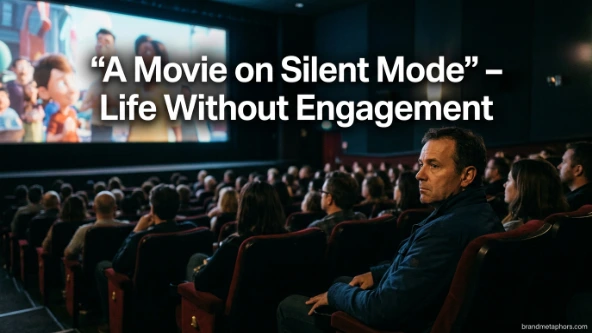
7. “A Movie on Silent Mode” – Life Without Engagement
Meaning & Explanation
This metaphor suggests life continuing, but without emotional or sensory stimulation.
Example Sentence
“The presentation felt like a movie on silent mode—everything visible, nothing felt.”
Sensory & Emotional Detail
Visual input without emotional connection.
Alternative Expressions
- “Like life without subtitles or sound”
- “Like watching a story through glass”
- “Like color without brightness”
Interactive Creative Practice: Turn Your Boredom into Language
Try this exercise:
- Recall a recent boring moment
- Choose one metaphor category (desert, fog, clock, silence, repetition)
- Rewrite your experience using that image
- Add one sensory detail (sound, texture, temperature, or emotion)
Example:
“The waiting room became a fogged aquarium of silence where time floated without direction.”
This practice helps you develop expressive writing skills and emotional awareness.
Bonus Tips: Using Metaphors for Boring in Writing and Social Media
- In storytelling: Use metaphors to slow down or emphasize emotional flatness
- In blogging: Replace “boring” with imagery to increase engagement
- In humor: Exaggerated boredom metaphors can create comedic effect
- In captions: “This meeting was a desert with WiFi.” (adds relatability)
- In journaling: Helps process emotions more creatively
Metaphors for Boring in Literature and Culture
Writers like Franz Kafka and Albert Camus often explored boredom as existential weight. In their works, boredom isn’t just dullness—it becomes a reflection of human existence itself.
Even modern cinema uses visual metaphors: long static shots, empty rooms, or repetitive scenes to evoke boredom intentionally.
In everyday culture, we use phrases like:
- “Dead silence”
- “Staring into space”
- “Time stood still”
These are all metaphors shaping how we understand boredom emotionally.
Conclusion
Boredom may feel empty, but language fills it with meaning. Through metaphors, we transform dull moments into vivid images—deserts, clocks, fog, silence, and endless rooms.
Instead of rejecting boredom, writers often use it. It becomes a canvas for creativity, a pause where imagination quietly stretches its legs.
The next time time feels slow or life feels still, don’t just say “I’m bored.” Say something that lives longer in memory:
“Time turned into cold honey, dripping too slowly to notice.”
Because even boredom, when named well, becomes beautiful.
FAQs: Metaphors for Boring
1. What are metaphors for boring used for?
They are used to creatively describe boredom in a vivid and imaginative way instead of using plain words like “boring.”
2. Why are metaphors better than saying something is boring?
Metaphors create imagery and emotion, making writing more engaging and memorable.
3. Can metaphors for boredom be humorous?
Yes, exaggerated metaphors like “a meeting longer than a Monday without coffee” can be funny and relatable.
4. Where can I use these metaphors?
You can use them in essays, storytelling, social media captions, blogs, and creative writing.
5. How can I create my own boredom metaphors?
Think of slow, repetitive, or empty experiences in nature or objects—then connect them emotionally to your situation.
If you want, I can also create:
- 100 short metaphors for boredom (quick reference list)
- Or SEO blog version optimized for ranking
- Or poetic version of this article