

Metaphors for Being Sick and Why We Use Them in Everyday Life
The hidden poetry of illness
There are days when the body refuses to cooperate. Your head feels like it’s wrapped in thick wool, your bones ache like they’ve been gently cracked and glued back together, and even breathing feels like work. In such moments, people rarely say, “I have a viral infection with fatigue symptoms.” Instead, they say, “I feel like I’ve been hit by a truck,” or “My body is shutting down.”
Metaphors become the bridge between physical pain and emotional understanding. They turn invisible discomfort into shared human language.
Why metaphors matter in sickness narratives
When someone is sick, they are not only describing a condition—they are trying to communicate an experience that is hard to measure or see. Metaphors help others feel what the sick person feels. They also help the sick person make sense of what is happening inside their body.
In short, metaphors transform medical silence into emotional expression.
The Language of Illness: Why Metaphors for Being Sick Matter
Turning pain into communication
Pain is private. Language is shared. Metaphors connect the two. Saying “my fever is a wildfire” instantly paints a picture that “I have a high temperature” cannot.
Cultural and emotional framing
Different cultures use different metaphors:
- Some see illness as imbalance.
- Others see it as invasion.
- Others view it as punishment or test.
These shapes influence how people respond emotionally and socially to sickness.
Mini reflection
Think about the last time you were sick. Did you describe it literally—or did you reach for imagery like storms, weight, or machines breaking down?
Being Sick as a Storm Inside the Body (Featured Metaphor 1)
Meaning and explanation
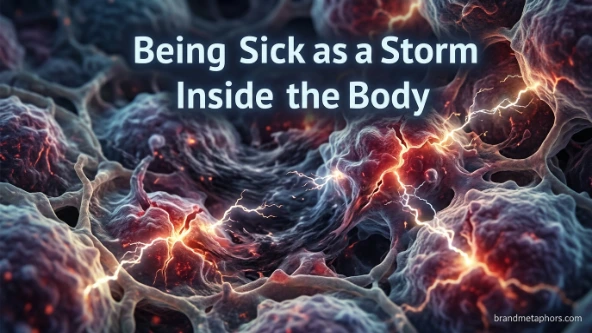
One of the most common metaphors for illness is the storm. The body becomes a sky filled with turbulence—fever as lightning, chills as cold winds, headaches as rolling thunder.
This metaphor captures unpredictability. Illness often arrives suddenly and overwhelms everything.
Example sentence or scenario
“The flu hit her like a violent storm, every muscle aching as if thunder were echoing through her bones.”
Alternative expressions
- “A hurricane inside my body”
- “Weather chaos in my system”
- “Internal thundercloud”
Sensory and emotional detail
You can almost hear it: the rushing pressure in your ears, the heat rising like humid air before rain. Emotionally, it feels uncontrollable, like being trapped outdoors during a storm with no shelter.
Mini storytelling
A student wakes up before an exam day. Instead of studying, she lies under blankets as fever rolls through her like waves of storm wind. Outside, the sky is calm—but inside her body, it is chaos without silence.
Being Sick as a Broken Machine (Featured Metaphor 2)
Meaning and explanation
Here, the body is imagined as a machine that is malfunctioning. Organs become parts, energy becomes fuel, and illness becomes mechanical failure.
This metaphor is especially common in modern and medical contexts because it helps people understand the body scientifically.
Example sentence or scenario
“His body felt like an old engine refusing to start, each movement grinding like rusted gears.”
Alternative expressions
- “My system is glitching”
- “Body on low battery mode”
- “Internal shutdown”
Sensory and emotional detail
There is a heaviness in every motion. Arms feel slow, thoughts lag like broken software. Emotionally, it brings frustration—like being trapped in a machine that no longer responds correctly.
Mini storytelling
A worker tries to get out of bed but feels like a robot with drained batteries. Each step is delayed, each breath slow. He jokes weakly, “I need a factory reset,” but deep down he wonders why his “system” has failed him.
Being Sick as a Battle or War (Featured Metaphor 3)
Meaning and explanation
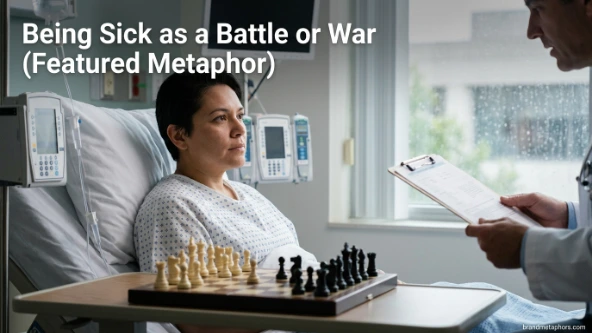
Illness is often described as a war: the body becomes a battlefield, immune cells become soldiers, and disease becomes an invading enemy.
This metaphor creates urgency and determination but can also add pressure.
Example sentence or scenario
“She fought the infection with every breath, as if her body were a fortress under siege.”
Alternative expressions
- “Fighting off sickness”
- “Battling a virus”
- “Defending my body”
Sensory and emotional detail
There is tension in every moment—like standing guard during an invisible attack. Emotionally, it can feel empowering but also exhausting, as if rest is weakness in a long war.
Mini storytelling
A father recovering from flu imagines his immune system as soldiers on a cold battlefield. Each sip of water feels like supplying troops. Each hour of sleep is reinforcement for the fight ahead.
Being Sick as a Foggy Journey Through the Body
Lost paths and unclear steps
Illness can also feel like walking through a forest covered in fog. Nothing is fully visible. Energy is low, direction unclear.
Example sentence
“He moved through the day like a traveler lost in thick fog, unsure where his strength had gone.”
Emotional meaning
This metaphor highlights confusion and vulnerability rather than aggression or breakdown.
Alternative expressions
- “Walking through haze”
- “Lost in a fog of fatigue”
- “Clouded journey”
Being Sick as Ocean Waves of Fatigue and Recovery
Rising and falling energy
Some illnesses don’t stay constant. They come in waves—better one moment, worse the next. The ocean metaphor captures this rhythm.
Example sentence
“Her energy rose and fell like tides she could not control.”
Sensory detail
There’s a rhythmic exhaustion—moments of calm followed by sudden crashes of weakness.
Emotional meaning
This metaphor teaches patience: healing is not straight, but cyclical.
Being Sick as a Candle Burning Low

Fading energy and slow recovery
Here, the body is a candle slowly melting away its wax. Energy is flame; sickness reduces brightness.
Example sentence
“He felt like a candle burning at its end, flickering with every breath.”
Emotional depth
This metaphor is gentle and quiet. It emphasizes fragility rather than chaos.
Interactive Exercises: Create Your Own Metaphors for Being Sick
Exercise 1: Finish the sentence
Complete these prompts:
- “My illness feels like…”
- “My body is a…”
- “My energy moves like…”
Exercise 2: Sensory mapping
Write down:
- How does your sickness feel (texture)?
- How does it sound?
- How does it move?
Then convert each into a metaphor.
Exercise 3: Story rewriting
Take a simple sentence like: “I am sick with fever.” Rewrite it using metaphor: “A wildfire of heat runs through my body.”
Creative goal
Try to create at least three original metaphors that feel personal and emotionally accurate.
Bonus Tips for Using Metaphors for Being Sick in Writing and Daily Life
In storytelling and poetry
Use metaphors to add emotional depth. Instead of stating symptoms, describe experiences.
In social media
Short metaphors work best:
- “Running on empty batteries today.”
- “Body in storm mode.”
In daily conversation
Metaphors help others understand your condition without medical detail:
- “I’m in fog mode today.”
- “My body is buffering.”
FAQs About Metaphors for Being Sick
What are metaphors for being sick?
They are figurative expressions that describe illness using imagery like storms, machines, battles, or journeys.
Why do people use metaphors when they are sick?
Because illness is hard to explain directly, metaphors help express pain and emotional experience more clearly.
Are illness metaphors universal?
Many are universal, but cultural background can shape how people describe sickness.
Can metaphors help emotional healing?
Yes, they can help people process feelings and communicate discomfort more effectively.
What is the most common metaphor for being sick?
The most common is comparing illness to a storm or battle inside the body.
Conclusion
Metaphors for being sick are more than poetic language—they are emotional tools. They help us translate invisible suffering into shared understanding. Whether illness feels like a storm, a broken machine, a fading candle, or a foggy journey, each metaphor gives shape to something otherwise hard to hold.
In the end, language doesn’t just describe sickness—it helps us survive it, understand it, and sometimes even soften it.