
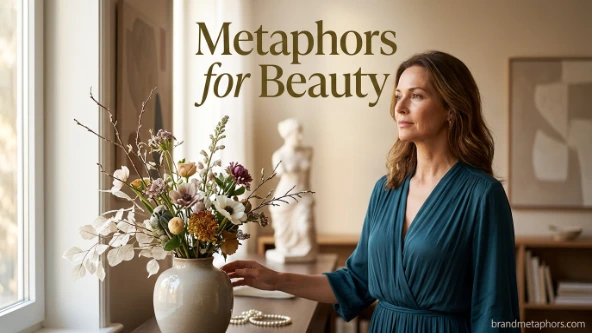
Introduction: When Beauty Feels Like a Whisper in the Air
Have you ever walked into a moment so quietly breathtaking that words almost refused to form? Like standing in front of a sunrise where the sky feels like it is slowly opening its eyes, or watching someone smile in a way that makes the whole room feel warmer without any visible change in temperature?
Beauty is often not loud. It doesn’t announce itself. Instead, it arrives like a soft wind brushing past your thoughts, leaving something behind that you cannot quite name—but you can feel it.
This is where metaphors for beauty become powerful. They help us translate the untranslatable. They give shape to something emotional, abstract, and deeply human. Instead of simply saying “she is beautiful” or “that place is beautiful,” metaphors allow us to say: she is a sunrise wrapped in human skin or that valley is a sleeping poem.
Understanding and using metaphors for beauty is not just a literary exercise. It is a way of seeing the world more deeply, expressing feelings more vividly, and even appreciating everyday life with more attention and gratitude.
Let’s step into this world where beauty becomes language, and language becomes art.
H2: What Are Metaphors for Beauty and Why They Matter
H3: Understanding the Core Idea
Metaphors for beauty are expressions that describe beauty by comparing it to something else—often something natural, emotional, or symbolic. Instead of stating beauty directly, they reveal it.
For example:
- “Her presence is a garden in bloom.”
- “His smile is morning sunlight breaking through fog.”
H3: Why They Matter in Writing and Life
Metaphors make beauty feel alive rather than static. They:
- Deepen emotional impact
- Help readers visualize abstract feelings
- Make descriptions more memorable
- Add artistic depth to communication
H3: Real-Life Reflection
Think about how people remember poetry, lyrics, or even movie dialogues. It’s rarely the plain descriptions—they remember the images. Metaphors turn beauty into something that lingers in memory.
H2: Beauty as Nature’s Language
H3: Metaphor – “Beauty is a Blooming Garden”
Meaning: Beauty grows, evolves, and changes like flowers in a garden.
Example:
- “Her beauty is a garden that never stops blooming, even in winter.”
Alternative expressions:
- A field of wildflowers
- A spring that never dries
Mini-story: Imagine a small courtyard where flowers grow wildly without planning. That is how natural beauty often feels—uncontrolled yet perfect in its own way.
H3: Sensory Detail
Soft petals, morning dew, earthy scent—this metaphor appeals to touch, sight, and smell.
H3: Interactive Prompt
Describe someone you admire using a nature-based metaphor. Are they a forest, a river, or a mountain sunrise?
H2: Beauty as Light and Illumination
H3: Metaphor – “Beauty is Light Breaking Through Shadows”
Meaning: Beauty brings clarity, hope, or emotional warmth.
Example:
- “Her smile is light slipping through a cracked window after a storm.”
Alternative expressions:
- A glowing lantern
- Sunlight on cold stone
H3: Cultural Reference
Many cultures associate beauty with light—symbolizing purity, truth, and life itself.
H3: Emotional Layer
This metaphor often connects beauty with healing or emotional relief.
H3: Writing Exercise
Write three sentences describing beauty using different types of light: morning, candlelight, and lightning.
H2: Beauty as Music and Rhythm
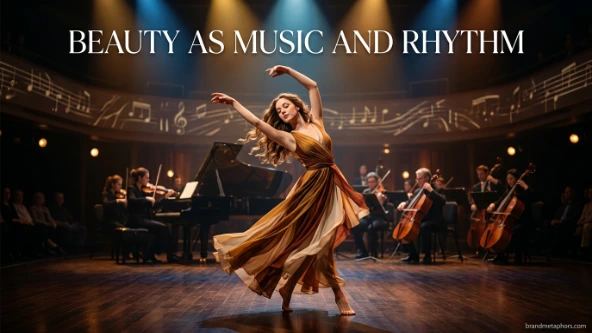
H3: Metaphor – “Beauty is a Silent Song”
Meaning: Beauty carries rhythm and emotional harmony, even without sound.
Example:
- “Her presence moves like a melody only the heart can hear.”
Alternative expressions:
- A soft symphony
- A rhythm of grace
H3: Mini Story
Imagine walking into a room where everything feels perfectly balanced—not loud, not chaotic, just harmonized. That feeling is what this metaphor captures.
H3: Sensory Angle
Even silence feels musical here.
H3: Creative Prompt
Think of a person or place and describe its “hidden music.”
H2: Beauty as Art and Creation
H3: Metaphor – “Beauty is a Painting Still Wet with Color”
Meaning: Beauty feels freshly created, expressive, and alive.
Example:
- “Her face is like a portrait painted by emotions themselves.”
Alternative expressions:
- A sculpture shaped by dreams
- A canvas touched by emotion
H3: Cultural Reflection
From Renaissance art to modern design, beauty has often been treated as an artistic creation.
H3: Emotional Depth
This metaphor suggests intentionality and artistry in existence itself.
H3: Exercise
Describe your daily environment as if it were a gallery.
H2: Beauty as Time and Memory
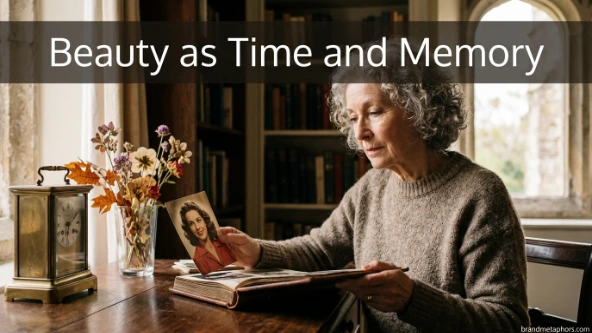
H3: Metaphor – “Beauty is a Memory That Refuses to Fade”
Meaning: Beauty is tied to moments that stay alive in the mind.
Example:
- “Her laughter is a memory that still echoes years later.”
Alternative expressions:
- A photograph in the heart
- A moment stitched into time
H3: Story Element
Think of childhood places that still feel beautiful even after years have passed.
H3: Emotional Impact
This metaphor connects beauty with nostalgia and longing.
H3: Prompt
Write about a beautiful memory using sensory details.
H2: Beauty as Water and Flow
H3: Metaphor – “Beauty is a River in Motion”
Meaning: Beauty is dynamic, ever-changing, and fluid.
Example:
- “Her elegance flows like water over smooth stones.”
Alternative expressions:
- A waterfall of grace
- A tide of softness
H3: Sensory Detail
Coolness, movement, reflection—water metaphors bring visual calmness.
H3: Mini Reflection
Nothing in water stays still, yet it remains beautiful at every moment.
H3: Exercise
Describe beauty that changes over time—like seasons or emotions.
H2: Beauty as Stars and Cosmic Wonder
H3: Metaphor – “Beauty is a Sky Full of Quiet Stars”
Meaning: Beauty is vast, mysterious, and infinite.
Example:
- “Her eyes hold galaxies of untold stories.”
Alternative expressions:
- A constellation of emotion
- A universe of grace
H3: Cultural Reference
Ancient civilizations often linked beauty with the cosmos and divine order.
H3: Emotional Layer
This metaphor evokes awe and humility.
H3: Creative Task
Describe a person as if they belong to space.
H2: Beauty as Emotion and Inner World
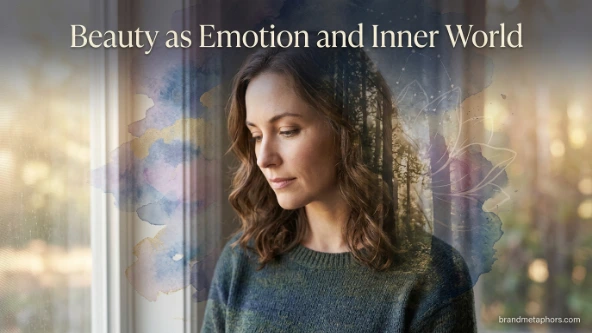
H3: Metaphor – “Beauty is an Ocean Inside the Soul”
Meaning: Beauty is deep, emotional, and layered.
Example:
- “His kindness feels like an ocean without end.”
Alternative expressions:
- A sea of warmth
- A depth of feeling
H3: Mini Story
Imagine meeting someone calm on the outside but filled with emotional depth inside.
H3: Sensory Detail
Stillness on the surface, movement underneath.
H3: Prompt
Describe inner beauty without using physical appearance.
H2: Beauty as Everyday Magic
H3: Metaphor – “Beauty is a Spark in Ordinary Moments”
Meaning: Beauty exists in daily life, not just extraordinary scenes.
Example:
- “Even a cup of tea at dawn feels like a quiet miracle.”
Alternative expressions:
- A flicker in routine life
- A hidden shimmer in the ordinary
H3: Real-Life Insight
Beauty is often noticed in small details—a shared laugh, warm sunlight, or gentle silence.
H3: Exercise
Write three ordinary moments and turn them into metaphors.
H2: Using Metaphors for Beauty in Writing and Life
Writing Tips
- Use nature and emotion together
- Avoid over-explaining the metaphor
- Keep imagery simple but powerful
Social Media Use
- “Her confidence is sunrise energy.”
- “Monday feels like a cloudy ocean—but we sail anyway.”
Daily Life Application
Metaphors help you notice beauty more intentionally, making ordinary experiences feel richer.
H3: Practice Challenge
Write one metaphor for beauty every day for a week.
Conclusion
Beauty is not a fixed definition—it is a language of perception. When we use metaphors, we don’t just describe beauty; we reimagine it. We turn faces into constellations, moments into music, and ordinary life into poetry.
The more you practice seeing beauty metaphorically, the more the world begins to feel alive with meaning. A street is no longer just a street—it becomes a river of footsteps. A smile is no longer just a smile—it becomes sunlight learning how to speak.
Beauty, in the end, is not only what we see. It is how we choose to see it.
FAQs
What are metaphors for beauty?
They are expressive comparisons that describe beauty using symbolic or imaginative imagery instead of direct language.
Why are metaphors important in describing beauty?
They make descriptions more vivid, emotional, and memorable, helping readers feel beauty rather than just understand it.
Can metaphors improve writing skills?
Yes, they enhance creativity, deepen expression, and make writing more engaging and impactful.
What are common themes in beauty metaphors?
Nature, light, music, emotions, water, and cosmic imagery are frequently used.
How can I practice writing beauty metaphors?
Start by observing everyday moments and comparing them to natural or emotional images, then expand your descriptions creatively.