
There are moments in life when everything feels slightly off—like the air has thickened, the light has dimmed, and even ordinary sounds carry a strange weight. A missed opportunity, a harsh word, a sudden setback, or a slow-burning disappointment can feel too large to describe directly. That’s where language quietly steps in and offers something powerful: metaphors.
Metaphors for bad things are not about softening reality—they are about shaping it into something we can understand, process, and even survive. When we say “life hit a rough patch” or “everything fell apart like a broken clock,” we are not escaping truth; we are translating it into images the mind can hold.
This article explores how metaphors help us describe negative experiences in creative, meaningful, and emotionally intelligent ways. You’ll find vivid comparisons, real-life storytelling, writing inspiration, and practical exercises to use these expressions in everyday life.
H2: Understanding Metaphors for Bad Things in Emotional Language
H3: What These Metaphors Really Do
Metaphors for negative experiences act like emotional translators. They turn abstract pain into something visual, tangible, and relatable. Instead of saying “I feel overwhelmed,” we might say “I’m drowning in unfinished tasks.” The meaning becomes clearer, deeper, and more human.
H3: Why They Matter in Real Life
We use these metaphors in conversations, writing, therapy, storytelling, and even social media. They help others understand what we’re going through without needing long explanations. They also help us process emotions by giving them shape.
H2: Life as a Storm – When Everything Feels Uncontrollable
H3: Meaning and Emotional Depth
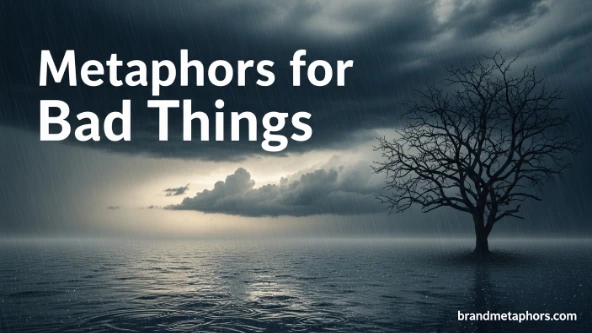
One of the most common metaphors for bad things is the idea of life as a storm. Storms represent chaos, unpredictability, and emotional turbulence.
H3: Example in Real Life
“She’s going through a storm right now; nothing feels stable.”
H3: Alternative Expressions
- Weathering chaos
- Caught in emotional turbulence
- A thunderous phase of life
H3: Sensory Detail
You can almost hear the thunder of stress, see the dark clouds of uncertainty, and feel the wind of change pushing everything off balance.
H3: Mini Story
A student preparing for exams, dealing with family pressure and financial stress, once described her life as “standing in the middle of a storm without an umbrella.” That simple image captured everything she couldn’t say out loud.
H2: Life Falling Apart Like a Broken Machine
H3: Meaning and Interpretation
This metaphor describes situations where multiple things fail at once—like systems breaking down.
H3: Example Sentence
“After losing his job and car in the same week, his life felt like a machine with missing parts.”
H3: Alternative Phrases
- Systems collapsing
- Everything malfunctioning
- Life in breakdown mode
H3: Emotional Tone
This metaphor often carries frustration and helplessness, as if life has become unpredictable and unfixable.
H2: Bad Things as Shadows That Follow You
H3: Symbolism of Shadows
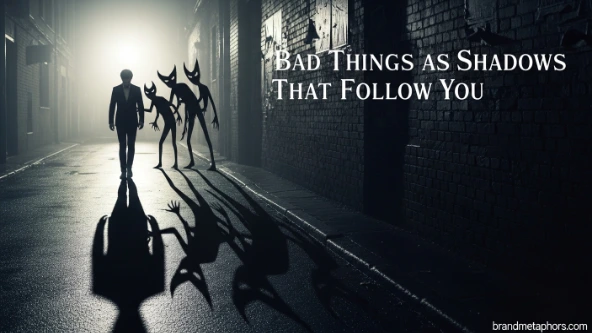
Shadows represent lingering problems, fears, or trauma that stay even when the “light” changes.
H3: Example Usage
“His past mistakes followed him like a shadow he couldn’t escape.”
H3: Variations
- Lingering darkness
- Emotional echo
- Past that clings like smoke
H3: Cultural Reference
In literature, shadows often symbolize guilt or hidden fears, especially in psychological dramas and gothic storytelling.
H2: Emotional Weight as a Heavy Backpack
H3: Meaning Behind the Metaphor
This metaphor describes burdens like stress, grief, or responsibility.
H3: Example Scenario
“She walked through life carrying a backpack full of worries no one could see.”
H3: Alternative Expressions
- Carrying invisible weight
- Burdened shoulders
- Emotional load
H3: Sensory Detail
You can almost feel the pressure pressing down on the back, slowing every step, making even small tasks exhausting.
H2: Bad Events as Cracks in Glass
H3: Meaning and Symbolism
Cracks in glass symbolize fragility and damage that spreads over time.
H3: Example Sentence
“One small lie created cracks in their friendship that never fully healed.”
H3: Alternative Phrases
- Fractured trust
- Breaking point
- Shattered foundation
H3: Mini Story
A family argument that started over something small eventually spread like cracks in a window, until silence replaced conversation.
H2: Emotional Pain as Fire Burning Inside
H3: Meaning and Intensity
Fire metaphors represent intense emotional pain, anger, or regret.
H3: Example Usage
“He carried a fire of regret that never seemed to go out.”
H3: Alternative Expressions
- Burning inside
- Emotional heat
- Scorching memory
H3: Sensory Detail
The sensation feels like heat behind the chest—constant, consuming, and impossible to ignore.
H2: Bad Situations as Dark Forests Without Paths
H3: Meaning of the Metaphor
A dark forest represents confusion, fear, and lack of direction.
H3: Example Sentence
“She felt lost in a dark forest of decisions with no clear way out.”
H3: Alternative Expressions
- Maze of uncertainty
- No-clear-road situation
- Fog of confusion
H3: Cultural Reference
Fairy tales often use forests as places of danger and transformation, symbolizing life’s uncertain phases.
H2: Interactive Exercises for Creative Metaphor Practice
H3: Exercise 1 – Turn Emotion into Weather
Write your current emotional state as a weather pattern. Example: “My stress is a constant drizzle that never stops.”
H3: Exercise 2 – Object Comparison Challenge
Pick one problem and compare it to an object in your house. Example: “My deadline feels like a ticking alarm clock I can’t turn off.”
H3: Exercise 3 – Rewrite a Bad Day
Take a difficult day and describe it only using metaphors instead of direct statements.
H3: Bonus Tip
Use metaphors in journaling or social media captions to make emotional expression more relatable and engaging.
H2: Using Metaphors for Bad Things in Writing and Daily Life
H3: In Creative Writing
Writers use metaphors to add emotional depth and imagery. Instead of saying “he was sad,” you might write “he was a closed window on a rainy afternoon.”
H3: In Conversations
Metaphors help explain feelings when direct words feel too heavy or unclear.
H3: In Social Media
Short metaphorical phrases often resonate more deeply than long explanations.
H3: Practical Tip
Keep a “metaphor notebook” where you collect creative comparisons from daily life.
H2: Psychological Power Behind Negative Metaphors
H3: How the Mind Understands Them
The brain processes images faster than abstract language. That’s why metaphors make emotional experiences easier to understand.
H3: Emotional Release
Describing pain through imagery can reduce emotional pressure by externalizing feelings.
H3: Communication Effect
Metaphors create empathy, helping others feel what you feel without detailed explanation.
H2: Common Mistakes When Using Negative Metaphors
H3: Overuse of Clichés
Phrases like “broken heart” or “dark times” can lose impact if used too often.
H3: Lack of Personal Detail
Generic metaphors may feel distant. Personal, sensory-based comparisons feel more powerful.
H3: Over-Dramatization
Too many extreme metaphors can make writing feel exaggerated instead of authentic.
H2: Expanding Your Metaphor Vocabulary for Life Challenges
H3: Observation Practice
Notice how people around you describe difficulties.
H3: Reading Inspiration
Books, poetry, and songs are rich sources of metaphorical language.
H3: Daily Experiment
Try describing one small inconvenience in three different metaphorical ways each day.
H2: Conclusion – Turning Struggle into Language That Heals
Bad things are part of life, but language gives us a way to hold them without being overwhelmed. Metaphors transform pain into pictures, confusion into clarity, and emotional weight into something we can express and share.
They don’t erase difficulty—but they make it speakable. And when something can be spoken, it can also be understood, shared, and slowly healed.
FAQs
H3: What are metaphors for bad things?
They are creative comparisons used to describe negative experiences like stress, sadness, or failure in more vivid, emotional ways.
H3: Why do we use metaphors for negative emotions?
Because they help express complex feelings in simple, relatable images that others can understand easily.
H3: Are metaphors useful in writing?
Yes, they add depth, imagery, and emotional impact to both creative and everyday writing.
H3: Can metaphors help with emotional healing?
Yes, they can help people process emotions by giving abstract feelings a clearer form.
H3: What is a good example of a bad-things metaphor?
“Life feels like a storm with no shelter” is a common example showing chaos and emotional struggle.