
Introduction
Good writing is more than using correct grammar. It is also about choosing the right words for the right situation. Writers, students, and English learners improve their communication by understanding vocabulary, figurative language, and the emotional effect of words. Whether you are writing a story, giving a speech, sending an email, or talking with friends, word choice can completely change your message.
Creative writing often includes descriptive language, literary devices, idioms, similes, metaphors, and expressive vocabulary. These tools help readers imagine scenes, understand emotions, and connect with characters. However, knowing the difference between informal expressions and offensive language is just as important. Many learners become confused by terms that seem similar but have different meanings and uses.
This guide explains the difference between cuss words and curse words in clear, simple language. You will learn what each term means, where they come from, when they are appropriate, and when they should be avoided. You will also find comparison tables, sentence examples, writing tips, common mistakes, exercises, and frequently asked questions to help build your English vocabulary and writing skills.
What Are Cuss Words?
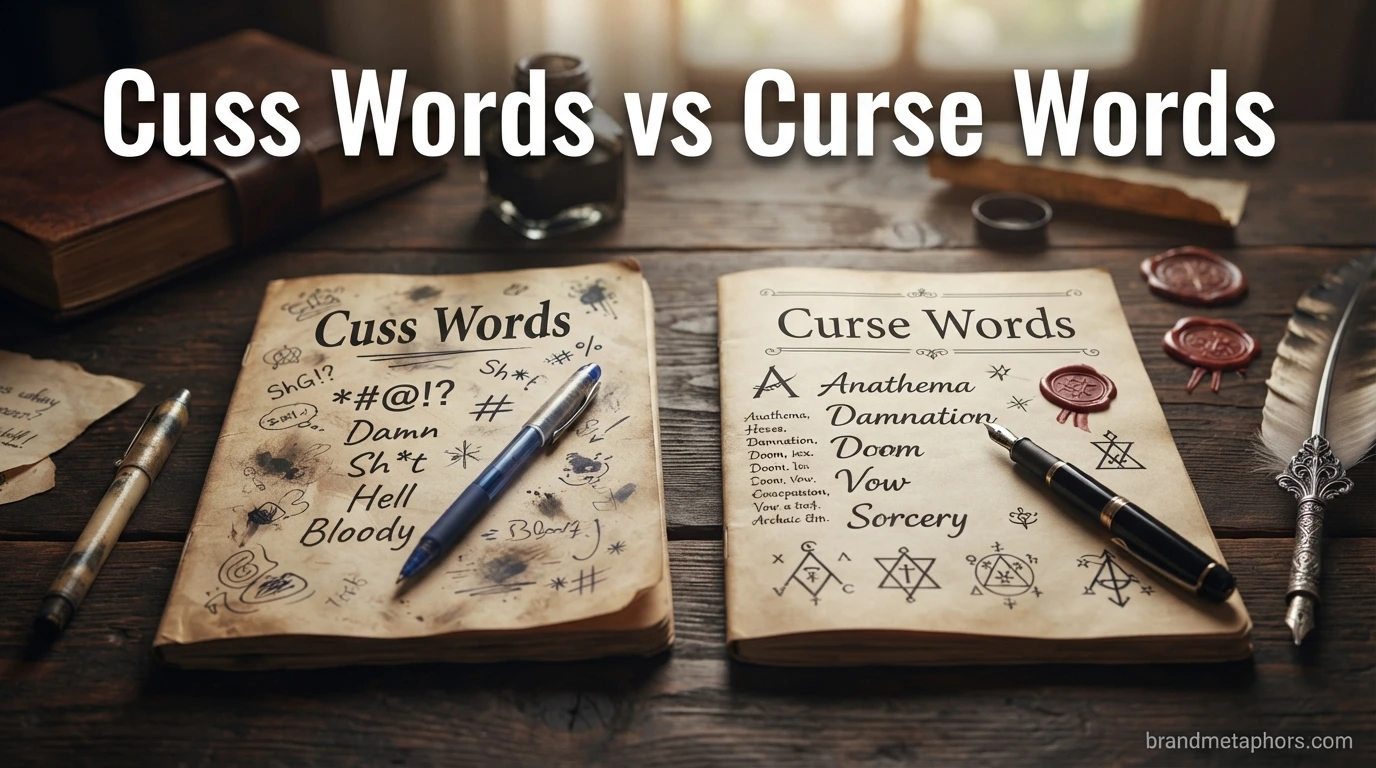
Cuss words are informal words or expressions that people use to show strong emotions such as anger, frustration, surprise, excitement, or pain. They are often considered rude or impolite, although the level of offensiveness depends on culture, age, and situation.
People commonly use them in casual conversations, movies, novels, and online discussions. They are usually not suitable for formal communication.
Characteristics
- Express strong emotions
- Often considered vulgar or offensive
- Common in spoken English
- Usually avoided in professional settings
- Can lose strength when used too often
Example Sentences
- He shouted a cuss word after dropping the heavy box.
- The character used several rude expressions during the argument.
- My teacher asked us not to use offensive language in class.
- The movie contains strong language intended for adults.
What Are Curse Words?
Originally, a curse word referred to words used to place a curse, wish harm, or call bad luck upon someone. Long ago, people believed spoken words could have magical or spiritual power.
Today, many English speakers use “curse words” as another name for swear words or profanity. However, the original meaning is still important in literature, mythology, religion, and history.
Traditional Meaning
A curse word was connected to:
- Magic
- Religion
- Superstition
- Wishing harm
- Ancient rituals
Modern Meaning
In everyday English, many dictionaries treat “curse word” as another term for profanity or swearing.
Example Sentences
- The old legend says the witch spoke a terrible curse.
- The king believed he had been cursed.
- Many people use the phrase “curse word” to mean a swear word.
- The novel describes an ancient curse affecting the entire village.
Quick Comparison Table
FeatureCuss WordsCurse WordsMain purposeExpress emotionOriginally wish harm or bad luckModern meaningProfanity or rude languageOften another word for profanityHistorical meaningNoYesUsed in casual speechVery oftenSometimesUsed in literatureYesFrequently in fantasy and mythologyFormal writingUsually avoidedDepends on contextEmotional impactStrongStrong or symbolic
History and Origin of Both Terms
Understanding word origins helps improve vocabulary and reading comprehension.
Origin of “Cuss”
“Cuss” developed as a shortened pronunciation of “curse” in American English during the nineteenth century. Over time, it became its own word referring mainly to rude or offensive speech.
Origin of “Curse”
The word “curse” comes from very old Germanic languages. It originally described speaking words intended to bring punishment, suffering, or bad fortune.
As English changed over hundreds of years, many speakers began using “curse word” as another expression for profanity.
Why People Use Strong Language

Language expresses emotions. Strong words often appear when people experience intense feelings.
Common reasons include:
- Anger
- Fear
- Excitement
- Surprise
- Pain
- Frustration
- Humor
- Group identity
Example
Instead of calmly saying,
“I hurt my foot.”
Someone might use strong language after accidentally kicking a chair because emotions rise suddenly.
Psychologists have found that emotional language can sometimes help people express feelings quickly, although overusing it may reduce its impact.
When Strong Language Is Appropriate
There are situations where mild or fictional strong language may fit naturally.
In Creative Writing
Characters should sound realistic.
Example:
The frightened soldier whispered an angry expression after hearing the explosion.
In Movies
Writers sometimes include profanity to match a character’s personality or the story’s setting.
Among Close Friends
Some friends casually use informal language without intending to offend each other.
In Humor
Comedians sometimes use mild profanity for comic effect.
Even in these situations, understanding your audience is essential.
When You Should Avoid Strong Language
Many situations require respectful vocabulary.
Avoid offensive language in:
- School assignments
- Job interviews
- Business emails
- Academic writing
- Professional presentations
- Speaking with teachers
- Speaking with young children
- Religious events
- Formal ceremonies
Better Alternatives
Instead of rude words, try:
- Oh no!
- Ouch!
- Goodness!
- That’s unbelievable!
- Seriously?
- Oh dear!
- Come on!
- What happened?
These expressions communicate emotion without offending others.
Strong Language in Literature and Figurative Language
Authors sometimes include strong language to make characters feel realistic. However, figurative language often creates stronger emotional effects without offensive vocabulary.
Metaphor Example
His anger was a volcano ready to erupt.
Simile Example
She was as quiet as falling snow.
Idiom Example
He finally let off steam after the stressful exam.
Hyperbole Example
I waited forever.
Personification Example
The wind screamed through the empty streets.
These literary devices improve creative writing while keeping language suitable for many audiences.
Sentence Examples in Different Contexts

Casual Conversation
- He became angry and used rude language.
- She asked everyone to speak politely.
- My friend apologized for using offensive words.
Classroom
- Our teacher explained why respectful communication matters.
- Students should avoid profanity during presentations.
Workplace
- Professional communication requires polite vocabulary.
- Respectful language builds stronger teamwork.
Story Writing
- The pirate shouted angrily across the ocean.
- The frightened traveler believed the castle carried an ancient curse.
- The mysterious forest seemed filled with dark magic.
Common Mistakes English Learners Make
Mistake 1: Thinking Both Terms Always Mean Exactly the Same
Reality:
Their meanings overlap today, but historically they are different.
Mistake 2: Copying Movie Dialogue
Movies often contain language unsuitable for classrooms or workplaces.
Mistake 3: Using Strong Language for Every Emotion
Using expressive adjectives usually creates better writing.
Instead of:
The food was [offensive word] good.
Write:
- The food was amazing.
- The meal was outstanding.
- The dinner was unforgettable.
Mistake 4: Ignoring Audience
Always consider:
- Who is listening?
- Where are you?
- Is the situation formal or informal?
Vocabulary Enhancement for Better Writing
Expanding vocabulary helps reduce dependence on offensive expressions.
Instead of Saying Someone Is Angry
Use:
- Furious
- Irritated
- Annoyed
- Upset
- Enraged
- Frustrated
Instead of Saying Something Is Bad
Use:
- Terrible
- Awful
- Disappointing
- Unpleasant
- Poor
- Horrible
Instead of Saying Something Is Good
Use:
- Excellent
- Fantastic
- Outstanding
- Wonderful
- Incredible
- Impressive
Using precise vocabulary makes writing stronger and more professional.
Practice Exercises
Exercise 1
Choose the better sentence.
A. He used rude language during the meeting.
B. He used offensive words during the meeting.
Both are correct, but “offensive words” sounds slightly more formal.
Exercise 2
Replace the rude expression.
Original:
He became angry and shouted bad words.
Improved:
He became angry and shouted in frustration.
Exercise 3
Identify the Figurative Language
Sentence:
Her smile was sunshine after the storm.
Answer:
Metaphor.
Exercise 4
Choose the Best Setting
Where is strong language least appropriate?
- Playground
- Business meeting
- Movie dialogue
- Comedy show
Answer:
Business meeting.
Exercise 5
Rewrite Politely
Original:
That assignment is awful.
Possible rewrite:
That assignment is very challenging.
Writing Tips for Students and English Learners

Good communication depends on thoughtful word choice.
Remember these tips:
- Think before speaking.
- Match vocabulary to your audience.
- Learn polite alternatives.
- Read books to expand vocabulary.
- Practice descriptive language.
- Use figurative language for stronger writing.
- Avoid unnecessary offensive expressions.
- Choose clarity over shock value.
- Build confidence through vocabulary practice.
- Edit your writing before submitting it.
These habits improve both speaking and writing skills.
Frequently Asked Questions
1. Are cuss words and curse words exactly the same?
Not completely. Today many people use them as synonyms, but historically a curse referred to wishing harm, while cuss words mainly describe rude language.
2. Can these words appear in books?
Yes. Novelists sometimes use them to develop realistic characters or dramatic scenes.
3. Should students use strong language in school assignments?
Generally, no. Academic writing should remain respectful unless you are directly analyzing literature or quoting a source.
4. Why do movies use so much profanity?
Writers often include it to make characters sound realistic, express emotions, or match certain audiences.
5. How can I express emotion without offensive language?
Use descriptive vocabulary, metaphors, similes, idioms, and expressive adjectives instead of profanity.
Conclusion
Understanding the difference between cuss words and curse words helps students, writers, and English learners communicate more effectively. Although modern English often treats these expressions as synonyms, their histories are different. A curse originally referred to wishing harm or bad luck, while cuss words developed as informal expressions used to show strong emotions.
The best communicators know that every situation requires different vocabulary. Respectful language works best in classrooms, workplaces, and formal writing, while creative writing may sometimes include stronger expressions if they fit the story and audience. Expanding your vocabulary through figurative language, descriptive words, idioms, metaphors, and similes allows you to express feelings clearly without depending on offensive language.
As your English skills grow, focus on choosing words that match your purpose, audience, and tone. Strong communication is not about using stronger words—it is about using the right words.