
Introduction
Strong writing is not only about using correct grammar. It is also about choosing the right words for the right situation. Whether you are writing a school essay, a business email, a poem, or a story, your word choice shapes your message. This is why learning the difference between commonly confused words is an important part of improving communication.
Figurative language also makes writing richer and more engaging. Literary devices such as metaphors, similes, personification, and descriptive language help readers picture ideas more clearly. However, before writers can use creative language well, they must first understand the exact meanings of everyday vocabulary. One common pair that often causes confusion is continual vs continuous.
Although these words look alike and share the same root, they do not mean exactly the same thing. They describe different types of actions or events. Using the wrong one can make your writing less clear.
In this complete guide, you will learn the meanings, differences, examples, common mistakes, writing tips, and practical exercises. By the end, you will confidently know when to use each word in academic writing, creative writing, and everyday conversation.
What Do Continual and Continuous Mean?
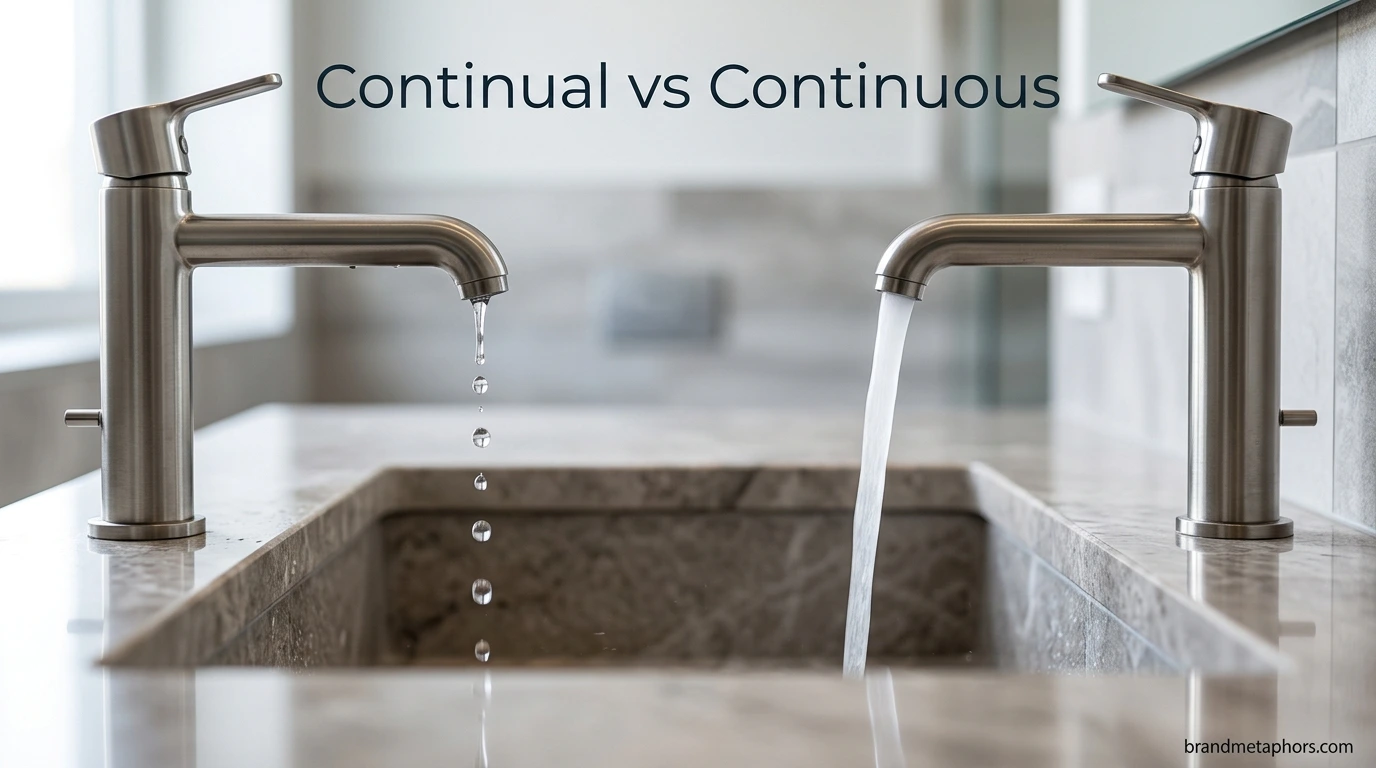
Both words describe something that happens over time, but they do so in different ways.
WordSimple MeaningKey IdeaContinualHappening again and again with breaksRepeatedContinuousHappening without any interruptionUnbroken
The easiest way to remember them is this:
- Continual = repeated with pauses
- Continuous = never stopping
This small difference changes the meaning of a sentence.
For example:
- The dog made continual noise throughout the day. (It barked many times.)
- The machine made a continuous noise. (The sound never stopped.)
Why Understanding the Difference Matters
Choosing the correct word helps readers understand exactly what you mean.
Using the wrong word can:
- Change the meaning of a sentence.
- Make academic writing less accurate.
- Create confusion in reports.
- Weaken storytelling.
- Reduce clarity in business communication.
Correct vocabulary also improves:
- Writing skills
- Vocabulary enhancement
- Descriptive language
- Reading comprehension
- Professional communication
The better your vocabulary becomes, the easier it is to express ideas clearly.
Continual Meaning Explained
Continual describes something that happens repeatedly over time but has short breaks between each event.
Think of it as something that keeps coming back.
Characteristics
- Repeats many times
- Stops briefly
- Starts again
- Often annoying or frequent
Examples
- The baby made continual cries during the night.
- We experienced continual rain showers all week.
- She received continual phone calls.
- There were continual interruptions during the meeting.
- The teacher gave continual reminders.
Notice that each action stopped before happening again.
Everyday Situations
Continual can describe:
- Phone notifications
- Repeated mistakes
- Frequent visitors
- Constant reminders
- Regular interruptions
Continuous Meaning Explained
Continuous describes something that never stops. There are no breaks or pauses.
It is one uninterrupted action.
Characteristics
- Never stops
- Flows without interruption
- Smooth and constant
- Unbroken over time
Examples
- The river has a continuous flow.
- The machine operated continuously for twelve hours.
- There was continuous music throughout the event.
- The road stretches in one continuous line.
- The patient required continuous monitoring.
Everything continued without stopping.
Everyday Situations
Continuous is often used for:
- Running water
- Electricity
- Sound
- Motion
- Time
- Production
- Heat
- Light
Quick Comparison Table
FeatureContinualContinuousStops occasionallyYesNoHappens repeatedlyYesNoNever interruptedNoYesHas pausesYesNoBest word to describe repetitionYesNoBest word to describe uninterrupted actionNoYes
Continual vs Continuous in Sentences
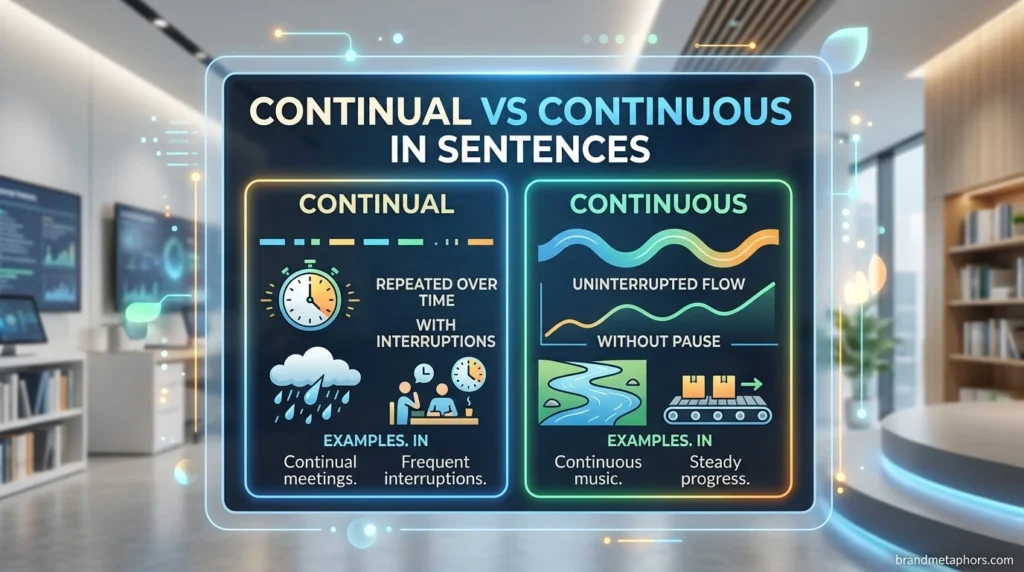
Understanding examples is the fastest way to learn.
Continual Examples
- The child asked continual questions.
- We faced continual delays on our trip.
- My computer gives continual error messages.
- The coach offered continual advice.
- There were continual power cuts.
Continuous Examples
- The waterfall produces continuous sound.
- Continuous sunshine dried the clothes quickly.
- The engine ran continuously.
- The bridge forms one continuous structure.
- Continuous learning helps people grow.
Compare these:
❌ The bell rang continuously all afternoon.
✔ The bell rang continually all afternoon.
Why?
The bell stopped between rings.
Another example:
❌ The river flowed continually.
✔ The river flowed continuously.
The water never stopped flowing.
Continual vs Continuous in Creative Writing
Creative writing depends on precise vocabulary.
Choosing the correct word creates stronger images for readers.
Continual in Storytelling
Use continual when events repeat.
Example:
Continual knocks on the old wooden door filled Emma with fear.
Readers imagine repeated knocking with pauses.
Another example:
His continual coughing echoed through the quiet house.
Continuous in Storytelling
Use continuous for actions without interruption.
Example:
A continuous stream of mist covered the mountains.
Another example:
Continuous thunder rolled across the dark sky.
These examples create vivid imagery using descriptive language.
Using These Words with Figurative Language
Figurative language adds color and emotion to writing. Understanding continual and continuous helps writers create more accurate comparisons.
Simile Examples
- Her continual questions were like tiny waves hitting the shore.
- His continuous smile was like the bright morning sun.
- The continual applause sounded like popcorn popping.
- The continuous rain fell like a silver curtain.
Metaphor Examples
- Continual criticism became tiny stones in her backpack.
- Continuous hope was a lighthouse guiding him home.
- Continuous determination became an endless road.
- Continual setbacks were stepping stones to success.
Personification
- The continual wind knocked at the window.
- Continuous sunlight hugged the flowers.
Hyperbole
- I received continual messages every minute.
- The continuous traffic never seemed to end.
These literary devices improve descriptive language and creative expression.
When to Use Each Word
Use Continual When
- Something happens repeatedly.
- There are breaks.
- The event keeps returning.
- You describe recurring situations.
Examples
- Continual meetings
- Continual mistakes
- Continual reminders
- Continual complaints
- Continual interruptions
Use Continuous When
- Something never stops.
- There are no pauses.
- You describe an ongoing process.
Examples
- Continuous movement
- Continuous music
- Continuous production
- Continuous monitoring
- Continuous operation
When to Avoid These Words
Sometimes another word works better.
Instead of continual, consider:
- Frequent
- Regular
- Repeated
- Recurring
- Constant (depending on context)
Instead of continuous, consider:
- Unbroken
- Steady
- Ongoing
- Constant
- Endless
Choose words that fit your audience and purpose.
Common Mistakes Students Make
Mistake 1
❌ Continuous interruptions
✔ Continual interruptions
Interruptions stop and start.
Mistake 2
❌ Continual flow of water
✔ Continuous flow of water
Water flows without stopping.
Mistake 3
Thinking both words mean exactly the same thing.
They are similar but not identical.
Mistake 4
Using continuous whenever something happens often.
Frequency does not always mean there are no pauses.
Mistake 5
Ignoring context.
Always ask:
Did it stop?
If yes, use continual.
If no, use continuous.
Tone Usage in Different Types of Writing
Academic Writing
Both words appear often.
Examples
- Continuous assessment
- Continual improvement
Business Writing
Use precise wording.
Examples
- Continuous monitoring of quality
- Continual customer feedback
Creative Writing
Either word may create different imagery.
Examples
- Continual whispers
- Continuous silence
Everyday Conversation
People sometimes use them interchangeably.
However, using the correct one makes your speech clearer.
Vocabulary Enhancement
Learning related words strengthens your English.
Words Related to Continual
- Frequent
- Repeated
- Recurring
- Regular
- Intermittent
Words Related to Continuous
- Constant
- Unbroken
- Endless
- Steady
- Ongoing
- Nonstop
Opposites
Continual
- Rare
- Occasional
Continuous
- Interrupted
- Broken
- Disconnected
Comparison Examples in Real Life
SituationCorrect WordWhyBarking dogContinualStops between barksRunning riverContinuousNever stopsPhone notificationsContinualCome repeatedlyFactory productionContinuousKeeps runningThunder during stormContinualComes again and againElectric currentContinuousConstant flowClassroom interruptionsContinualRepeated breaksConveyor beltContinuousMoves nonstop
Sentence Examples for Practice
Continual
- Her continual laughter made everyone smile.
- The road had continual bumps.
- We received continual updates.
- His continual practice improved his skills.
- The continual ringing became annoying.
- There were continual reminders about homework.
- The child made continual requests for candy.
- Continual repairs increased the cost.
Continuous
- Continuous snowfall covered the town.
- The clock made a continuous ticking sound.
- The artist worked with continuous focus.
- Continuous exercise improves health.
- Continuous research leads to discoveries.
- The fan produced continuous airflow.
- Continuous lighting brightened the room.
- Continuous reading expands knowledge.
Writing Tips for Students
When editing your writing:
- Ask whether the action stopped.
- Look for repeated events.
- Think about interruptions.
- Replace vague words with precise vocabulary.
- Read your sentence aloud.
- Check whether uninterrupted action is intended.
These habits improve grammar, vocabulary, and writing skills.
Practice Exercises
Exercise 1
Choose the correct word.
- The waterfall produced ______ noise.
Answer: continuous
- The teacher gave ______ reminders.
Answer: continual
- We enjoyed ______ sunshine.
Reply: continuous
- The baby made ______ cries.
Answer: continual
- The machine ran for eight hours without stopping.
Answer: continuous
Exercise 2
Correct the sentence.
Incorrect:
The phone made continuous notifications.
Correct:
The phone made continual notifications.
Incorrect:
The river had a continual flow.
Correct:
The river had a continuous flow.
Exercise 3
Fill in the blanks.
- The engine made a __________ sound.
- We experienced __________ delays.
- She needed __________ support.
- The class had __________ interruptions.
Answers
- continuous
- continual
- continuous
- continual
Frequently Asked Questions
1. What is the main difference between continual and continuous?
Continual means something happens repeatedly with breaks. Continuous means something happens without any interruption.
2. Can the words be used interchangeably?
Sometimes in casual conversation they are, but careful writers choose the correct one because the meanings are different.
3. Is continual the same as constant?
Not always. Continual usually includes pauses, while constant often suggests little or no change.
4. Which word is used for flowing water?
Continuous is correct because water flows without stopping.
5. Which word describes repeated interruptions?
Continual is correct because interruptions occur again and again with pauses between them.
Final Comparison Table
QuestionContinualContinuousHappens again and again✔✘Stops briefly✔✘Never interrupted✘✔Good for repeated events✔✘Good for nonstop action✘✔ExampleContinual complaintsContinuous rain
Conclusion
Understanding the difference between continual and continuous helps you become a clearer and more confident writer. Although the words are closely related, they describe different kinds of actions. Continual refers to events that happen repeatedly with pauses in between, while continuous describes something that goes on without stopping.
Mastering this distinction improves academic writing, creative writing, professional communication, and everyday conversations. It also strengthens vocabulary, supports better descriptive language, and helps you use literary devices more accurately in stories and essays.
The easiest memory trick is simple:
- Continual = repeats with breaks
- Continuous = never stops
The more you read, write, and practice using these words in real sentences, the more natural the difference will become. Careful word choice is one of the simplest ways to make your writing stronger, more accurate, and easier for every reader to understand.