
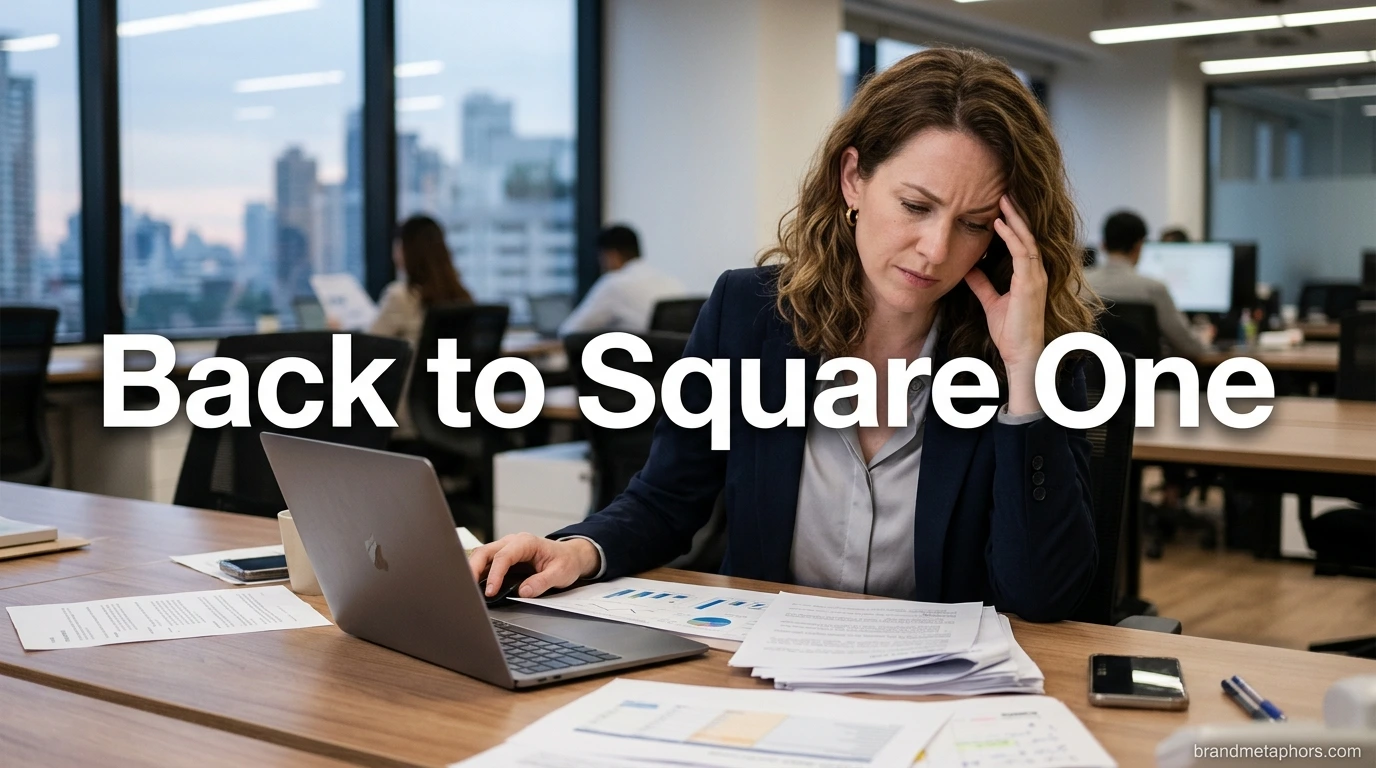
Have you ever spent hours working on a project, only to realize that none of your efforts worked? Maybe you had to erase everything and begin again. That frustrating moment is perfectly described by a well-known English expression that means returning to the starting point after a failed attempt.
This idiom appears in everyday conversations, business meetings, sports, education, and even news headlines. It helps speakers express disappointment while also recognizing the need to restart with a fresh plan.
In this guide, you’ll learn its meaning, history, common situations, examples, grammar, synonyms, mistakes to avoid, and practical tips for using it naturally in speech and writing.
What Does This Idiom Mean?
The expression means to return to the beginning after an unsuccessful attempt. It suggests that previous efforts did not solve the problem, making it necessary to start over.
Unlike simply “trying again,” this phrase implies that progress has been completely lost.
Simple definition
To begin again from the very start because an earlier plan, solution, or attempt failed.
Key idea
Someone who uses this expression usually means:
- Previous work did not succeed.
- The original plan no longer works.
- A completely new approach is needed.
- Progress has been reset.
Origin and History
The exact origin is debated, but several theories explain where the phrase came from.
Theory 1: Football broadcasting
One popular explanation connects the phrase to early football radio broadcasts. A grid was supposedly divided into numbered squares so commentators could describe where the ball was located. Returning to the first square represented starting over.
Theory 2: Board games
Another theory suggests it came from board games where players sometimes return to the starting space after drawing a certain card.
Theory 3: Educational diagrams
Some researchers believe teachers used numbered diagrams to explain different stages of learning or problem-solving. Going back to the first step naturally became associated with restarting.
Although no single explanation has been fully proven, the meaning has remained remarkably consistent for decades.
When People Use This Expression
This idiom fits many everyday situations where a plan has failed.
School
A student writes an essay but accidentally deletes the file.
Result: They must begin again.
Workplace
A company launches a product that customers dislike.
Result: The team redesigns everything.
Technology
Software developers discover a major programming error.
Result: Much of the code must be rewritten.
Sports
A coach changes strategies after losing several games.
Result: Training begins from the basics.
Personal life
Someone follows poor financial advice and loses money.
Result: They rebuild their savings from scratch.
Common Situations and Examples

Below are practical examples showing how native speakers naturally use this expression.
Everyday conversation
- We thought we fixed the problem, but we’re back to square one.
- The vacation plans fell apart, so we’re starting over.
- After losing the documents, the team had to begin again.
- The negotiations failed, leaving everyone at the beginning.
- Every solution created another issue.
At work
- Our marketing strategy didn’t increase sales.
- The project needs a complete redesign.
- Customer feedback changed everything.
- We must rethink the entire process.
In education
- The experiment failed.
- The research contained errors.
- The teacher asked for a fresh draft.
- The assignment must be rewritten.
In relationships
- They tried counseling.
- Communication problems continued.
- Now they must rebuild trust.
Types of Situations Where It Applies
Although the meaning stays the same, the situations vary.
SituationWhat HappensResultBusinessProduct failsNew strategyEducationAssignment rejectedRewrite from beginningTechnologySoftware bugRebuild programConstructionDesign errorRestart projectSportsLosing seasonNew training planPersonal goalsPlan failsFresh beginningFinanceInvestment mistakeNew budgetResearchIncorrect dataRepeat study
Why This Expression Is So Popular
Native English speakers like this idiom because it communicates a complex idea in only a few words.
Instead of saying:
“Our previous efforts failed completely, and now we need to restart everything.”
People simply say:
“We’re back to square one.”
Its popularity comes from several strengths.
It is easy to understand
Even learners quickly recognize that it refers to restarting.
It creates a vivid picture
Listeners imagine someone returning to the first step of a journey.
It works in many situations
You can use it in:
- Business
- School
- Politics
- Sports
- Technology
- Daily life
- Family discussions
Synonyms and Similar Expressions
English offers several phrases with similar meanings.
Common alternatives
- Start from scratch
- Begin again
- Go back to the beginning
- Return to the drawing board
- Make a fresh start
- Restart the process
- Try again
- Reset everything
- Begin anew
- Rebuild from the ground up
Small differences
Start from scratch
Means beginning with nothing.
Return to the drawing board
Usually means creating a new plan after failure.
Fresh start
Often suggests a positive emotional beginning.
Restart
Usually refers to repeating a process rather than completely redesigning it.
Sentence Examples for Different Contexts
Daily life
- Our travel documents expired, so we’re back to square one.
- The recipe didn’t work, so I’ll begin again.
- We lost the map and had to restart our route.
Workplace
- Months of planning were wasted after the client changed the requirements.
- The design failed the safety inspection.
- The entire proposal must be rewritten.
School
- My science project didn’t work.
- The experiment produced incorrect results.
- I need to repeat every step.
Sports
- The team’s strategy failed.
- The coach decided to rebuild the defense.
- Practice started with the basics again.
Technology
- The database crashed.
- Engineers rebuilt the system.
- The developers created a completely new version.
Benefits of Learning Idioms Like This

Learning idioms improves much more than vocabulary.
Better communication
Native speakers use idioms regularly.
Understanding them helps conversations flow naturally.
Stronger writing
Essays, blogs, and stories become more interesting.
Improved listening
Movies, podcasts, interviews, and television often include figurative expressions.
Greater confidence
Knowing common expressions makes English feel more natural.
Better exam performance
Many language exams test idioms and everyday expressions.
Benefits include:
- Better speaking
- Better reading
- Better listening
- Better writing
- Richer vocabulary
- Natural pronunciation
- Improved fluency
Common Mistakes to Avoid
Many English learners misuse this expression.
Mistake 1: Using it for small setbacks
Incorrect:
We forgot one pencil, so we’re back to square one.
Better:
We forgot one pencil.
The idiom should describe a major restart.
Mistake 2: Mixing it with “start from scratch”
Although similar, they are not always identical.
“Start from scratch” emphasizes beginning with nothing.
This expression emphasizes losing previous progress.
Mistake 3: Using it for successful situations
Incorrect:
We finished early, so we’re back to square one.
Correct:
We solved the problem.
The phrase always suggests failure or loss of progress.
Mistake 4: Overusing it
Avoid repeating it several times in one paragraph.
Instead, alternate with:
- restart
- begin again
- rethink
- rebuild
- reset
- fresh start
Tips for Using It Naturally
To sound like a native speaker, remember these simple tips.
Use it after failure
It usually follows an unsuccessful attempt.
Pair it with action verbs
Examples:
- went
- ended up
- found ourselves
- returned
- came
Use it in storytelling
Stories become more engaging when readers see how characters must restart after setbacks.
Keep the tone conversational
The idiom works best in everyday English rather than extremely formal legal or scientific writing.
Real-Life Examples
Imagine these situations.
Example 1: Business startup
A company launches a new app.
Customers report many problems.
The company redesigns the entire product.
They are effectively back at the beginning.
Example 2: Student project
A student forgets to save an important assignment.
The computer crashes.
Every page disappears.
The student must write everything again.
Example 3: Home renovation
Workers discover hidden structural damage.
The renovation plan changes completely.
Construction begins again.
Example 4: Marathon training
An athlete suffers an injury.
Months of progress disappear.
Recovery requires rebuilding strength from the basics.
Frequently Asked Questions
1. What does this idiom mean?
It means returning to the starting point because earlier efforts failed.
2. Is it formal or informal?
It is mostly informal but widely accepted in newspapers, business discussions, and professional conversations.
3. Can it be used in business writing?
Yes. It commonly appears in reports, presentations, meetings, and project discussions.
4. Is it the same as “start from scratch”?
Not exactly. One emphasizes losing previous progress, while the other emphasizes beginning with nothing.
5. Can students use it in essays?
Yes, especially in narrative, descriptive, or informal writing.
6. Why is it so common?
It quickly describes the need to restart after failure, making communication clear and memorable.
7. Can it describe personal situations?
Absolutely. It works for careers, relationships, education, finances, health goals, and hobbies.
8. How can I remember its meaning?
Imagine playing a board game where you are sent back to the first square after making a mistake. That image matches the idiom’s meaning perfectly.
Conclusion
This classic English idiom is one of the most useful expressions for describing situations where progress is lost and a fresh beginning becomes necessary. Whether discussing school assignments, business projects, sports, technology, or everyday challenges, it clearly communicates the idea of returning to the starting point after an unsuccessful attempt.
By understanding its meaning, history, grammar, synonyms, and real-life uses, you’ll recognize it easily in conversations, books, movies, and articles. Practice using it in realistic situations, but avoid overusing it or applying it to minor setbacks. With regular practice, this expression will become a natural part of your English vocabulary and help you communicate with greater confidence and fluency.