
When you sit down to write an email to a new client, a hiring manager, or a future colleague, the way you close your message matters. You want to sound enthusiastic yet professional. This brings up a common question for students, writers, and language learners alike: is it correct to say looking forward to working with you?
The short answer is yes! It is entirely correct, grammatically sound, and widely accepted in the professional world. However, mastering communication is about much more than just avoiding grammatical errors. Truly impactful writing relies on a deep understanding of language dynamics, including figurative language, descriptive language, and tone.
Whether you are focusing on creative writing, trying to achieve vocabulary enhancement, or simply sharpening your everyday writing skills, understanding how to phrase your professional anticipation is key. Let’s dive deep into why this phrase works, how it functions grammatically, and how you can elevate your writing using various literary devices, metaphor examples, and simile examples.
1. The Power of Figurative Language in Communication
Before we break down the specific grammar of our focus phrase, let’s explore why the way we express ourselves matters so much. Figurative language is a vital tool that goes beyond the literal definitions of words to create vivid imagery, evoke emotion, and spark connections. While business emails usually favor direct communication, incorporating elements of descriptive and poetic writing can dramatically improve how your message is received.
When we look at communication as a whole, relying solely on flat, literal descriptions can make your writing feel robotic. By integrating varied vocabulary and expressive phrasing, you transform basic information into an engaging experience for the reader.
Why Expressive Phrasing Matters:
- It builds bridges: It shows warmth and human connection rather than stark, cold transaction.
- It enhances clarity: Sometimes, a well-placed idiom meaning or a vivid description can paint a clearer picture than a paragraph of technical jargon.
- It drives engagement: Readers are more likely to respond positively to text that feels alive and thoughtful.
For students and writers aiming for vocabulary enhancement, learning where to use literal prose versus where to inject a touch of poetic expression is a fundamental step toward mastery.
2. Grammatical Breakdown: Why It Is Correct
Let’s look closely at the phrase: “looking forward to working with you.” To understand why this is grammatically correct, we need to look at the phrase’s structure. The core of this expression is the phrasal verb “look forward to.” In English, the word “to” can act either as part of an infinitive verb (like to run, to eat) or as a preposition. In this specific idiom, “to” functions strictly as a preposition.
Because “to” is a preposition here, it must be followed by a noun or a noun phrase. When we want to follow it with an action, we must turn that verb into a noun. We do this by adding -ing, which creates a gerund.
Grammar Core: > * Correct: I am looking forward to working (gerund) with you.
- Incorrect: I am looking forward to work (infinitive) with you.
Subject Dropping in Casual Writing
You might also wonder if it is okay to drop the “I” or “We” at the beginning of the sentence.
- “I am looking forward to working with you” is the complete, formal version.
- “Looking forward to working with you” is a conversational shortcut where the subject is implied. This is perfectly acceptable in standard business emails, though you should keep the full version for highly formal letters or academic applications.
3. Idiom Meaning and Phrasal Usage
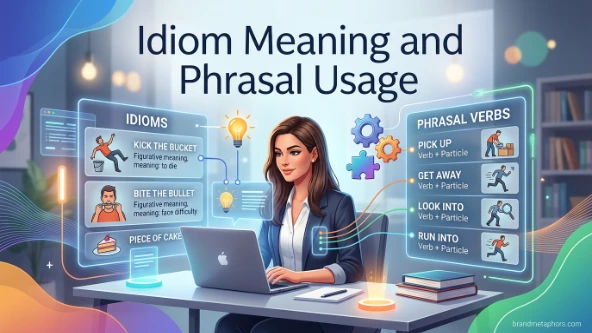
To truly grasp this phrase, it helps to view it through the lens of an idiom meaning. An idiom is an expression whose meaning cannot easily be understood from the literal definitions of its individual words.
Literally, if you “look forward,” you are turning your eyes toward the space in front of you. Figuratively, however, the phrase means to anticipate a future event with pleasure, excitement, or satisfaction.
Cultural and Linguistic Context
In English-speaking professional cultures, this phrase does double duty:
- Functional: It signals the end of a conversation or negotiation and sets up the next steps.
- Emotional: It softens the tone of business transactions, assuring the recipient that you view the upcoming collaboration as a positive experience rather than just a chore.
For language learners, mastering this phrasal idiom is a major milestone in developing natural-sounding writing skills.
4. Comparing Literal vs. Figurative Expressions
To better understand how we communicate anticipation, let’s look at a comparison examples table. This highlights the difference between direct, literal language and more expressive, figurative approaches.
Type of LanguageExample SentenceTone and ImpactDirect / Literal“We will begin our project on Monday.”Clear, functional, but lacks warmth or emotion.Standard Idiomatic“I am looking forward to working with you.”Professional, polite, and universally accepted.Metaphorical“We are planting the seeds for a highly fruitful partnership.”Creative, imaginative, excellent for building strong rapport.Hyperbolic / Poetic“I am counting down the seconds until our minds collide on this project.”Overly dramatic; great for fiction, but too intense for the office.
By studying these variations, writers can see how changing a few words completely alters the energy of a message.
5. Exploring Literary Devices: Simile and Metaphor Examples
While you might not use complex poetry in a standard morning email, exploring literary devices like similes and metaphors can expand your creative mind. This is incredibly useful for creative writing and advanced essays.
Let’s look at how we can express the concept of “looking forward to working together” using different creative tools.
Metaphor Examples
A metaphor states that one thing is another thing to make a vivid comparison. It bypasses literal limits to create instant imagery.
- “Collaborating with your team is a breath of fresh air for our department.”
- “This upcoming project is the bridge to our mutual success.”
- “Working with you is a masterclass in innovation.”
Simile Examples
A simile compares two distinct things using the words “like” or “as” to highlight a shared characteristic.
- “Awaiting our partnership is like waiting for the first rain after a long summer drought.”
- “Working with your team is as smooth as clockwork.”
- “Collaborating with you feels like finding the final piece of a complex puzzle.”
Using these devices in essays or stories adds rich, descriptive language that captures your reader’s imagination far better than plain text alone.
6. Categorized Sentence Examples for Everyday Use
To help you apply these concepts in real life, here are multiple sentence examples categorized by different professional and creative settings.
Standard Business Contexts
- “Thank you for the wonderful meeting today; I am truly looking forward to working with you on the upcoming marketing campaign.”
- “Please find the signed contract attached. We are looking forward to working with you and your team to achieve these goals.”
- “It is an honor to join this department, and I am looking forward to working with you all starting next month.”
Creative and Collaborative Settings
- “Your artistic vision matches perfectly with mine, and I’m looking forward to working with you to bring this story to life.”
- “As we blend our musical styles, I am really looking forward to working with you in the studio.”
Academic and Mentorship Environments
- “Thank you for accepting me into your research lab, Professor; I am looking forward to working with you this semester.”
- “As your peer tutor, I am looking forward to working with you to raise those math grades!”
7. Tone and Nuance: Matching Your Audience
One of the most critical aspects of advanced communication is matching your tone to your specific audience. The phrase “looking forward to working with you” is highly adaptable, but small changes can shift its vibe from casual to formal.
[Extremely Casual] —> [Balanced Professional] —> [Highly Formal] “Can’t wait to work!” -> “Looking forward to working with you” -> “I anticipate a fruitful collaboration”
The Three Tones at a Glance:
- Casual / Conversational: “Looking forward to working with you!” (Great for internal Slack messages or emails to close, long-term creative partners).
- Balanced Professional: “I am looking forward to working with you on this project.” (Ideal for clients, new employers, and standard business correspondence).
- Formal / Elegant: “We eagerly anticipate the opportunity to collaborate with your organization.” (Best for official proposals, legal agreements, or high-profile academic letters).
8. When to Use the Phrase
Knowing when to use this phrase ensures your communication feels natural and timely. Here are the best situations to deploy it:
- After Accepting a Job Offer: It is the perfect closing sentence for an email accepting a new position, showing your future boss that you are motivated and ready to start.
- When Signing a Contract with a Client: It reinforces a positive relationship right as a business deal becomes official.
- After a Successful Introductory Meeting: If you just met a potential partner and the conversation went well, this phrase cements your interest in moving forward.
- When Welcoming a New Vendor or Team Member: It works beautifully from the employer’s side to make a new partner feel welcome and valued.
9. When to Avoid the Phrase
While it is a fantastic phrase, it isn’t a one-size-fits-all solution. There are specific times when saying you look forward to working with someone is awkward or inappropriate.
- Before a Deal is Agreed Upon: If you are still in the pitch or interview phase, saying this can sound presumptuous—as if you assume you already have the job. Instead, use: “I look forward to the possibility of working with you.”
- In Disciplinary or Legal Contexts: If you are resolving a serious workplace dispute or dealing with a legal issue, using warm, anticipatory language can feel insincere or confusing. Keep your tone strictly neutral.
- When No Actual Collaboration Will Occur: If someone is selling you a one-time, automated product and you will never interact with them again, the phrase doesn’t make logical sense. Stick to a simple “Thank you for your assistance.”
10. Common Mistakes and How to Fix Them
Even native speakers occasionally trip over this phrase. Let’s look at the most common errors so you can easily avoid them in your writing.
1. The Infinitive Trap
- Wrong: I am looking forward to work with you.
- Right: I am looking forward to working with you.
- Why: As established, “to” is a preposition here, requiring the gerund (-ing) form.
2. The Overlap Typo
- Wrong: I am looking forward for working with you.
- Right: I am looking forward to working with you.
- Why: The set phrasal verb is always “look forward to.” Replacing it with “for” is grammatically incorrect.
3. Punctuation Overload
- Wrong: Looking forward to working with you!!!
- Right: Looking forward to working with you. (Or use a single exclamation mark if the mood is genuinely celebratory).
- Why: In professional writing, multiple exclamation marks can make your message look juvenile or unprofessional.
11. Practice Exercises for Students and Writers
To truly lock this knowledge into your long-term memory, try your hand at these simple exercises.
Exercise 1: Spot the Error
Identify the grammatical or tonal mistake in the sentences below and rewrite them correctly.
- “Hi Mr. Smith, I look forward to work with you on the audit next week.”
- “We are looking forward for working with your company.”
- “I haven’t been hired yet, but I am looking forward to working with you!”
Exercise 2: Tone Transformation
Rewrite the basic thought: “I want to work with you” into three distinct versions based on what you learned:
- Version A: A casual Slack message to a teammate.
- Version B: A polished email to a new corporate client.
- Version C: An essay-style sentence using a metaphor example or poetic expression.
12. Quick Comparison: Similar Professional Greetings
If you find yourself using the exact same phrase over and over again, your writing can start to feel repetitive. Use this quick comparison table to discover excellent alternatives that keep your communication fresh.
Alternative PhraseBest Use CaseTone Level“I’m excited to get started.”Fast-paced startups, creative projects, internal teams.Casual / High Energy”I look forward to our collaboration.”Corporate environments, consulting, B2B interactions.Formal / Polished”It will be a pleasure working with you.”Freelancers welcoming a new client, hospitality industry.Warm / Professional”I anticipate a highly productive partnership.”Executive letters, official joint ventures, academic boards.Very Formal
13. Frequently Asked Questions (FAQs)
1. Is “look forward to working with you” formal or informal?
It sits perfectly right in the middle! It is formal enough for a traditional business letter, yet warm enough for a casual email,is one of the most versatile phrases in the English language.
2. Can I say “I look forward to work with you”?
No, this is a common grammatical error. Because “to” acts as a preposition in this idiom, it must be followed by the gerund form of the verb, which is “working.”
3. What is the difference between “look forward” and “looking forward”?
“I look forward” sounds slightly more formal and traditional. “I am looking forward” (or simply “Looking forward”) sounds a bit more dynamic, modern, and personal. Both are entirely correct.
4. How do I reply when someone says this to me?
You can reply by matching their enthusiasm! Excellent responses include:
- “The feeling is mutual! I am also looking forward to getting started.”
- “Thank you, I am equally excited to work together.”
- “Likewise, I can’t wait to dive into the project.”
5. Can I use this phrase in an essay or creative writing story?
While it is primarily a business phrase, you can certainly use it in dialogue within a story. If you are writing an essay, you might elevate the phrase using descriptive language or literary devices to express the broader concept of human collaboration.
Conclusion
Mastering the nuances of everyday phrases like “looking forward to working with you” is a brilliant way to sharpen your practical writing skills. By understanding the underlying grammar, avoiding common preposition errors, and learning how to adjust your tone, you ensure your emails always hit the mark.
Furthermore, exploring the world of figurative language, simile examples, and metaphor examples expands your creative horizons. It allows you to transform basic, functional prose into deeply engaging, clear, and impactful communication. Keep practicing, pay attention to your audience, and watch your writing thrive!