
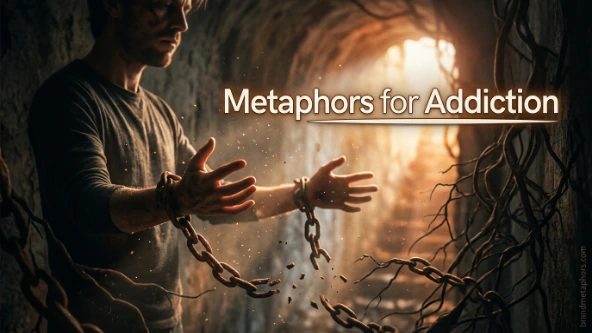
Introduction: When Craving Feels Like a Storm You Can’t Outrun
It often begins quietly. A thought that returns more often than it should. A habit that once felt harmless but slowly starts rearranging a person’s day, then their choices, then their sense of self. Addiction rarely announces itself with drama at the start. Instead, it settles in like weather—subtle at first, then impossible to ignore.
Many people describe it not as a single experience but as a shifting landscape: a storm they can’t outrun, a weight they carry in their chest, a voice that never quite stops speaking. Because addiction is deeply personal and often invisible from the outside, language becomes one of the few tools we have to make sense of it.
That is where metaphors matter.
Metaphors for addiction help us translate something complex, emotional, and often misunderstood into images the mind can hold. They don’t simplify the experience in a careless way; instead, they give shape to something that often feels shapeless. Whether you’re a writer, a reader seeking understanding, or someone trying to articulate inner experiences, these comparisons can offer clarity, empathy, and reflection.
Below are carefully crafted metaphors, each expanded with meaning, examples, sensory detail, and creative prompts to help you use them in writing or daily expression.
1. Addiction as a “Tide That Keeps Pulling You Back”
Addiction is often compared to the ocean—not calm, but relentless.
Meaning & Explanation
This metaphor suggests that even when a person tries to move away, something stronger keeps drawing them back. Like tides governed by invisible forces, addiction can feel cyclical and inevitable.
Example Sentence / Scenario
“She promised herself she was done, but the tide returned at night, pulling her thoughts back to the same place.”
Alternative Expressions
- A magnetic current beneath the surface
- A wave that forgets how to retreat
- The sea that knows your name
Sensory & Emotional Detail
Imagine standing on wet sand, feeling the cold water rush forward and erase your footprints again and again. There is both beauty and helplessness in it—the rhythm is natural, but it doesn’t ask permission.
Mini Story Element
A fisherman once said he didn’t fear the stormy sea as much as the calm one that lured him too close. That calm, deceptive and familiar, is what addiction can resemble—inviting before it overwhelms.
Creative Prompt
Write a paragraph describing your own “tide moment”—something in life that repeatedly pulls a character back despite their efforts to move away.
2. Addiction as a “Shadow That Learns Your Shape”
Shadows are always present when there is light—but this one feels personal.
Meaning & Explanation
This metaphor reflects how addiction often mirrors a person’s habits, routines, and vulnerabilities, slowly adapting until it feels inseparable from them.
Example Sentence / Scenario
“It wasn’t just following him anymore; it had become a shadow that learned his shape too well.”
Alternative Expressions
- A second silhouette
- A quiet twin that never speaks but follows
- Darkness stitched to movement
Sensory & Emotional Detail
Picture walking through a streetlamp-lit alley. Every step is accompanied by something just behind you—not touching, but never leaving. Over time, it feels less like something external and more like part of you.
Mini Cultural Reference
In literature, shadows often symbolize hidden truths. In this metaphor, the shadow isn’t just secrecy—it is familiarity turned into dependence.
Creative Prompt
Describe a character who slowly realizes their shadow no longer matches their movements exactly.
3. Addiction as a “Fire That Feeds on Attention”
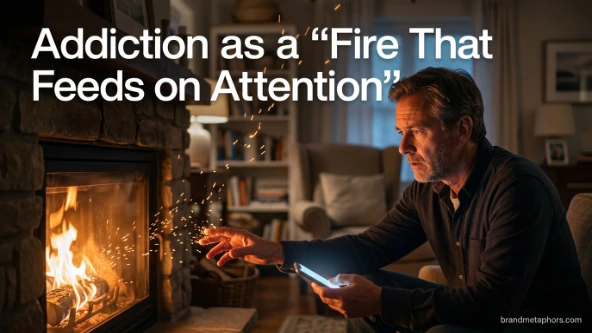
Fire can warm or destroy, but this one grows the more you feed it.
Meaning & Explanation
This metaphor captures how addiction intensifies when engaged. Attention, time, and repetition act like fuel.
Example Sentence / Scenario
“Every glance toward it was another log thrown onto a fire she swore she wouldn’t light again.”
Alternative Expressions
- A flame that learns your breath
- Burning hunger disguised as comfort
- A hearth that turns into wildfire
Sensory & Emotional Detail
Think of warmth spreading across cold hands at first relief—then heat too sharp to ignore. The glow becomes dangerous only after it feels comforting.
Mini Story Element
Ancient myths often depict fire as stolen knowledge or forbidden comfort. Similarly, addiction can feel like something that begins as relief but becomes consuming.
Creative Prompt
Write about a “small flame moment” that grows into something uncontrollable in a character’s life.
4. Addiction as a “Maze That Reshapes Itself”
No matter how many times you walk it, the exits seem to move.
Meaning & Explanation
This metaphor expresses confusion, repetition, and frustration. The more one tries to escape, the more disorienting the path becomes.
Example Sentence / Scenario
“He remembered every turn, yet the maze had changed again, as if it remembered him too.”
Alternative Expressions
- A corridor that rearranges itself
- A puzzle with shifting pieces
- Walls that move when you stop looking
Sensory & Emotional Detail
Stone walls feel damp. Air is tight. Footsteps echo longer than expected, as if the maze is listening.
Mini Story Element
In Greek mythology, labyrinths often symbolized psychological struggle. The Minotaur was not just a monster—it was a fear made physical.
Creative Prompt
Create a map of a maze that changes each time the protagonist tries to escape it.
5. Addiction as a “Song You Can’t Stop Replaying”
Not all repetition is visual—some of it is musical.
Meaning & Explanation
This metaphor reflects intrusive thoughts and compulsive mental loops. Like a song stuck in the mind, it repeats without permission.
Example Sentence / Scenario
“It played again, the same refrain, softer each time but impossible to silence.”
Alternative Expressions
- A melody stuck in the bones
- A chorus without ending
- A rhythm that ignores silence
Sensory & Emotional Detail
Imagine hearing music even when the room is quiet. Not loud, but persistent—like memory pretending to be sound.
Mini Cultural Reference
Many poets describe grief and longing as music that refuses resolution. Addiction, in this sense, becomes an unfinished song.
Creative Prompt
Write a “soundtrack of relapse” where each note represents a different emotional trigger.
6. Addiction as a “Familiar Room That Locks From the Inside”
Comfort can sometimes become confinement.
Meaning & Explanation
This metaphor highlights how something once safe or familiar becomes restrictive over time.
Example Sentence / Scenario
“It looked like home, but the door had no handle anymore.”
Alternative Expressions
- A room that shrinks slowly
- Comfort that becomes captivity
- A home built without exits
Sensory & Emotional Detail
Soft lighting, worn furniture, the smell of something once comforting. Yet the air feels thinner every time you stay longer.
Mini Story Element
Many people return to familiar spaces during stress, but addiction transforms familiarity into dependency.
Creative Prompt
Describe a room that changes slightly every time a character enters it.
7. Addiction as a “Debt That Grows in Silence”
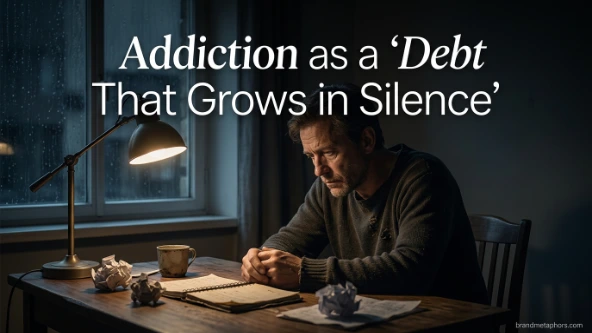
Nothing visible, but always accumulating.
Meaning & Explanation
This metaphor reflects delayed consequences and emotional accumulation.
Example Sentence / Scenario
“It didn’t ask for payment at first, only interest—quiet, invisible, and constant.”
Alternative Expressions
- A ledger written in memory
- Invisible interest collecting pain
- A balance you never agreed to
Sensory & Emotional Detail
There is no sound to debt growing—only the subtle awareness that something is building beneath the surface.
Mini Cultural Reference
In literature, debts often symbolize moral or emotional consequences rather than financial ones.
Creative Prompt
Write a character who discovers they have been “paying interest” emotionally for years without noticing.
8. Addiction as a “Weather System Inside the Mind”
Not just a mood—but a climate.
Meaning & Explanation
This metaphor shows how addiction can shift emotional states unpredictably.
Example Sentence / Scenario
“One moment it was clear skies, the next a storm he didn’t remember inviting.”
Alternative Expressions
- Emotional climate shifts
- Inner storms with no forecast
- Seasons without calendars
Sensory & Emotional Detail
Pressure changes behind the eyes. A heaviness in the chest like humidity before rain.
Creative Prompt
Describe a “weather report” for a character’s emotional state across a week.
9. Addiction as a “Mirror That Distorts Over Time”
What you see slowly stops being accurate.
Meaning & Explanation
This metaphor highlights identity distortion and self-perception changes.
Example Sentence / Scenario
“The reflection didn’t lie—it just stopped telling the whole truth.”
Alternative Expressions
- A mirror that fogs from within
- Glass that bends identity
- Reflection with missing edges
Sensory & Emotional Detail
The face in the mirror looks familiar but slightly delayed, as if it belongs to yesterday.
Creative Prompt
Write a dialogue between a character and their reflection that slowly disagrees with them.
10. Addiction as a “Thread That Becomes a Net”

What starts as connection can become entanglement.
Meaning & Explanation
This metaphor shows how repeated behaviors weave into patterns that become hard to escape.
Example Sentence / Scenario
“It began as a single thread of comfort, until she realized she was standing inside a net she had woven herself.”
Alternative Expressions
- A web of repetition
- Threads turned into traps
- A pattern that tightens with time
Sensory & Emotional Detail
Light pressure against skin. Movement restricted but not fully stopped—just slowed.
Creative Prompt
Design a symbolic “net diagram” of habits in a character’s life.
Conclusion
Addiction is complex, deeply human, and often difficult to describe in plain terms. That is why metaphors matter—they do not reduce the experience; they translate it. They give shape to something internal, allowing it to be seen, discussed, and understood with more empathy.
A tide, a shadow, a maze, a fire—each metaphor reveals a different layer of the experience. None of them define addiction completely, but together they help us approach it with more awareness and less judgment.
Language cannot solve everything, but it can illuminate what once felt invisible. And sometimes, that illumination is the first step toward understanding.
FAQs: Metaphors for Addiction
1. Why are metaphors useful for understanding addiction?
Metaphors help translate complex emotional and psychological experiences into relatable images, making them easier to understand and communicate.
2. Can metaphors oversimplify addiction?
They can if used carelessly, but thoughtful metaphors aim to deepen understanding rather than reduce complexity.
3. How can writers use addiction metaphors effectively?
By grounding them in sensory detail, emotional truth, and consistent imagery throughout their writing.
4. Are these metaphors meant to be literal?
No. They are symbolic tools for expression, reflection, and storytelling.
5. Can metaphors help in personal reflection?
Yes. They can help people articulate feelings that are otherwise difficult to express in direct language.
If you want, I can also turn this into a poem series, a short story, or a visual infographic-style breakdown.