

In the dim glow of an early morning office, the city still half-asleep beyond the glass windows, a business leader stares at a whiteboard filled with arrows, charts, and half-formed ideas. To one person, it looks like chaos. To another, it feels like a map of a living organism trying to find its rhythm. This is the world of business—not just numbers and strategies, but movement, emotion, and imagination.
Metaphors for business help us make sense of that complexity. They turn abstract ideas like growth, competition, leadership, and innovation into vivid mental pictures we can understand instantly. Instead of saying “the company is expanding,” we might say “the company is a growing forest.” Suddenly, we don’t just see data—we see life.
In this article, we will explore powerful metaphors for business, how they shape thinking and communication, and how you can use them to improve leadership, storytelling, branding, and creativity.
H2: What Are Metaphors for Business and Why Do They Matter?
Metaphors for business are imaginative comparisons that describe business concepts in relatable, often visual or emotional ways. They replace technical explanations with symbolic meaning.
For example:
- A business is a machine
- A team is a sports squad
- A startup is a seed
- Leadership is a compass
These comparisons are not just decorative language—they shape how we make decisions.
When we call a company a “machine,” we focus on efficiency. When we call it a “garden,” we focus on growth and patience. The metaphor quietly changes strategy.
In essence, metaphors are not just words. They are mental frameworks that guide action.
H2: Why Business Metaphors Improve Communication and Thinking
Business is full of complexity—budgets, teams, markets, competition. Metaphors simplify that complexity into something human.
They help in three powerful ways:
- Clarity – Complex ideas become easier to understand
- Memory – People remember stories more than data
- Emotion – Metaphors add feeling to logic
A manager saying “we are drowning in tasks” instantly communicates urgency better than a spreadsheet ever could.
Metaphors also align teams. When everyone sees the business as a “ship,” they understand teamwork, direction, and storms together.
H2: Business as a Ship – Navigating Uncertainty and Leadership
One of the most timeless metaphors for business is the ship at sea.
A business is a vessel sailing through unpredictable waters—markets shift like tides, competitors appear like storms, and opportunities rise like distant horizons.
Meaning and Explanation
This metaphor highlights leadership, direction, and resilience. The leader becomes the captain, the team becomes the crew, and strategy becomes navigation.
Example Sentence or Scenario
“The CEO steadied the ship during the financial storm, ensuring no one abandoned their post despite rough waters.”
Alternative Expressions
- Steering the company
- Navigating the market
- Weathering the storm
- Keeping the course steady
Sensory and Emotional Detail
Imagine the creaking of wood, the salt in the air, waves crashing against the hull. There is fear—but also trust. Everyone depends on direction and unity.
Mini Storytelling
A small tech startup once nearly collapsed during a funding crisis. Instead of panicking, the founder gathered the team and said, “We are not sinking—we are adjusting sails.” That shift in metaphor changed morale. The ship didn’t stop. It redirected.
H2: Business as a Garden – Growth, Patience, and Cultivation

Another powerful metaphor for business is the garden.
A business is not built overnight—it is grown. Seeds must be planted, watered, protected, and given time.
Meaning and Explanation
This metaphor emphasizes patience, nurturing talent, and long-term thinking.
Example Sentence or Scenario
“The startup flourished like a well-tended garden after years of careful nurturing and consistent effort.”
Alternative Expressions
- Cultivating success
- Planting seeds of innovation
- Harvesting results
- Growing organically
Sensory and Emotional Detail
You can almost smell the soil after rain. Growth is slow but alive. Leaves unfold quietly, unseen at first, then suddenly everywhere.
Mini Storytelling
A small family business started with a single product in a tiny shop. Instead of rushing expansion, the owner focused on customer trust. Years later, that slow cultivation turned into a thriving brand with loyal customers who felt like part of the garden itself.
H2: Business as a Machine – Efficiency, Systems, and Precision
In contrast to the softness of gardens, another common metaphor for business is the machine.
Here, every part has a role. If one gear fails, the entire system slows down.
Meaning and Explanation
This metaphor focuses on efficiency, structure, and productivity.
Example Sentence or Scenario
“The marketing department is the engine of the business, driving consistent growth through targeted campaigns.”
Alternative Expressions
- Well-oiled system
- Engine of growth
- Operational gears
- Productivity pipeline
Sensory and Emotional Detail
Think of rhythmic clicking gears, synchronized movement, the hum of electricity powering a factory floor. It feels controlled, calculated, powerful.
Mini Storytelling
A logistics company once improved performance simply by identifying bottlenecks in its “machine.” By fixing one broken gear in its delivery system, efficiency increased dramatically overnight.
H2: Using Business Metaphors in Leadership and Motivation
Leaders who use metaphors don’t just explain—they inspire.
Instead of saying: “We need better teamwork,” they say: “We are one orchestra. Every instrument matters.”
Metaphors help employees see purpose in their roles. They turn routine tasks into meaningful contributions.
A strong metaphor can:
- Reduce workplace stress
- Improve team alignment
- Strengthen emotional connection
Leadership becomes less about instructions and more about storytelling.
H2: Metaphors in Marketing and Branding Strategy
Brands live or die by the metaphors they create.
A company that positions itself as a bridge connects people. One that calls itself a shield promises protection. A brand that is a compass offers guidance.
Marketing uses metaphors to:
- Build identity
- Create emotional resonance
- Differentiate from competitors
Consumers don’t remember features—they remember feelings.
When a brand becomes “the friend who always helps,” it is no longer just a product. It becomes a relationship.
H2: Common Mistakes When Using Business Metaphors
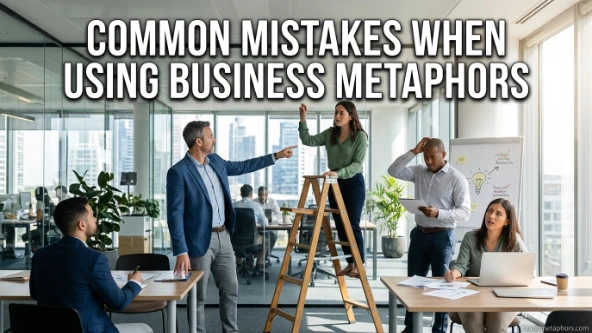
Metaphors are powerful—but they can mislead if used poorly.
Common mistakes include:
- Mixing unrelated metaphors (ship + machine confusion)
- Overcomplicating simple ideas
- Using clichés without meaning
- Losing clarity in poetic language
A metaphor should illuminate, not confuse.
If people need to decode your metaphor, it has already failed.
H2: Interactive Exercises to Practice Business Metaphors
Let’s make this practical.
Exercise 1: Build Your Own Metaphor
Think of your workplace. Is it:
- A jungle?
- A sports team?
- A kitchen?
Now explain why.
Exercise 2: Rewrite Plain Sentences
Transform this: “Our company is growing fast.”
Try: “Our company is a wildfire of innovation spreading across new markets.”
Exercise 3: Emotional Mapping
Choose a business challenge and assign it a metaphor:
- Stress = storm
- Opportunity = sunrise
- Failure = detour
Notice how your thinking changes.
These exercises train your mind to see business as a living story, not just data.
H2: Bonus Tips for Using Business Metaphors in Writing and Social Media
If you want your communication to stand out, metaphors are your secret weapon.
- Use metaphors in headlines for engagement
- Keep them simple and relatable
- Match metaphor with audience (formal vs creative)
- Don’t overuse—one strong image is enough
- Combine metaphor with real data for balance
On social media, metaphors can turn boring updates into memorable messages.
Instead of: “We achieved growth this quarter,” say: “We’ve climbed another peak—and the view is just getting better.”
H2: The Lasting Power of Business Metaphors
Business is not only built with numbers—it is built with imagination. Metaphors give structure to that imagination.
They help leaders lead, teams connect, and ideas travel faster than reports ever could. Whether it is a ship navigating storms, a garden growing patiently, or a machine humming with precision, metaphors shape how we see success itself.
The most successful businesses are not just efficient or profitable—they are meaningful stories people believe in.
FAQs on Metaphors for Business
1. What are metaphors for business?
They are creative comparisons that explain business ideas using familiar images like ships, gardens, or machines.
2. Why are metaphors important in business communication?
They simplify complex ideas, improve understanding, and create emotional connection.
3. Can metaphors improve leadership skills?
Yes, they help leaders inspire teams, communicate vision clearly, and build unity.
4. What is the most common business metaphor?
The “business as a machine” and “business as a ship” are among the most widely used.
5. How can I use metaphors in marketing?
Use them in slogans, storytelling, and branding to create strong emotional identity and memorability.
Conclusion
Metaphors for business are more than linguistic decoration—they are tools of thought. They shape how we interpret challenges, guide teams, and imagine growth. When used wisely, they transform business communication from mechanical reporting into meaningful storytelling.
In a world overflowing with data, metaphors remind us of something essential: every business is not just a system, but a story in motion—waiting to be understood, shaped, and told.