

Introduction: When the World Feels Too Loud to Understand
There are moments when life doesn’t feel like a straight road—it feels like a room where everything is happening at once. The kettle is whistling, notifications are buzzing, thoughts are overlapping like radio stations fighting for signal, and even silence feels noisy. In those moments, we reach for language that can hold what logic cannot. That is where metaphors for chaos become powerful.
Chaos is not just messiness. It is emotional overload, unpredictability, sudden change, and the feeling that control has slipped through your fingers like sand. Writers, poets, and storytellers often use metaphors to shape this invisible storm into something we can see, hear, and feel. A storm inside the mind. A tangled thread refusing to be pulled straight. A collapsing city of thoughts.
These images do more than decorate language—they help us understand experience itself. Whether you are a writer trying to express inner turmoil, a student learning creative expression, or simply someone trying to make sense of overwhelming days, metaphors for chaos can give shape to what feels shapeless.
Let’s step into the world of disorder—not to tame it, but to translate it.
What Are Metaphors for Chaos? Understanding Emotional and Creative Disorder
Metaphors for chaos are imaginative comparisons that describe confusion, disorder, or emotional intensity through vivid imagery. Instead of saying “I feel overwhelmed,” we might say “my mind is a storm without weather forecasts.” This shift transforms abstract emotion into sensory experience.
Chaos metaphors often appear in literature, psychology, and everyday speech because they help externalize internal states. When feelings are too complex, metaphor becomes a bridge between emotion and understanding.
In literature, chaos is rarely just destruction—it is transformation, uncertainty, and motion. Think of ancient myths where storms signal divine conflict or rebirth. Even in modern storytelling, chaos often marks turning points where characters are forced to change.
On a personal level, using metaphors for chaos can help us process stress, anxiety, or creative overload. It gives structure to the unstructured. It does not erase disorder—it gives it language.
Chaos as a Storm Inside the Mind: Emotional Turbulence Explained
One of the most powerful metaphors for chaos is the storm inside the mind. This metaphor captures emotional turbulence, where thoughts clash like thunderclouds and feelings flash like lightning without warning.
Meaning and Explanation
A storm suggests movement, intensity, and unpredictability. When applied to the mind, it represents overwhelming thoughts, anxiety spirals, or emotional conflict.
Example Sentence
“My thoughts became a storm, each worry crashing louder than the last until I couldn’t hear myself think.”
Alternative Expressions
- A thunderstorm of emotions
- Mental hurricane
- Rain of racing thoughts
- Lightning-struck mind
Sensory and Emotional Detail
You can almost hear the roar—fast breathing, pounding heartbeats, mental noise like wind tearing through trees. There is no stillness, only motion.
Mini Storytelling Moment
Imagine a student sitting before an exam paper, ink trembling on the pen tip. Outside, it is sunny. Inside, however, questions swirl like dark clouds. Each memory of forgetting a formula becomes lightning. The storm is invisible to others but deafening within.
Cultural Reference
In Romantic poetry, especially in the works of poets like Lord Byron, storms often symbolize inner emotional unrest—proof that nature and human emotion are deeply connected.
Chaos as a Tangled Thread: When Life Refuses to Unravel
Another powerful metaphor for chaos is the tangled thread or knot, representing confusion, complexity, and emotional entanglement.
Meaning and Explanation
A knot suggests something that was once organized but has become twisted beyond easy repair. It reflects situations where problems overlap and clarity is lost.
Example Sentence
“My plans turned into a knot of deadlines, promises, and forgotten intentions.”
Alternative Expressions
- A web of confusion
- Knotted thoughts
- Twisted timeline
- A ball of tangled yarn
Sensory and Emotional Detail
You can feel the frustration in your fingers trying to pull a thread loose, only to tighten it further. It is slow, irritating, and mentally draining.
Mini Storytelling Moment
Picture an artist reaching into a drawer for a single strand of thread, only to pull out an entire knotted mess. Hours pass as they try to separate it, but each movement makes it worse. That is how certain days feel—every attempt at solving one problem tightens another.
Cultural Reference
In Greek mythology, the idea of knots often symbolized fate—like the Gordian Knot, which could not be untied until Alexander the Great cut through it. Sometimes chaos cannot be gently solved; it must be confronted directly.
Chaos as a Collapsing City: Shifting Landscapes of Thought
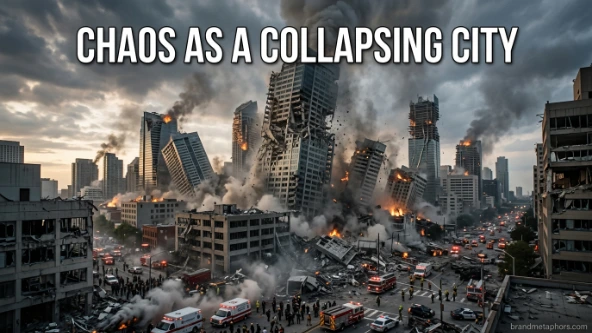
A more dramatic metaphor for chaos is the collapsing city, where order breaks down and structures begin to fall.
Meaning and Explanation
This metaphor represents systems under pressure—mental, emotional, or social—that begin to fail or change rapidly.
Example Sentence
“My routine felt like a collapsing city, each habit falling one after another.”
Alternative Expressions
- Crumbling architecture of thought
- Shifting mental landscape
- Falling towers of routine
- Earthquake of structure
Sensory and Emotional Detail
There is dust in the air, echoing silence after impact, the distant sound of something breaking. It feels both frightening and strangely quiet.
Mini Storytelling Moment
Imagine waking up in a dream where your hometown is slightly different every morning—streets moved, buildings rearranged, familiar paths gone. That disorientation mirrors emotional chaos when nothing feels stable anymore.
Cultural Reference
Post-apocalyptic literature and films often use collapsing cities to symbolize societal chaos—think of ruined skylines in dystopian stories that reflect internal collapse.
Why Writers Use Metaphors for Chaos in Literature and Storytelling
Writers use chaos metaphors because pure description often fails to capture emotional intensity. Saying “I was stressed” is flat; saying “my thoughts were a collapsing thunderstorm of tangled wires” creates impact.
Metaphors for chaos serve three key purposes:
- They make abstract emotions visible
- They create emotional connection with readers
- They add rhythm, imagery, and depth to storytelling
Amid to poetry, chaos metaphors often represent transformation. In novels, they mark turning points. In personal essays, they reveal vulnerability.
Even in everyday communication, people instinctively use them: “my schedule exploded,” “my brain froze,” or “everything is falling apart.” These phrases are not literal—they are emotional shortcuts that carry meaning efficiently.
Real-Life Chaos: How We Experience Disorder in Daily Life
Chaos is not always dramatic. It lives in everyday moments—late buses, unread emails, overlapping responsibilities, and emotional exhaustion.
A parent juggling work and childcare might describe their day as a spinning carousel that never stops. A student during exams may feel like pages are flipping too fast to read. Even simple digital overload—too many tabs, too many messages—can feel like mental clutter.
Chaos in real life is often quiet but persistent. It is not always destruction; sometimes it is simply too much happening at once.
And this is where metaphors become useful—they validate experience. They remind us that feeling overwhelmed is not failure; it is a human response to complexity.
How to Create Your Own Metaphors for Chaos (Interactive Guide)
Creating metaphors for chaos is a creative exercise in observation and imagination.
Try this simple method:
- Identify the feeling: confusion, overwhelm, pressure, or disorder
- Choose a domain: nature, technology, architecture, travel, music
- Connect emotion to image
Example Process
Feeling: mental overload Domain: weather Metaphor: “My thoughts were a forecast that kept changing every second.”
Exercise Prompt
Complete these sentences:
- “My day feels like __________ without direction.”
- “My thoughts are a __________ that won’t settle.”
- “Chaos in my life is like __________ breaking apart.”
Try writing at least five variations using different domains like oceans, machines, or forests.
Creative Writing Prompts and Exercises for Chaos Metaphors
To strengthen your use of chaos metaphors, practice with these creative exercises:
1. Emotional Snapshot Writing
Describe a stressful moment using only metaphorical language. Avoid direct words like “stress” or “confusion.”
2. Object Transformation
Choose an object (clock, mirror, road) and describe it as if it is experiencing chaos.
3. Before and After Contrast
Write two short paragraphs: one where chaos is present, and one where calm returns. Use different metaphors for each.
4. Sensory Expansion
Take one metaphor (e.g., storm) and describe it using all five senses.
These exercises help train the mind to think symbolically rather than literally.
Using Chaos Metaphors in Social Media, Poetry, and Communication

Chaos metaphors are not just for literature—they are powerful in everyday expression.
In Social Media
Short metaphorical lines create emotional resonance:
- “My week is a storm in slow motion.”
- “Currently living inside a tangled timeline.”
In Poetry
Metaphors allow layered meaning and emotional depth. Chaos becomes rhythm, repetition, and imagery.
In Daily Communication
They help others understand your emotional state without lengthy explanation:
- “My schedule is a collapsing puzzle today.”
- “My brain is buffering.”
Bonus Tips
- Keep metaphors fresh—avoid overused ones
- Mix domains (nature + technology) for originality
- Use sensory language for stronger impact
Turning Chaos into Clarity: Finding Meaning in Disorder
Chaos is not always something to escape. Sometimes it is something to understand. In creative thinking, chaos often precedes clarity. A messy draft becomes a refined essay. A tangled idea becomes a breakthrough concept.
Metaphors help us see this transformation. A storm clears the air. A knot teaches patience. A collapsing city becomes a foundation for rebuilding.
When we name chaos creatively, we begin to shape it. And when we shape it, we begin to understand it.
FAQs About Metaphors for Chaos
1. What are metaphors for chaos?
They are imaginative comparisons that describe disorder, confusion, or emotional intensity using vivid imagery like storms, knots, or collapsing structures.
2. Why are chaos metaphors important in writing?
They help express complex emotions in relatable and sensory ways, making writing more engaging and meaningful.
3. Can chaos metaphors be used in everyday speech?
Yes, people naturally use them in phrases like “my brain is fried” or “my schedule is a mess.”
4. How do I create original chaos metaphors?
Combine emotions with unexpected images from nature, technology, or daily life, and focus on sensory detail.
5. Are chaos metaphors only used in literature?
No, they appear in poetry, conversations, social media, therapy, and even business communication.
Conclusion
Chaos is not just disorder—it is experience without clear edges. It is the moment when life feels too full, too fast, or too unpredictable to describe plainly. Metaphors for chaos give us a way to speak that language of overwhelm without losing meaning.
Whether it is a storm in the mind, a tangled thread of thoughts, or a collapsing city of routines, these images help us translate internal noise into expressive clarity. And in doing so, they remind us that even chaos can be understood, shaped, and eventually transformed into something meaningful.
Because sometimes, the first step out of chaos is not control—it is language.