
Introduction
There are moments when a person wakes up and the world feels strangely heavier than it should. The light coming through the window seems dull, sounds feel distant, and even simple tasks—getting out of bed, replying to a message, eating breakfast—feel like climbing a mountain. On the outside, everything may look normal, but inside, something feels quietly collapsed. This is often how depression begins its silent presence in daily life.
One of the most powerful ways humans try to understand such inner experiences is through metaphors. We compare emotional pain to storms, darkness, weight, or emptiness because these images help give shape to something that is otherwise invisible. “Metaphors for depression” are not just poetic expressions; they are bridges that help people explain what they feel when words fail.
Understanding these metaphors matters because they build empathy, awareness, and emotional clarity. They help people recognize their own experiences and allow others to listen with deeper understanding instead of judgment. In this article, we explore powerful metaphors for depression and what they reveal about the emotional world beneath the surface.
1. Depression as a Heavy Fog That Never Fully Lifts
Depression is often described as a thick fog rolling into a familiar landscape. Everything is still there—the roads, the trees, the buildings—but nothing looks clear anymore. This metaphor captures how life can continue, yet feel disconnected and unclear at the same time.
In this fog, decisions become harder. A person might stand in the middle of simple choices—what to eat, whether to go outside—and feel unsure, as if direction itself has disappeared. The fog does not completely block reality; it distorts it. That is what makes it so unsettling.
Emotional meaning
The fog represents confusion, numbness, and reduced emotional clarity. It is not complete darkness but a muted version of life where everything feels distant.
Real-life reflection
A student sitting in class may hear the lecture but cannot fully absorb it, as if the words are passing through mist. They are present but not fully connected.
This metaphor helps explain why depression is often misunderstood: from the outside, everything looks visible, but inside, clarity is missing.
2. Depression as Sinking in a Quiet Ocean
Another powerful image is the feeling of slowly sinking underwater. At first, everything is calm, almost silent. But gradually, the pressure increases, and movement becomes harder. This metaphor reflects how depression can develop slowly, without dramatic warning signs.
What it represents
The ocean symbolizes emotional depth and overwhelming weight. The deeper someone goes, the harder it becomes to reach the surface or ask for help.
Subsection: Losing the surface light
At the beginning, there may still be glimpses of hope, like sunlight reaching the upper water. But as sinking continues, even that light fades.
Subsection: Struggling to rise
People experiencing depression often describe trying to “swim up” emotionally but feeling exhausted before they reach relief.
This metaphor shows why depression is not laziness or lack of effort. It is more like fighting invisible water pressure that drains energy over time.
3. Depression as a Locked Room with No Visible Door
Sometimes depression feels like being inside a room where everything is normal except the exit cannot be found. The walls are not frightening; they are just unchanging. The challenge is the sense of being stuck.
This metaphor reflects emotional isolation. Even when support exists outside, it may not feel reachable.
Emotional interpretation
The locked room represents restriction of thought. A person may replay the same worries repeatedly, unable to find new emotional “routes” out.
Real-life scenario
Someone may receive advice from friends, but inside the room of their mind, those words cannot be fully processed. It feels like hearing voices through a closed door.
This metaphor helps explain why telling someone to “just think positive” often does not work. The issue is not attitude—it is perceived access to emotional freedom.
4. Depression as a Broken Instrument Losing Its Sound

Imagine a musical instrument that once played beautifully but now produces uneven, dull, or missing notes. Depression can feel like that loss of emotional harmony.
Meaning of this metaphor
It reflects how joy, motivation, and interest may not disappear completely but become inconsistent or distorted.
Emotional distortion
A person might laugh at a joke but feel nothing afterward. The “sound” is there, but it does not resonate inside.
Identity impact
This metaphor also highlights identity confusion. People may feel like they are no longer “playing themselves” correctly, even if they remember who they used to be.
It is not that the instrument is destroyed—it is out of tune. And tuning takes time, care, and patience.
5. Depression as a Constant Inner Storm
Unlike a visible storm in the sky, this one happens inside. There may be no external chaos, but internally, thoughts crash like thunder.
What the storm represents
This metaphor captures emotional turbulence—fear, sadness, guilt, and anxiety colliding all at once.
Living through the storm
Some days, the storm is loud and overwhelming. Other days, it becomes a distant rumble, but it rarely disappears completely.
People often learn to function within the storm, continuing daily life while emotionally drenched. This is why outsiders may not realize how intense it feels inside.
The storm metaphor shows that depression is not always silence or emptiness—it can also be emotional overload.
6. Depression as a Backpack Filled with Invisible Weight
Many people describe depression as carrying a backpack that others cannot see. The weight is not physical, yet it affects every step.
Understanding the burden
This backpack contains thoughts like self-doubt, exhaustion, regret, and emotional fatigue. The heavier it becomes, the harder even simple actions feel.
Everyday impact
Walking up stairs, replying to messages, or starting tasks can feel like carrying extra kilograms that no one else notices.
Emotional insight
The invisibility of the weight is what makes it painful. Others may assume everything is fine because there is no visible struggle.
This metaphor teaches empathy: not all burdens are visible, but they can still shape every movement in life.
7. Depression as a Maze Without Clear Exits
A maze represents confusion, repetition, and the feeling of going in circles. Depression often creates similar mental patterns.
Emotional structure of the maze
Thoughts repeat: “Why do I feel this way?” “Will it ever change?” “What is wrong with me?” Each question leads back to the same emotional space.
Subsection: Dead ends of thought
Many paths feel like solutions but lead nowhere emotionally, increasing frustration.
Subsection: Searching for direction
Even when guidance is available, it may feel like the map cannot be read from inside the maze.
This metaphor highlights why depression can feel mentally exhausting—it is not just emotion but constant cognitive searching without resolution.
8. Depression as an Empty House Echoing Silence
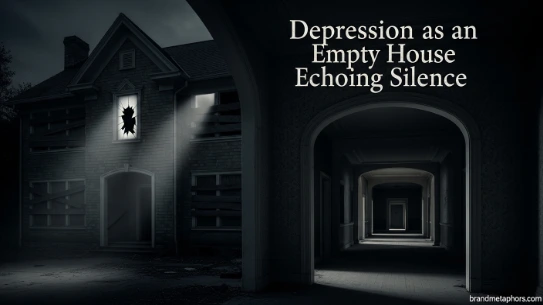
An empty house still has structure, walls, and rooms—but it lacks warmth and life. This metaphor reflects emotional emptiness or numbness.
What it means emotionally
It is not always sadness. Sometimes it is absence—absence of feeling, motivation, or connection.
Real-life experience
A person may sit with family but feel emotionally far away, as if they are in a different room of the same house.
The echo in this metaphor represents thoughts bouncing without emotional response. It helps explain why some people with depression say, “I feel nothing at all.”
9. Depression as a Glass Wall Between Self and the World
This metaphor shows separation rather than absence. The person can see life happening but feels unable to fully step into it.
Emotional meaning
The glass wall is transparent but unbreakable. It allows observation but not participation.
Social impact
Friends may invite someone out, but emotionally it feels like watching life from behind a barrier.
This metaphor is especially powerful because it captures loneliness in the middle of connection. The world is visible, but emotional access feels blocked.
10. Depression as Time Moving Through Thick Sand
Time is usually invisible, but in depression it feels heavy, slow, and sticky—like moving through sand.
What this represents
Minutes can feel like hours. Tasks take longer not because of difficulty, but because of emotional drag.
Psychological effect
This distortion of time increases frustration and self-criticism, making people feel “behind” in life.
The sand metaphor shows how depression changes perception, not just mood. Life does not stop—it slows in a deeply personal way.
11. Depression as a Dim Light That Flickers Instead of Shining
Not all metaphors for depression are entirely dark. Sometimes there is a small light that flickers unpredictably.
Meaning of the flickering light
It represents hope, motivation, or interest that appears briefly and then fades.
Emotional reality
A person may feel okay one morning and deeply low by evening without clear reason. This unpredictability can be confusing.
The flickering light reminds us that even in depression, emotional change is possible, even if unstable.
12. Depression as a Season That Feels Endless
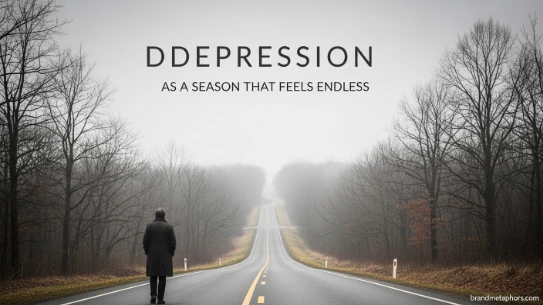
Seasons change in nature, but depression can feel like a winter that refuses to end.
What this metaphor teaches
It shows emotional endurance rather than permanent state. Winter feels long, but it is still a phase.
Human experience
People may forget what emotional “spring” feels like, even though they have experienced it before.
This metaphor brings perspective: even long emotional winters are not permanent, even if they feel endless in the moment.
Conclusion
Metaphors for depression help translate invisible emotional experiences into images that people can understand, feel, and relate to. Whether it is fog that clouds clarity, an ocean that pulls downward, or a backpack of unseen weight, each metaphor reveals a different layer of emotional struggle. Together, they show that depression is not a single feeling but a complex landscape of confusion, numbness, heaviness, and sometimes fragile hope.
Most importantly, these metaphors remind us that emotional pain is real even when it is not visible. They help build empathy, encourage patience, and open space for more compassionate understanding. While depression can feel isolating, these shared images create connection through language. And in that connection, there is often the first quiet step toward understanding and healing.
FAQs
What are metaphors for depression?
They are symbolic comparisons that describe emotional experiences of depression using images like fog, storms, or weight.
Why are metaphors important in understanding depression?
They help explain invisible feelings in a way that is easier to understand and relate to.
Can metaphors help people with depression communicate better?
Yes, they allow people to express complex emotions when direct words feel difficult.
Is depression always described with negative metaphors?
Not always. Some metaphors include light, seasons, or recovery to show hope and change.
Why is depression compared to weight or pressure?
Because many people feel emotionally and physically exhausted, as if carrying something heavy.
Do metaphors make depression easier to understand for others?
Yes, they help others empathize by turning abstract emotions into familiar images.
Can depression feel different for each person?
Yes, which is why many different metaphors are used to describe it.