
Introduction
Picture a bustling marketplace at sunset. Voices rise in different languages, spices perfume the air with unfamiliar warmth, fabrics shimmer in colors you can’t quite name. At first, it may feel overwhelming—so many differences colliding in one space. But linger for a moment, and something shifts. The chaos becomes harmony. The unfamiliar becomes fascinating. The diversity becomes the very thing that makes the scene come alive.
This is the power of diversity—not just as a social concept, but as a lived experience. Yet, diversity can sometimes feel abstract or misunderstood. That’s where metaphors come in. They translate complexity into something we can see, feel, and understand. By comparing diversity to vivid images and relatable ideas, metaphors help us grasp its beauty, its challenges, and its importance in everyday life.
In this article, we’ll explore a rich collection of metaphors for diversity—each offering a different lens. Through stories, reflections, and practical insights, you’ll discover how diversity shapes not just societies, but perspectives, relationships, and growth itself.
Diversity as a Tapestry
A tapestry is one of the most common metaphors for diversity—and for good reason. Each thread is distinct in color and texture, yet when woven together, they create something far more meaningful than any single strand.
Imagine a grandmother weaving a tapestry by hand. Each thread represents a person—different backgrounds, beliefs, and experiences. Alone, each thread is simple. Together, they tell a story.
Why this metaphor matters
This metaphor emphasizes connection. Diversity isn’t just about coexistence; it’s about interdependence. Remove one thread, and the pattern weakens.
Real-life reflection
In a workplace, for instance, diverse perspectives often lead to better decisions. One person’s viewpoint fills the gap another might miss. Like threads, people strengthen each other.
Diversity as a Garden
Think of a garden filled with roses, sunflowers, lilies, and wildflowers. Each plant requires different care, yet together they create a vibrant ecosystem.
H3: A Garden Thrives on Variety
A single-type garden may look orderly, but it lacks resilience. A diverse garden attracts more pollinators, survives changing conditions, and feels alive.
H3: Lessons from the Garden
- Differences are not flaws—they’re necessities
- Growth requires understanding unique needs
- Harmony doesn’t mean uniformity
Mini story
A gardener once tried planting only one type of flower. The result? Disease spread quickly. When he diversified, the garden flourished.
Diversity as a Symphony
A symphony blends different instruments—violins, drums, flutes—each contributing a unique sound.
Imagine if every instrument played the same note. The result would be dull, even irritating. Diversity in sound creates emotion, depth, and beauty.
Emotional insight
Diversity brings richness to human experience. It creates contrast, which makes life more meaningful.
Practical takeaway
In teams, encourage different voices rather than silencing them. The “noise” might actually be harmony waiting to be organized.
Diversity as a Puzzle
A puzzle is incomplete without all its pieces. Each piece is shaped differently, and only together do they reveal the full picture.
Understanding the metaphor
Diversity reminds us that no single perspective can capture the whole truth. Each person adds a piece.
Real-life scenario
Consider solving a complex problem. One person may focus on logic, another on empathy, another on creativity. Together, they form a complete solution.
Deeper meaning
This metaphor highlights belonging. Every piece has a place—even if it takes time to find it.
Diversity as a Library
A library holds countless books, each telling a different story. Some are familiar, others challenge our worldview.
H3: Stories Expand Understanding
Reading different perspectives helps us grow. Similarly, interacting with diverse people expands empathy.
H3: Avoiding a Single Story
If you only read one genre, your understanding remains limited. The same applies to life.
Reflection
Think about a time when someone’s story changed your perspective. That’s diversity in action.
Diversity as a Mosaic
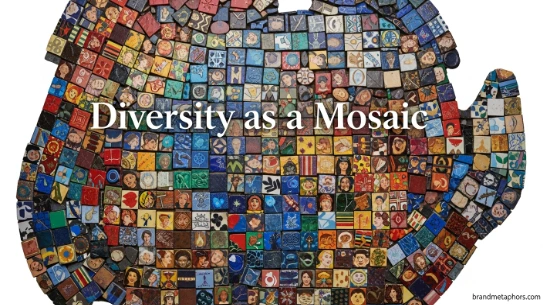
A mosaic is made from small, varied pieces of glass or stone. Individually, they may seem random. Together, they form a stunning image.
Symbolism
Diversity isn’t always immediately cohesive. It can seem fragmented. But with time and perspective, it reveals a bigger picture.
Mini storytelling
An artist once discarded imperfect tiles, thinking they ruined the design. Later, those same pieces became the most striking part of the mosaic.
Lesson
Imperfections and differences often create the most beauty.
Diversity as a Recipe
Imagine cooking a dish using only salt. It’s incomplete. Flavor comes from combining different ingredients.
H3: Balance and Contrast
Sweet, sour, spicy, and savory elements create depth. Diversity works the same way.
H3: Cultural Reflection
Food itself is a reflection of diversity—blending traditions, techniques, and flavors across cultures.
Everyday application
Embrace different ideas like ingredients. Even if they seem unusual, they might enhance the outcome.
Diversity as a River System
A river system includes streams, tributaries, and currents—all flowing together.
Deeper insight
Each stream has its origin, but they merge into something larger. Diversity reflects shared humanity despite different beginnings.
Real-life connection
People come from different backgrounds, yet contribute to a collective society.
Lesson
Unity doesn’t erase individuality—it channels it.
Diversity as a Toolbox
A toolbox with only one tool is limited. A variety of tools allows you to handle different challenges.
Practical meaning
Diversity equips groups to solve a wider range of problems.
Scenario
A team facing a crisis benefits from varied skills—analytical thinkers, communicators, and innovators.
Insight
Differences are not obstacles; they are resources.
Diversity as a Color Palette
An artist’s palette includes countless colors. Limiting to one shade restricts creativity.
Emotional angle
Colors evoke feelings. Diversity brings emotional richness to life.
Mini story
A painter once used only black and white. When introduced to color, his work transformed—becoming more expressive and alive.
Lesson
Diversity expands possibility.
Diversity as a Forest
A forest contains different trees, animals, and ecosystems working together.
H3: Strength in Ecosystems
Biodiversity ensures resilience. If one species struggles, others support the balance.
H3: Human Parallel
Societies function similarly. Diversity strengthens adaptability.
Reflection
Uniform systems are fragile. Diverse ones endure.
Diversity as a Conversation
Imagine a conversation where everyone agrees. It ends quickly and offers little growth.
Insight
Diversity introduces dialogue, debate, and learning.
Real-life example
Healthy discussions often involve differing viewpoints. That’s where innovation happens.
Lesson
Listening is key. Variety isn’t just about speaking—it’s about hearing.
Diversity as a Journey
Diversity can also be seen as a journey—one that involves exploration, discomfort, and growth.
Emotional depth
Encountering differences can feel unfamiliar. But that discomfort often leads to understanding.
Mini story
A traveler once feared foreign cultures. After immersing himself, he realized those differences enriched his life.
Lesson
Growth lies beyond familiarity.
Diversity as Light Through a Prism
When light passes through a prism, it splits into a spectrum of colors.
Meaning
What appears as one becomes many—revealing hidden complexity.
Reflection
Human identity is similar. Beneath surface similarities lies a spectrum of experiences.
Insight
Diversity reveals what unity alone cannot.
Common Misunderstandings About Diversity
Despite its importance, diversity is often misunderstood.
Misconception 1: Diversity means division
In reality, it creates connection through understanding.
Misconception 2: It’s only about visible differences
Diversity includes thoughts, experiences, and perspectives.
Misconception 3: It’s inconvenient
While it may require effort, the benefits far outweigh the challenges.
Practical advice
Approach diversity with curiosity rather than judgment. That shift changes everything.
Applying Diversity Metaphors in Daily Life
Metaphors aren’t just poetic—they’re practical tools.
H3: At Work
Think of your team as a toolbox or symphony. Encourage different strengths.
H3: In Relationships
View differences as puzzle pieces rather than conflicts.
H3: In Personal Growth
Treat life like a library—seek new perspectives intentionally.
Key takeaway
Understanding diversity begins with how you see it. Metaphors reshape perception, and perception shapes behavior.
Conclusion
Diversity is not a problem to solve—it’s a reality to understand and embrace. Through metaphors like tapestries, gardens, symphonies, and mosaics, we begin to see diversity not as fragmentation, but as richness. Each difference adds depth, meaning, and possibility to the human experience.
When we shift our perspective, diversity transforms from something unfamiliar into something essential. It becomes the thread that strengthens communities, the color that brightens creativity, and the voice that deepens understanding.
The next time you encounter difference, pause. Instead of asking, “Why is this different?” ask, “What does this add?” That simple shift can turn confusion into curiosity—and curiosity into connection.
FAQs
What are metaphors for diversity?
Metaphors for diversity are symbolic comparisons—like a tapestry or garden—that help explain the value and meaning of differences among people.
Why are metaphors useful for understanding diversity?
They simplify complex ideas and make them relatable, helping people emotionally and intellectually connect with the concept.
Which metaphor best represents diversity?
There isn’t just one. A tapestry, garden, and symphony are all powerful, each highlighting different aspects like unity, growth, and harmony.
How can I use these metaphors in real life?
Apply them in conversations, teamwork, and personal reflection to better understand and appreciate differences.
Is diversity always beneficial?
While it may bring challenges, diversity generally leads to stronger, more creative, and resilient outcomes when managed thoughtfully.
Can diversity exist without inclusion?
Yes, but it won’t thrive. Inclusion ensures that diverse voices are heard and valued.
How do metaphors change perception?
They shape how we think and feel, turning abstract ideas into vivid, meaningful experiences that influence behavior.