
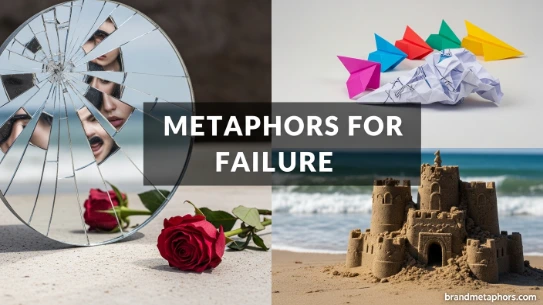
Introduction (180–200 words)
There is a moment most people recognize but rarely talk about. It is the quiet after something does not work out—the exam result that falls short, the business idea that collapses, the relationship that fades, or the opportunity that slips away just when hope was building. In that moment, failure does not feel like a concept. It feels like a weight in the chest, a pause in time, and a question that keeps repeating: What now?
This is where metaphors become powerful. Instead of treating failure as a final verdict, metaphors help us see it as something familiar, something we can understand and move through. They turn confusion into clarity and emotional heaviness into meaning. When we say failure is “a broken bridge” or “a storm passing through,” we are not avoiding reality—we are reshaping how we relate to it.
This article explores metaphors for failure that help explain its emotional, mental, and practical sides. Each image offers a different lens, helping us understand not only what failure is, but also what it does, and how it can shape growth in real life. By the end, failure may feel less like an ending and more like a process with direction.
Failure as a Broken Bridge
Failure is often like standing before a bridge that suddenly collapses halfway. You can see where you wanted to go, but the path is no longer safe or complete. This metaphor captures the sudden interruption of plans and expectations.
A broken bridge does not mean the destination is gone. It means the route needs to change. In life, this can be a job rejection, a failed exam, or a project that does not reach completion. The emotional impact comes from the shock of realizing that effort alone was not enough to carry you across.
What this metaphor teaches
- Plans can fail even with strong effort
- Alternatives often exist beyond the visible path
- Rebuilding requires patience and redesign
Instead of standing still at the broken edge, this metaphor encourages stepping back and looking for new crossings—other routes, new skills, or different timing. Failure, then, is not the end of movement. It is a forced redirection toward a better or more suitable path.
Failure as a Teacher in Disguise
Failure can feel harsh, but it often carries lessons that success never teaches. Like a strict teacher, it corrects without softness, but with purpose.
When a student fails a test, they often remember the material more deeply afterward. The discomfort creates awareness. Similarly, in life, mistakes highlight what was missing—preparation, timing, strategy, or understanding.
Hidden lessons inside failure
- It shows gaps in knowledge or preparation
- It builds emotional strength through experience
- It forces honest self-evaluation
This metaphor helps reframe failure not as punishment, but as instruction. A disguised teacher may not be pleasant, but it is effective. Many people only realize their true strengths after first recognizing their weaknesses through failure.
Instead of asking “Why did this happen to me?”, this perspective asks “What is this trying to teach me?” That shift turns pain into information.
Failure as Falling and Standing Up
Failure is like falling while learning to walk. Everyone understands that a child does not learn balance without losing it first. The fall is not the opposite of learning—it is part of it.
In adulthood, however, we often forget this simple truth. A failed attempt feels final instead of developmental. But every fall contains the mechanics of improvement: what went wrong, how balance was lost, and how to adjust next time.
Emotional reality of falling
- Embarrassment and frustration
- Temporary loss of confidence
- Fear of repeating the mistake
Yet standing up after falling builds resilience. The act of trying again transforms failure into progress. Over time, repeated falls become fewer, not because failure disappears, but because balance improves.
This metaphor reminds us that movement forward always includes missteps. What matters is not avoiding falling, but refusing to stay down.
Failure as a Storm Passing Through
Failure can feel overwhelming, like a storm that suddenly enters life and disrupts everything. Plans scatter, emotions rise, and visibility becomes unclear.
But storms are temporary. They pass, even if they feel endless in the moment. This metaphor emphasizes time and perspective. What feels permanent today often becomes a memory tomorrow.
What storms leave behind
- Cleared emotional pressure
- Stronger awareness of priorities
- A calmer environment after chaos
During a storm, the best action is not control, but patience. Similarly, in failure, forcing immediate solutions often increases stress. Sometimes, waiting for clarity is part of recovery.
When the storm passes, life does not return exactly as before. It changes. But it also becomes clearer. This metaphor helps reduce panic and encourages emotional endurance during difficult phases.
Failure as a Locked Door
A locked door represents opportunity that is visible but inaccessible. You can see what you wanted, but you cannot enter. This is one of the most frustrating experiences of failure.
However, a locked door does not mean there are no other rooms. It simply means that particular entry is unavailable right now.
How people respond to locked doors
- Some keep trying the same key repeatedly
- Some give up completely
- Others search for different doors
This metaphor highlights flexibility. Failure often happens when one specific approach does not work. Instead of forcing the same method, new strategies may open different opportunities.
Sometimes the lock represents timing, skills, or external conditions—not personal worth. Understanding this reduces self-blame and encourages exploration.
Failure as a Burnt Map
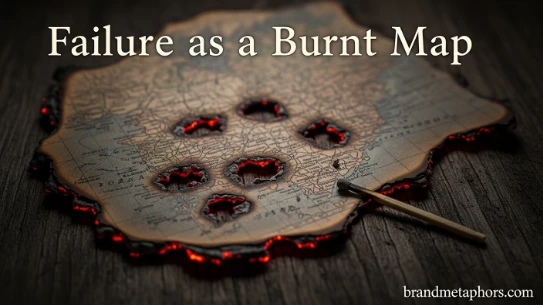
A burnt map symbolizes losing direction after believing you had everything planned. It represents confusion when strategies fail and guidance disappears.
Many people rely heavily on plans, expecting life to follow them. But when failure happens, those plans feel useless, like ashes.
Emotional effects of a burnt map
- Loss of direction
- Anxiety about next steps
- Doubt in decision-making ability
Yet even a burnt map teaches something valuable: no map is permanent. Real navigation often requires adjusting in real time. Instead of relying on old instructions, people learn to read the present moment more carefully.
This metaphor teaches adaptability. When the map is gone, awareness becomes the new guide.
Failure as a Cracked Mirror
A cracked mirror still reflects an image, but not a perfect one. This metaphor represents self-perception after failure. People often begin to question their abilities, identity, or worth.
The cracks represent doubts and emotional damage. However, the reflection is still real.
Insights from a cracked mirror
- Imperfection does not erase identity
- Self-view becomes more complex but also more honest
- Growth comes from accepting flaws
Failure can distort self-image temporarily. But over time, people learn to see beyond the cracks and understand themselves more deeply. Instead of breaking identity, failure reshapes it into something more realistic and grounded.
Failure as Compost for Growth
In nature, compost is made from decay, yet it becomes the foundation for new life. This is one of the most powerful metaphors for failure.
What once felt useless—mistakes, losses, and setbacks—can become material for future growth.
How failure becomes compost
- Experiences turn into wisdom
- Pain becomes emotional strength
- Mistakes guide better decisions
This metaphor completely changes how failure is valued. It is no longer wasteful; it is transformative. Growth often depends on what was previously broken down.
Instead of discarding failure, this perspective suggests using it as fuel for improvement.
Failure as an Empty Cup
An empty cup represents a moment when effort feels drained and results are missing. It can feel like nothing is left to give.
However, emptiness also means space. A full cup cannot receive anything new, but an empty one can.
Meaning of the empty cup
- A pause for recovery
- Space for new learning
- Opportunity to refill with better strategies
This metaphor encourages rest and renewal. Failure often empties emotional and mental energy. Instead of seeing this as weakness, it can be seen as preparation for refill and growth.
Failure as Tangled Thread
Failure can feel like a thread that has become tightly tangled. The more you pull, the worse it gets. This represents situations where confusion increases despite effort.
Lessons from tangled thread
- Force does not always solve problems
- Patience leads to clearer solutions
- Small steps untangle complexity
This metaphor highlights the importance of slowing down. Many failures become worse when rushed solutions are applied. Careful attention often reveals simple fixes hidden in complexity.
Reframing Failure in Daily Life
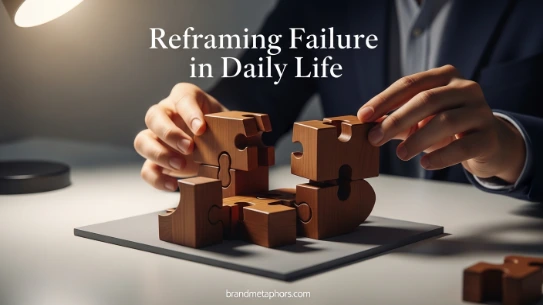
Metaphors only become useful when they change behavior. In daily life, failure is not rare—it appears in studies, work, relationships, and personal goals.
Practical reframing techniques
- Replace “I failed” with “this attempt didn’t work”
- Identify one lesson from each setback
- Separate identity from outcome
Failure becomes less personal and more procedural. Instead of defining who you are, it describes what happened in a specific moment.
This shift reduces emotional pressure and increases learning speed. Over time, people who reframe failure effectively become more resilient and adaptable.
Conclusion
Failure is rarely just one thing. It is not only loss, or mistake, or disappointment. Through metaphors, we see it as many different experiences: a broken bridge that redirects us, a storm that eventually passes, a teacher in disguise, or compost that feeds future growth. Each image adds a layer of understanding that makes failure less heavy and more meaningful.
When failure is seen through these lenses, it becomes part of movement rather than an end point. It teaches patience, flexibility, self-awareness, and resilience. Most importantly, it reminds us that setbacks are not separate from growth—they are often where growth begins. By changing how we interpret failure, we also change how we respond to it. And in that shift, failure becomes not a final chapter, but a necessary part of the story forward.
FAQs
What are metaphors for failure?
Metaphors for failure are simple comparisons that help explain failure in easier and more meaningful ways.
Why are metaphors useful for understanding failure?
They reduce emotional pressure and make complex feelings easier to understand.
Can failure really lead to growth?
Yes, failure often highlights mistakes and helps improve future decisions.
Is failure always negative?
No, failure can also provide learning, experience, and direction.
How does failure affect confidence?
It can lower confidence temporarily but can also build stronger resilience over time.
What is the best way to respond to failure?
Reflect on what went wrong, learn from it, and try again with better understanding.
Why do people fear failure?
Because it is linked to embarrassment, loss, and uncertainty.
Can mindset change how we see failure?
Yes, a positive mindset can transform failure into a learning opportunity.