
Introduction
On a quiet evening, someone stands beneath a vast sky filled with scattered stars. The world feels both infinitely large and intimately close. In that moment, a question often rises quietly in the mind: How can something so immense, so beyond comprehension, ever be described in words? Across cultures, languages, and centuries, people have tried to answer this question not with certainty, but with imagination. They have turned to metaphors—bridges between what we know and what we cannot fully grasp.
Metaphors for God are not literal definitions. Instead, they are ways of expressing the inexpressible. They help people relate to the divine through familiar images like light, love, ocean, father, or shepherd. These expressions shape spiritual understanding, emotional comfort, and personal belief. In everyday life, they influence how people pray, hope, and interpret life’s challenges.
This article explores different metaphors for God, their meanings, emotional depth, and real-life relevance. It also looks at how these metaphors shape human thought, bring comfort, and sometimes create misunderstanding when taken too literally. By the end, you will see how metaphor becomes a powerful tool—not to define God completely, but to help the human heart understand something greater than itself.
The Power of Metaphor in Understanding the Divine
Metaphors are essential because human language has limits. When we try to describe something infinite or eternal, literal words fall short. Metaphors step in to fill that gap by connecting the unknown with the known.
For example, saying “God is light” does not mean physical light. Instead, it expresses clarity, guidance, and hope. Light removes darkness, just as divine understanding is believed to remove confusion and fear.
Metaphors allow people to build emotional relationships with abstract ideas. Without them, spiritual concepts would feel distant and unreachable. Through metaphor, people can feel meaning rather than just think about it.
Why metaphors matter in daily life
- They shape how people interpret life events
- They provide emotional comfort during hardship
- They help express deep beliefs in simple ways
In daily conversations, people might not realize they are using metaphors when they say things like “God is watching over me.” Yet these phrases shape their sense of safety and meaning. Metaphors are not just poetic tools—they are mental frameworks that influence belief, identity, and hope.
God as Light: Illumination and Truth
One of the most universal metaphors is God as light. Across cultures, light represents truth, wisdom, and guidance. Darkness, in contrast, often symbolizes confusion, fear, or ignorance.
When people say “God is light,” they are expressing the idea of spiritual clarity. Just as light reveals what is hidden in darkness, divine presence is believed to reveal truth in uncertain times.
Emotional meaning of light
Light brings warmth, safety, and direction. In moments of emotional struggle, this metaphor helps people feel that confusion will not last forever.
Real-life interpretation
A student struggling with decisions might feel “lost in the dark.” When clarity comes, they may describe it as “seeing the light.” This does not refer to physical illumination but inner understanding.
The metaphor of light encourages hope. It suggests that no matter how confusing life becomes, understanding and peace are always possible.
God as Love: Relationship and Connection

Another deeply rooted metaphor is God as love. This image emphasizes closeness, care, and emotional connection rather than distance or authority.
Love is something humans experience daily—through family, friendship, and compassion. By comparing God to love, people bring the divine into the realm of personal experience.
H3: Love as unconditional presence
This metaphor suggests acceptance beyond conditions or expectations. It reflects the idea that divine care is not earned but freely given.
H3: Emotional impact in life
When people feel lonely or rejected, the metaphor of divine love can provide emotional healing. It reframes isolation as something temporary and reminds individuals that they are still valued.
In relationships, this metaphor also encourages people to act with kindness and forgiveness, reflecting the same love they believe they receive.
God as Father or Mother: Protection and Care
Many traditions describe God using family roles such as father or mother. These metaphors express care, guidance, discipline, and protection.
A father figure often symbolizes strength and authority, while a mother figure represents nurturing and comfort. Together, they create a balanced image of divine care.
H3: Comfort in vulnerability
When life feels uncertain, the idea of a protective parent figure brings emotional stability. It helps individuals feel supported even in isolation.
H3: Limitations of the metaphor
However, this metaphor can also be challenging for those with difficult family experiences. It shows how metaphors are powerful but not universal.
Still, the intention is not literal family structure but emotional security and trust in something greater.
God as the Ocean: Vastness and Mystery
The ocean is often used to describe something vast, deep, and beyond full understanding. Similarly, God is compared to the ocean to express infinity and mystery.
Standing at the shore, one can see waves but cannot see the ocean’s full depth. This reflects the idea that human understanding can only grasp parts of the divine.
Emotional depth of this metaphor
The ocean metaphor creates a sense of humility. It reminds people that not everything can be controlled or fully understood.
Life reflection
During uncertain times, this metaphor can help people accept ambiguity. Instead of demanding full answers, they learn to trust the unknown, just as sailors trust the sea.
God as Shepherd: Guidance and Direction
The shepherd metaphor describes God as a guide who leads and protects. A shepherd cares for sheep, ensuring they do not get lost or harmed.
This metaphor emphasizes direction, care, and vigilance. It suggests that even when people feel lost, they are still being guided.
H3: Feeling guided in uncertainty
When facing major life decisions, people may feel like they are “following a path.” This metaphor reinforces the idea that guidance exists even when the destination is unclear.
H3: Human responsibility
At the same time, sheep still move and choose paths. This shows that guidance does not remove human responsibility but supports it.
God as Creator: Source of Life and Order
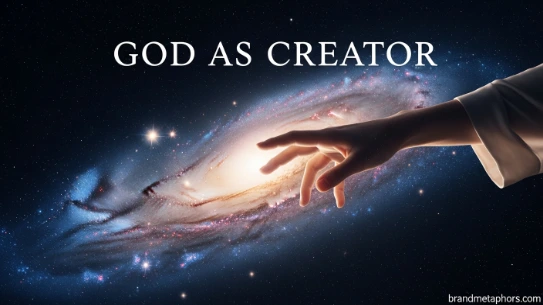
The creator metaphor presents God as the origin of everything—life, nature, and existence itself. It emphasizes structure, intention, and design.
This metaphor helps people understand existence as meaningful rather than random. It connects the universe to a conscious source.
Emotional significance
Knowing that life has a “source” can bring comfort. It gives meaning to existence and encourages gratitude for life itself.
Real-life interpretation
People often use this metaphor when reflecting on nature, beauty, or birth. It creates a sense of awe and appreciation for life’s complexity.
God as Judge: Justice and Moral Order
The judge metaphor reflects fairness, accountability, and moral structure. It suggests that actions have consequences and that justice ultimately exists.
This metaphor is often used to explain ethical behavior and encourage responsibility.
H3: Moral awareness
It helps individuals think about right and wrong more carefully, shaping behavior through accountability.
H3: Emotional complexity
While it can bring comfort to those seeking justice, it may also create fear if misunderstood. It shows how metaphors can influence emotions in different ways.
God as Fire: Transformation and Power
Fire is a powerful metaphor representing transformation, intensity, and purification. It destroys but also renews.
In this sense, God as fire symbolizes change that leads to growth. Difficult experiences may feel painful but can result in transformation.
Emotional meaning
Fire can feel both frightening and energizing. It reflects moments in life when change is unavoidable but necessary.
Life example
Someone overcoming hardship may describe it as “going through fire.” This reflects transformation rather than destruction alone.
God as Artist: Creativity and Expression
The artist metaphor portrays God as a creator of beauty, patterns, and complexity. Life is seen as a form of artistic expression.
This idea encourages people to see meaning in details—colors, experiences, and relationships.
H3: Life as a creative process
Just as artists shape their work over time, life is viewed as evolving and meaningful even in imperfect forms.
H3: Emotional inspiration
This metaphor inspires creativity in individuals, encouraging them to express themselves through art, writing, or action.
God as Time: Eternity and Continuity
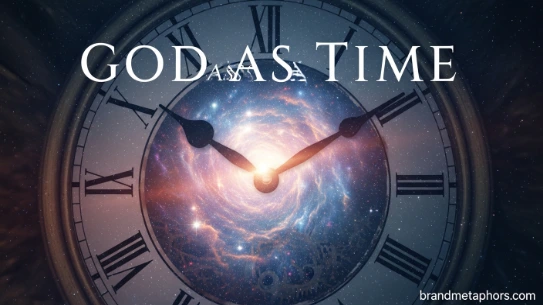
Time is another metaphor used to describe the divine as eternal and unchanging. Unlike human life, time continues endlessly.
This metaphor helps people understand permanence beyond human limits.
Reflection on existence
It encourages thinking beyond immediate concerns and seeing life as part of a larger continuum.
Emotional effect
It can bring both peace and awe, reminding individuals that life is part of something ongoing and vast.
Misunderstanding Metaphors: When Symbol Becomes Literal
One common issue with metaphors is taking them too literally. When symbolic language is misunderstood, it can limit spiritual understanding.
For example, interpreting “God as father” only in human terms may restrict its deeper meaning of care and guidance.
H3: Importance of flexibility
Metaphors are meant to expand understanding, not restrict it. They should be seen as perspectives, not fixed definitions.
H3: Emotional awareness
Understanding metaphor helps people respect different interpretations and avoid unnecessary conflict.
The Role of Metaphors in Everyday Spiritual Life
Metaphors are not just abstract ideas—they influence daily thinking. People use them in prayer, reflection, and conversation without even realizing it.
They shape how individuals interpret success, failure, hope, and loss.
For example, someone may say they feel “guided” or “held,” expressing emotional states through metaphorical language. These expressions help people process experiences in meaningful ways.
Ultimately, metaphors create a bridge between human experience and spiritual understanding.
Conclusion
Metaphors for God are not attempts to define the infinite but to relate to it. Through images like light, love, ocean, shepherd, fire, and creator, people give shape to ideas that cannot be fully contained in words. These metaphors provide comfort, meaning, and emotional connection in everyday life.
However, their true strength lies in flexibility. They are not fixed truths but evolving perspectives that help individuals understand something beyond human limits. When used thoughtfully, metaphors encourage reflection, compassion, and a deeper awareness of life’s mysteries.
In the end, metaphors remind us that understanding the divine is not about certainty but about connection—between thought and feeling, language and imagination, human experience and the unknown.
FAQs
What is a metaphor for God?
A metaphor for God is a symbolic way of describing the divine using familiar ideas like light, love, or nature to express deeper meaning.
Why are metaphors used to describe God?
Metaphors help express concepts that are too vast or abstract for literal language, making them easier to understand emotionally and intellectually.
Are metaphors for God meant to be taken literally?
No, they are symbolic. Taking them literally can limit their meaning and reduce their deeper spiritual and emotional value.
What is the most common metaphor for God?
Some of the most common metaphors include light, love, father or mother, and creator, depending on cultural and spiritual traditions.
How do metaphors help in spiritual life?
They provide emotional comfort, guidance, and a way to relate personal experiences to spiritual beliefs in everyday life.
Can different metaphors be used at the same time?
Yes, multiple metaphors can coexist, each highlighting different aspects of understanding the divine.
What happens if metaphors are misunderstood?
Misunderstanding metaphors can lead to confusion or rigid beliefs, which is why it is important to see them as symbolic rather than literal.