
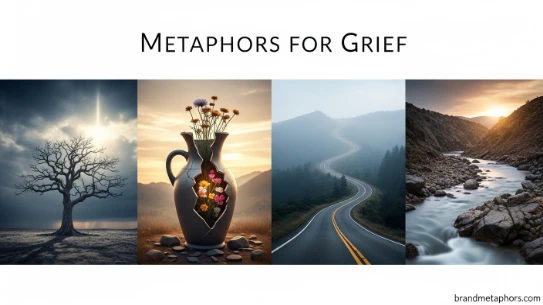
Introduction (150–200 words)
Grief rarely arrives with warning or clarity. It doesn’t knock politely or follow a predictable path. Instead, it often feels like waking up in a familiar room where something essential has quietly disappeared. A chair is still there, a routine still continues, yet the meaning behind it has shifted in a way that is difficult to explain. In moments like these, language becomes fragile. Words fall short, and people often turn to metaphors to express what cannot be said directly.
Metaphors for grief help us translate the invisible weight of loss into something we can slightly understand. They allow us to say, “It feels like a storm inside me,” or “It is like carrying something heavy I cannot put down.” These comparisons do not remove pain, but they give shape to it.
This article explores powerful metaphors for grief and what they reveal about human emotion. By understanding these symbolic expressions, we gain deeper insight into how people process loss, heal slowly, and find meaning in suffering. Each metaphor is not just poetic language—it is a reflection of lived experience.
Understanding Metaphors for Grief
Grief is complex, personal, and often contradictory. It can feel both heavy and empty, loud and silent, constant yet unpredictable. Because of this emotional complexity, metaphors become essential tools for expression. They allow individuals to communicate internal experiences that cannot be measured or easily described.
When someone says grief feels like “a fog,” they are not speaking literally. They are describing confusion, emotional distance, and lack of clarity. Metaphors bridge the gap between internal emotion and external communication. They give structure to something that otherwise feels formless.
Psychologically, metaphors also help people process emotions safely. By shifting pain into symbolic language, the mind can observe it without becoming overwhelmed. Saying grief is “a long road” subtly introduces the idea of movement and progress, even when it feels slow.
In everyday life, metaphors also help others understand what a grieving person is experiencing. They create empathy by offering shared images. Instead of explaining complicated emotions in clinical terms, metaphors make grief relatable, human, and emotionally accessible.
Grief as an Ocean: Waves, Depth, and Tides
One of the most common metaphors for grief is the ocean. It represents vastness, unpredictability, and emotional depth. At times, grief feels calm, like still water. At other moments, it rises suddenly like a crashing wave, pulling everything back under.
Waves of Emotion
Grief as waves suggests that pain does not follow a straight timeline. Some days are manageable, while others feel overwhelming without warning. A person may feel stable in the morning and drowned by evening.
The Depth of Silence
The ocean also represents depth—emotions that cannot be seen from the surface. Even when someone appears fine, there may be currents of sadness moving underneath.
This metaphor is powerful because it normalizes emotional fluctuation. It reassures people that grief is not linear. Just like tides, it comes and goes, but it remains connected to something larger within us. Over time, people learn not to fight the ocean but to learn how to float within it.
Grief as a Shadow That Follows You
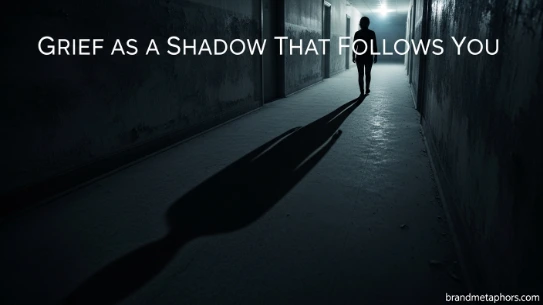
Another powerful metaphor is grief as a shadow. A shadow is always present but changes shape depending on light and environment. Similarly, grief often follows a person everywhere, even when they are not actively thinking about their loss.
At first, the shadow feels overwhelming—large, dark, and consuming. Over time, it may become less intrusive, but it rarely disappears completely. Instead, it becomes part of movement and identity.
This metaphor reflects the idea that grief is not something to “get rid of,” but something that integrates into life. A person may laugh, work, or travel, but the shadow remains nearby, especially during quiet moments or emotional triggers.
The shadow metaphor also highlights how grief shifts over time. In some lighting—happy moments—it may seem smaller. In darker times, it becomes more noticeable. This helps people understand why grief can suddenly return even after long periods of calm.
Grief as a Broken Mirror of the Self
Grief is often described as a broken mirror because it reflects a changed sense of identity. When a significant loss occurs, a person may feel as though the image they once had of life—and themselves—has fractured.
Fragmented Identity
Each shard of the mirror reflects a memory, emotion, or version of the past. Some pieces are clear, while others are distorted or painful to look at.
Searching for Wholeness
People often try to “put themselves back together,” but the metaphor suggests that the original image cannot fully return. Instead, individuals learn to live with a new reflection.
This metaphor helps explain why grief is not just about losing someone, but also about losing a version of the self. It acknowledges that identity changes after loss. Over time, the broken mirror becomes less about damage and more about transformation—showing a life that has been reshaped but not destroyed.
Grief as a Heavy Weight You Carry
Many people describe grief as a physical weight. It feels like carrying something invisible but extremely heavy on the chest, shoulders, or back.
Constant Physical Presence
Unlike emotional pain that comes and goes, weight feels constant. It affects energy, motivation, and even simple tasks like getting out of bed.
Gradual Adaptation
Over time, the weight may not disappear, but the body becomes stronger. People learn how to carry it differently. What once felt unbearable becomes part of daily movement.
This metaphor is especially powerful because it connects emotional pain with physical sensation. It validates exhaustion and fatigue that often accompany grief. It also introduces the idea that healing is not about removing the weight, but learning to live with it in a manageable way.
Grief as a Storm: Chaos and Emotional Weather
Grief is frequently compared to a storm—sudden, powerful, and uncontrollable. It arrives without warning and disrupts everything in its path.
Storms represent emotional chaos: tears, anger, confusion, and numbness. Just like weather systems, grief has phases. There is buildup, intensity, and eventual calm.
However, storms can return. This reflects how grief is not a single event but a recurring emotional experience. A memory, date, or sound can trigger another emotional storm long after the initial loss.
Despite its destruction, storms also clear the air. This aspect of the metaphor suggests that intense emotional expression can lead to release and clarity. After the storm passes, there is often a quiet stillness—a moment of emotional reset.
Grief as a Garden: Growth Through Seasons
Grief as a garden is a more hopeful metaphor. It suggests that emotional healing grows slowly over time, like plants responding to seasons.
In early grief, the garden may feel barren, frozen, or lifeless. Nothing seems to grow, and everything feels still. But beneath the surface, roots are still forming.
Seasons of Healing
- Winter: numbness and isolation
- Spring: small moments of awareness and healing
- Summer: connection and emotional warmth
- Autumn: reflection and acceptance
This metaphor reminds us that healing is cyclical, not linear. Some seasons feel more painful than others, but each is part of a natural process. The garden does not rush growth—it simply continues.
Grief as a Wound That Slowly Heals
Another common metaphor is grief as a wound. At first, the pain is sharp, raw, and constant. It demands attention and care.
Over time, the wound begins to close. However, even when healed, it may leave a scar. The scar does not mean the pain is still active, but that the experience remains part of personal history.
This metaphor helps normalize emotional sensitivity. Certain triggers may “reopen” emotional discomfort temporarily, just as physical scars can become sensitive under pressure. Healing, therefore, is not forgetting—it is adaptation and resilience.
Grief as an Empty Room Filled with Absence
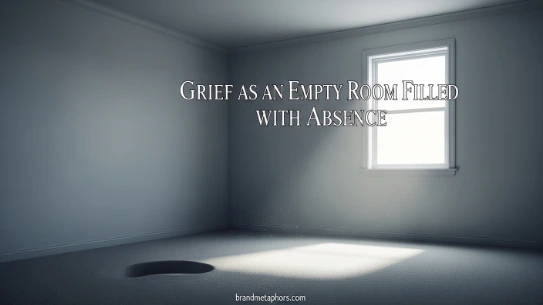
Grief can also feel like entering an empty room that once held warmth, noise, and presence. The furniture is still there, but something essential is missing.
This metaphor emphasizes absence rather than pain. The silence itself becomes emotional. Everyday objects suddenly carry memory and meaning.
The empty room metaphor reflects how grief is often experienced in ordinary spaces—kitchens, bedrooms, or hallways—where absence feels most noticeable. It captures the emotional echo that remains after loss, where presence is remembered through its disappearance.
Grief as a Long and Uncertain Journey
Grief is often described as a journey because it involves movement through time, even when progress feels invisible.
Unpredictable Paths
There is no map for grief. Some paths are straight, others are circular or blocked. People may feel lost, retrace steps, or pause for long periods.
Companionship and Solitude
Sometimes the journey is walked alone; other times, others join briefly before continuing their own paths.
This metaphor highlights patience. It suggests that grief is not about reaching a destination quickly, but about learning how to continue walking despite uncertainty.
Cultural Interpretations of Grief Metaphors
Different cultures use unique metaphors to describe grief, shaped by traditions, beliefs, and language. Some cultures view grief as a spiritual transition, while others emphasize emotional endurance or collective mourning.
In some traditions, grief is seen as a river carrying memories forward. In others, it is described as a fire that both destroys and purifies. These variations show that while grief is universal, its expression is deeply cultural.
Understanding these metaphors helps build empathy across differences. It reminds us that no single image can fully capture grief, but many perspectives together create a more complete understanding.
How Metaphors Help Healing and Emotional Understanding
Metaphors are not just poetic tools—they are therapeutic. They help individuals name emotions that are otherwise overwhelming or unclear.
By saying grief is “a storm,” a person acknowledges chaos without becoming consumed by it. By calling it “a journey,” they allow space for movement and change. Metaphors create emotional distance just enough to observe pain without being fully absorbed by it.
They also support communication. When people cannot explain their feelings directly, metaphors allow others to understand them more deeply. This fosters empathy, connection, and emotional validation.
Ultimately, metaphors help transform grief from something silent and isolating into something shared and understood.
Conclusion
Grief is one of the most universal yet deeply personal human experiences. It resists simple explanation, which is why metaphors become so powerful in expressing it. Whether described as an ocean, a shadow, a broken mirror, or a long journey, each metaphor reveals a different layer of emotional truth.
These symbolic expressions do not remove pain, but they give it shape, language, and meaning. They help people recognize that grief is not a single feeling but a shifting experience that evolves over time. Some metaphors emphasize heaviness, others highlight growth or transformation, but all point to one shared reality: grief is part of being human.
By understanding these metaphors, we learn not only how to describe loss, but how to sit with it, carry it, and eventually integrate it into life with greater compassion and clarity.
FAQs
What are metaphors for grief?
Metaphors for grief are symbolic expressions that describe emotional loss in relatable imagery, such as oceans, storms, or journeys.
Why do people use metaphors to describe grief?
People use metaphors because grief is complex and difficult to explain directly. Metaphors make emotions easier to understand and communicate.
Is grief really like a wave or ocean?
Yes, many people experience grief in waves—intense emotions that come and go unpredictably over time.
Can grief ever fully go away?
Grief usually does not disappear completely. Instead, it changes form and becomes easier to carry over time.
Why is grief compared to a shadow?
Because it stays present in some form, even when a person is not actively thinking about loss.
How do metaphors help in healing?
They help people process emotions, feel understood, and express feelings that are otherwise hard to verbalize.
Are grief metaphors the same in all cultures?
No, different cultures use different metaphors based on traditions, beliefs, and emotional frameworks.