
Introduction
There are moments in life when silence feels heavier than sound. You lie awake at night, replaying a conversation that went wrong, a decision you wish you could undo, or a word that slipped out too harshly. The room is quiet, yet inside your mind, everything feels loud. That lingering discomfort, that tight feeling in the chest, is often what we call guilt. But guilt is not always easy to explain in simple words.
This is where metaphors become powerful. They turn invisible emotions into something we can picture, feel, and understand. Instead of being just a vague emotion, guilt becomes a heavy stone, a burning fire, or a shadow that follows us everywhere. These images help us recognize what guilt is doing inside us and how it affects our thoughts, behavior, and peace of mind.
In this article, we will explore deep and relatable metaphors for guilt. Each one reveals a different layer of this complex emotion. By understanding these metaphors, we can better understand ourselves, our reactions, and even how to heal from emotional burdens.
Guilt as a Heavy Stone on the Heart
One of the most common metaphors for guilt is a heavy stone placed on the heart. It describes how guilt can feel physically exhausting, even when nothing is physically wrong with us.
Imagine walking with a backpack filled with rocks. At first, it seems manageable, but over time, every step becomes harder. This is how guilt works in real life. It slows down your thoughts, drains your energy, and makes even simple tasks feel overwhelming.
People often carry guilt silently. They smile in public but feel weighed down in private. The “stone” does not disappear on its own; it stays until it is acknowledged or released. This metaphor shows that guilt is not just emotional—it affects the body too, creating stress, fatigue, and restlessness.
Real-life example
A person who hurts a friend unintentionally may keep replaying the moment again and again. Each replay adds more weight, like another stone added to the backpack.
Understanding this metaphor helps us realize that guilt needs attention, not suppression. When we face it honestly, the stone becomes lighter.
Guilt as a Shadow That Follows You
Another powerful metaphor is guilt as a shadow. A shadow is always present when there is light, just like guilt often follows us even when we try to move forward.
This shadow does not always shout. Instead, it quietly stays behind us, influencing how we think and act. You may be enjoying a moment, yet still feel a small voice reminding you of past mistakes.
Unlike physical shadows, emotional shadows cannot be escaped by simply changing direction. They stay until we confront the source of light—or in this case, the cause of guilt.
Why this metaphor matters
A shadow grows when the light is strong. Similarly, guilt can grow when we avoid facing it. The more we ignore it, the more noticeable it becomes in our daily life.
Simple reflection
If guilt is a shadow, then awareness is light. When we understand our actions and accept responsibility, the shadow becomes less frightening and more manageable.
Guilt as a Burning Fire Inside

Guilt is often described as a burning fire inside the mind or chest. This metaphor reflects how guilt can feel intense, sharp, and uncomfortable.
At first, the fire may be small—a spark of regret. But when ignored, it can grow stronger, creating emotional heat that is difficult to escape. This “fire” can show up as anxiety, sleeplessness, or constant overthinking.
H3: The slow burn of regret
Some guilt does not explode immediately. Instead, it burns slowly over time, especially when a person cannot apologize or make things right.
H3: Emotional lessons from fire
Fire is not always destructive. It can also signal danger and push us to change. In the same way, guilt can motivate growth when understood properly.
This metaphor teaches that guilt must be handled carefully. Ignoring it allows it to spread, but understanding it can turn its energy into learning and transformation.
Guilt as a Broken Mirror
Guilt can also be seen as a broken mirror. A mirror normally reflects a clear image of who we are. But when it breaks, the reflection becomes distorted.
When someone feels guilt, their self-image often becomes damaged. They may start seeing themselves as “bad” or “unworthy,” even if the mistake was small or unintentional.
H3: Distorted self-image
A broken mirror does not show the full truth. Similarly, guilt can exaggerate mistakes and hide positive qualities.
H3: Healing the reflection
Repairing a broken mirror takes time. In emotional terms, this means forgiving oneself and rebuilding self-trust.
This metaphor helps us understand that guilt often changes how we see ourselves, not just what we did. Healing begins when we separate actions from identity.
Guilt as Chains That Restrict Movement
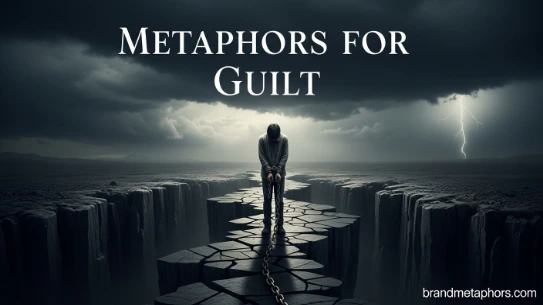
Guilt is often compared to chains because it restricts emotional freedom. These chains are not visible, but they can feel very real.
People with strong guilt may avoid certain places, conversations, or even relationships. They feel tied to their past actions and unable to move forward.
H3: Emotional restriction
Chains limit movement. In the same way, guilt can limit choices and create fear of repeating mistakes.
H3: Breaking free
The chains of guilt weaken when we take responsibility, apologize when needed, and learn from our actions.
This metaphor shows that guilt is not meant to imprison us forever. It is meant to guide us until we understand the lesson behind it.
Guilt as a Storm Inside the Mind
Guilt can also feel like a storm. Thoughts become loud, chaotic, and uncontrollable. One moment you feel calm, and the next, waves of regret hit you again.
In this storm, logic becomes difficult to hear. Emotions take over, creating confusion and mental pressure.
A storm also suggests movement. Guilt does not stay still; it shifts and changes depending on memories, triggers, or reminders.
The key lesson in this metaphor is that storms eventually pass. No emotional storm lasts forever. When we allow ourselves to process guilt instead of resisting it, the storm slowly becomes calm weather again.
Guilt as an Echo That Repeats

Guilt can be seen as an echo that repeats your past actions or words. Even when the moment is gone, the sound returns in your mind.
You may hear phrases like “I should not have done that” or “Why did I say that?” repeating again and again. These mental echoes can become exhausting.
Why echoes matter
An echo becomes louder in empty spaces. Similarly, guilt becomes stronger when we are alone with our thoughts and without resolution.
Breaking the echo cycle
The echo fades when it meets understanding. Accepting the past helps silence repetitive self-blame.
This metaphor shows that guilt often survives through repetition, not reality.
Guilt as an Emotional Wound
Guilt is also compared to a wound. Just like a physical injury, emotional wounds need time and care to heal.
At first, the wound feels sharp and sensitive. Even small reminders can hurt deeply. Over time, if cared for, it begins to heal, leaving a scar instead of pain.
H3: Infection of unresolved guilt
When ignored, guilt can “infect” thoughts, leading to shame or self-criticism.
H3: Healing process
Healing requires honesty, self-forgiveness, and sometimes making amends.
This metaphor teaches that guilt is not permanent pain—it is a temporary injury that can recover with care.
Guilt as a Silent Courtroom in the Mind
Sometimes guilt feels like an internal courtroom where you are both the accused and the judge. Your thoughts constantly question your actions, intentions, and decisions.
In this courtroom, evidence is often one-sided. You focus only on mistakes and ignore good intentions or circumstances.
This leads to harsh self-judgment, where even small errors feel like major crimes.
The lesson here is balance. A fair “mental court” must consider context, intention, and learning—not just blame.
Healthy Guilt vs Toxic Guilt
Not all guilt is harmful. Some guilt helps us grow, while other forms trap us in negativity.
H3: Healthy guilt
Healthy guilt appears when we recognize a mistake and want to correct it. It leads to learning, apology, and change.
H3: Toxic guilt
Toxic guilt keeps repeating even after we have learned the lesson. It turns into self-blame and emotional suffering.
Understanding this difference helps us respond better to our emotions instead of being controlled by them.
How to Understand and Release Guilt
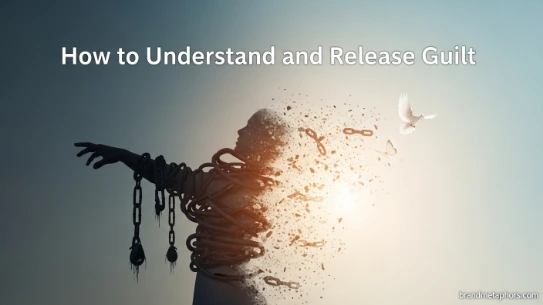
Guilt becomes easier to handle when we understand it instead of fighting it.
First, identify what the guilt is trying to tell you. Often, it points to values like honesty, kindness, or responsibility.
Second, take action if needed. This may include apologizing or correcting a mistake.
Third, practice self-forgiveness. Everyone makes errors, and growth requires acceptance.
Finally, learn from the experience and move forward instead of staying stuck in the past.
When treated properly, guilt becomes a teacher rather than a punishment.
Conclusion
Guilt is a complex emotion, but metaphors help us understand it in simple and meaningful ways. Whether it feels like a heavy stone, a burning fire, a shadow, or a broken mirror, each image reveals how deeply it can affect our thoughts and emotions.
However, guilt is not meant to stay forever. It exists to guide us, not to imprison us. When we understand its message, take responsibility where needed, and practice self-forgiveness, guilt loses its power to control us.
In the end, guilt is not just pain—it is also a path toward awareness, growth, and emotional maturity. By recognizing its metaphors, we learn not only about guilt but also about ourselves.
FAQs
What are metaphors for guilt?
Metaphors for guilt are simple images like a heavy stone, shadow, or fire that help explain how guilt feels emotionally.
Why do we use metaphors for emotions like guilt?
Metaphors make complex emotions easier to understand by connecting them to familiar visual or physical experiences.
Is guilt always negative?
No, guilt can be healthy when it encourages learning and positive change.
How does guilt affect mental health?
Excessive guilt can lead to anxiety, stress, and low self-esteem if not managed properly.
Can guilt go away completely?
Yes, guilt can fade when it is understood, addressed, and replaced with self-forgiveness.
What is the difference between guilt and shame?
Guilt focuses on actions (“I did something wrong”), while shame affects identity (“I am wrong”).
How can I release guilt in a healthy way?
You can release guilt by accepting responsibility, making amends if possible, and practicing self-forgiveness.
Why does guilt feel physical sometimes?
Guilt activates stress responses in the body, which can cause heaviness, tension, or fatigue.