

The school bell rings in the distance—sharp, familiar, almost like a heartbeat of a building that never truly sleeps. In its echo, students shuffle through hallways that smell faintly of chalk dust, polished floors, and early morning hopes.
Somewhere, a pencil drops. Somewhere else, laughter bursts like sunlight through a cloudy window.
School is not just a place. It is a living metaphor in itself.
We often think of school as a system of classrooms, textbooks, exams, and schedules. But language gives us something deeper: metaphors that transform school into something far more vivid and meaningful. A prison of discipline to some, a garden of growth to others, or even a battlefield of challenges and victories.
These metaphors help us understand not just what school is—but what it feels like, what it means, and how it shapes who we become.
In this article, we’ll explore powerful metaphors for school, unpack their meanings, and learn how to use them in writing, storytelling, and everyday reflection. You’ll also find creative exercises, storytelling moments, and practical tips to make these ideas your own.
Metaphors for School: Why They Matter in Language and Life
Metaphors are not just literary decorations. They are bridges between abstract ideas and human experience.
When we say “school is a factory,” we’re not literally talking about machines. We’re expressing how students are processed, standardized, and shaped. When we say “school is a garden,” we highlight growth, care, and patience.
These comparisons matter because they:
- Help us understand emotions tied to education
- Shape how students perceive learning
- Influence how teachers teach and students learn
- Make writing more vivid and expressive
In short, metaphors turn school from a rigid institution into a living story.
Now let’s explore three powerful metaphors that capture the essence of school in different lights.
1. School as a Garden of Growth: Where Minds Bloom Slowly
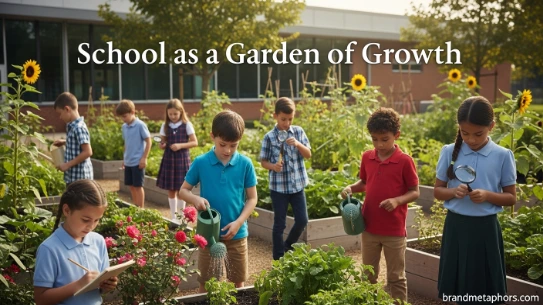
Imagine a vast garden at dawn. Dew rests gently on leaves. Seeds buried in soil begin their invisible work. Nothing looks dramatic at first—but beneath the surface, everything is changing.
This is school as a garden.
Meaning and Explanation
In this metaphor, students are seeds. Teachers are gardeners. Knowledge is sunlight and water. Growth is slow, patient, and deeply natural.
Not every plant grows at the same speed. Some bloom early, others take time. Some need more care, more attention, more warmth.
Example Sentence or Scenario
“Her classroom was a garden of curious minds, each student blooming in their own season.”
Alternative Expressions
- School is a greenhouse of potential
- Learning is cultivation of the mind
- Education is tending young minds like plants
Sensory and Emotional Details
You can almost feel the soft rustle of leaves in this metaphor. The quiet patience. The sense that nothing is wasted—not even slow progress. It reassures students that growth is not a race but a rhythm.
Mini Storytelling Moment
A young boy once believed he was “bad at school” because he learned slower than others. But his teacher, noticing his careful curiosity, compared him to bamboo. “It grows underground for years before shooting up,” she said. Years later, that boy became a writer—slowly, quietly, beautifully growing into himself.
2. School as a Factory of Minds: Structured, Systematic, and Standardized
Now shift the image.
You hear machines humming. Conveyor belts move steadily. Everything is measured, timed, and inspected. Each product is expected to look similar, function similarly, perform similarly.
This is school as a factory.
Meaning and Explanation
In this metaphor, students are products in a production line. Curriculum is the assembly process. Exams are quality control. The goal is efficiency and uniformity.
This metaphor is often used critically, highlighting how education systems sometimes prioritize standardization over individuality.
Example Sentence or Scenario
“Some critics argue that modern education turns school into a factory, producing identical answers instead of original thinkers.”
Alternative Expressions
- School as a production line of grades
- Education as standardized manufacturing
- Learning as assembly-line instruction
Sensory and Emotional Details
There is a metallic echo in this metaphor. A sense of repetition. Clockwork precision. For some, it feels safe and structured; for others, restrictive and cold.
Mini Storytelling Moment
A girl once loved painting galaxies on the edges of her notebook. But her teachers told her to stay within lines, to focus on “correct answers.” She began to feel like she was being shaped into something she wasn’t.
Years later, she became an illustrator. Looking back, she said: “School taught me discipline—but I had to unlearn the factory before I could become myself.”
3. School as a Battlefield: Struggles, Strategy, and Victory

Now the tone changes again.
You hear footsteps echo like marching boots. There are challenges, deadlines, rivalries, and pressure. Every exam feels like a battle. Every result like a victory or defeat.
This is school as a battlefield.
Meaning and Explanation
In this metaphor, students are warriors. Exams are battles. Grades are trophies or scars. Success requires strategy, endurance, and resilience.
It reflects the competitive side of education—where students often feel they are constantly proving themselves.
Example Sentence or Scenario
“He entered exam season like a soldier entering battle, armed with notes, caffeine, and determination.”
Alternative Expressions
- School is an arena of competition
- Education is a series of intellectual battles
- Learning is a quest for academic victory
Sensory and Emotional Details
There is tension here. The rustle of paper during exams feels like armor shifting. The ticking clock becomes a war drum. Anxiety and adrenaline coexist.
Mini Storytelling Moment
A student once failed his exams and felt defeated. He described it as “losing a battle.” But a teacher told him, “You are not the war—you are the warrior learning strategy.”
That shift changed everything. He stopped fearing failure and started studying differently. The battlefield became less about winning instantly and more about learning to fight smarter.
Interactive Exercise: Create Your Own School Metaphor

Take a moment and try this:
- Think of your school or learning experience.
- Choose an image: ocean, spaceship, library, jungle, machine, or anything else.
- Complete this sentence:
“School is like __________ because __________.”
Now expand it:
- Who are the students in this metaphor?
- Who is the teacher?
- What represents success or failure?
Example:
“School is like a spaceship because every lesson is a new planet to explore, and every mistake is just a course correction.”
Bonus Tips: Using Metaphors for School in Writing and Daily Life
Metaphors are powerful tools beyond literature. Here’s how you can use them:
1. In Essays and Creative Writing
Instead of saying:
- “School is difficult”
Try:
- “School feels like climbing a mountain in fog, where each step requires faith before sight.”
2. In Social Media Posts
Metaphors make captions memorable:
- “Today felt like navigating a stormy classroom sea 🌊📚”
3. In Speech or Presentations
Use metaphors to make ideas relatable:
- “Education is not a race, it is a journey through a vast landscape.”
4. In Personal Reflection
Metaphors help you understand your own experience:
- Are you growing like a garden?
- Are you struggling like a warrior?
- Are you feeling processed like a factory product?
The Emotional Power of School Metaphors
Each metaphor reveals a different truth:
- The garden teaches patience
- The factory critiques systemization
- The battlefield reflects pressure and resilience
None of them are fully right or wrong. Instead, they are lenses—ways of seeing the same reality differently.
And perhaps that is the most important lesson: school is not one fixed meaning. It is many meanings layered together, shifting depending on who is looking.
FAQs About Metaphors for School
H3: What is a metaphor for school?
A metaphor for school is a figurative comparison that describes school as something else, like a garden, factory, or battlefield, to express deeper meaning.
H3: Why are metaphors important in describing school?
They help people understand emotional, social, and educational experiences in a more vivid and relatable way.
H3: What is the most common metaphor for school?
One of the most common is “school is a factory,” often used to critique standardized education systems.
H3: How can students use metaphors in writing?
Students can use metaphors to make essays, stories, and reflections more creative and expressive.
H3: Can school have multiple metaphors at the same time?
Yes. School is complex, and different metaphors highlight different aspects of the same experience.
H3: How do metaphors help with learning?
They make abstract ideas easier to understand and remember by connecting them to familiar images or emotions.
Conclusion
School is never just walls, books, and exams. It is a living experience shaped by emotion, growth, pressure, and possibility.
That we see school as a garden, we learn patience. When we see it as a factory, we question structure. When we see it as a battlefield, we understand struggle and resilience.
But perhaps school is not one metaphor at all.
Perhaps it is all of them at once—a shifting landscape where every student walks a different path, carrying a different story, seeing a different sky.
And in that diversity of meaning lies the true beauty of education.