
The Sea That Speaks in Symbols: An Introduction to Sea Metaphors
Close your eyes for a moment and imagine standing at the edge of the sea. The air tastes of salt and wind. Waves rise and fall like breathing. Somewhere far out, the horizon dissolves into mystery, as if the world is quietly refusing to end.
The sea is never just water.
This is movement. It is memory. It is mood. This is a living metaphor waiting to be shaped by language.
That is why writers, poets, and storytellers have long relied on metaphors for the sea to express emotions and ideas that are too vast for plain words. The ocean becomes a mirror for human experience—sometimes calm and reflective, sometimes violent and overwhelming, sometimes endlessly unknown.
In writing, sea metaphors help transform simple sentences into emotional landscapes. In everyday life, they help us understand feelings that are hard to name. And in storytelling, they create imagery that lingers long after the words are gone.
This article explores powerful sea metaphors, how they work, and how you can use them creatively in writing, speech, and even social media storytelling.
Why Sea Metaphors Matter in Writing and Expression
The sea is one of the richest sources of imagery in language because it naturally contains contrast: calm and chaos, beauty and danger, stillness and motion.
When we use ocean metaphors, we are not just describing water—we are describing experience.
Sea metaphors help you:
- Express emotions more vividly
- Add depth to storytelling
- Create relatable imagery
- Connect abstract ideas with sensory experience
- Make writing more poetic and memorable
For example, instead of saying “I felt overwhelmed,” a sea metaphor lets you say: “I was drowning in waves of thought.”
That single image carries emotion, movement, and intensity all at once.
Powerful Metaphors for Sea in Writing and Poetry
Below are three rich and commonly used metaphors for the sea, each explained in depth with meaning, examples, sensory detail, and creative variations.
1. The Sea as Emotion: “A Storm Within the Mind”
Meaning and Explanation
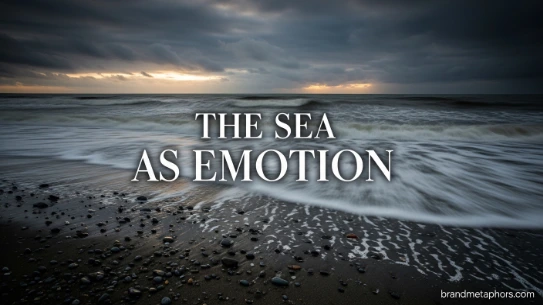
In this metaphor, the sea represents human emotions—especially turbulent or overwhelming feelings. Calm waters reflect peace, while storms represent anger, anxiety, grief, or confusion.
The mind becomes an ocean, and thoughts become waves.
Example Sentence or Scenario
“Her thoughts turned into a restless sea, each worry crashing harder than the last.”
Alternative Expressions
- “An ocean of emotion”
- “Stormy waters of the heart”
- “Waves of feeling crashing inside”
- “A mind flooded with tides of emotion”
Sensory and Emotional Detail
Imagine standing on a cliff during a storm. Wind lashes your face, waves roar below, and everything feels uncontrollable. That is what emotional overwhelm feels like in this metaphor—internal weather without shelter.
Mini Storytelling Element
A young student waits for exam results. On the outside, she smiles politely. But inside, her thoughts churn like a stormy sea—hope rising like waves, fear sinking like heavy anchors. Every passing minute feels like thunder echoing across her mind.
Why This Metaphor Works
It connects emotional experience with something physical and universal. Everyone has seen or imagined stormy seas, making the feeling instantly relatable.
2. The Sea as Life’s Journey: “A Voyage Across Unknown Waters”
Meaning and Explanation
Here, the sea represents life itself—a journey filled with uncertainty, discovery, challenges, and direction changes. Ships symbolize individuals navigating their path.
Example Sentence or Scenario
“Life is an endless voyage across shifting seas, where every decision is a change of course.”
Alternative Expressions
- “Sailing through life’s tides”
- “Crossing the ocean of existence”
- “Navigating uncertain waters”
- “A journey across deep waters”
Sensory and Emotional Detail
You can almost hear the creaking of a wooden ship, feel the salt spray on your skin, and see stars guiding travelers at night. The sea becomes both teacher and obstacle.
Cultural and Literary Reference
This metaphor is common in ancient seafaring cultures and literature. In many myths, sailors represent human destiny—guided by stars, fate, or divine winds. Even in modern storytelling, life is often described as “setting sail” or “weathering storms.”
Mini Storytelling Element
A fisherman leaves his harbor at dawn every day, not knowing what the sea will give him. Some days it offers abundance, other days emptiness. But he still sails—because the sea is not just his livelihood, it is his life’s path.
Why This Metaphor Works
It captures uncertainty and growth in a single image. Life rarely moves in straight lines, just like the sea never stays still.
3. The Sea as Mystery: “An Endless Book of Hidden Stories”
Meaning and Explanation
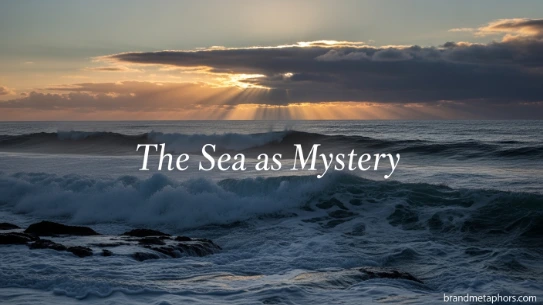
In this metaphor, the sea becomes a keeper of secrets, memories, and unknown truths. It represents depth, mystery, and the unseen world beneath the surface.
Example Sentence or Scenario
“The ocean holds stories no one has ever read, written in currents and buried in silence.”
Alternative Expressions
- “A silent archive of secrets”
- “An unspoken world beneath waves”
- “A hidden library of tides”
- “Depths of unknown memory”
Sensory and Emotional Detail
Think of diving underwater—light fading, sound disappearing, and a quiet world unfolding beneath you. Shipwrecks, coral cities, and forgotten treasures exist in imagination just below the surface.
Mini Storytelling Element
An old coastal villager believes the sea remembers everything: lost ships, whispered promises, and forgotten names. At night, he listens to the waves as if they are speaking in a language older than time.
Why This Metaphor Works
It taps into human curiosity. The sea is physically vast and scientifically still not fully explored, making it perfect for representing mystery and imagination.
Interactive Exercises: Practice Using Sea Metaphors
Try these creative prompts to build your own sea metaphors:
Exercise 1: Emotion Mapping
Pick an emotion (joy, fear, sadness, excitement). Now describe it as a type of sea.
- Is it calm like a lagoon?
- Wild like a storm?
- Deep like an abyss?
Write 3 sentences using that comparison.
Exercise 2: Life as a Journey
Write a short paragraph describing your life as a sea voyage. Include:
- A ship (you)
- A destination (goal)
- A weather condition (challenge)
Exercise 3: Hidden Depths
Describe a secret or memory as something hidden under the sea. Use sensory language:
- What does it look like underwater?
- What sounds surround it?
- How deep is it?
Bonus Tips for Using Sea Metaphors in Writing and Daily Life
- Use contrast: Pair calm seas with chaos for emotional impact.
- Avoid overuse: One strong sea metaphor is better than many weak ones.
- Blend senses: Add sound (waves), sight (horizon), and touch (salt wind).
- Use in social media captions: “Some days I am a calm sea. Some days I am a storm pretending to be still.”
- In storytelling: Use sea metaphors to transition between emotional states.
- In journaling: Describe your mood daily as a “weather report of the sea.”
FAQs About Metaphors for Sea
What are sea metaphors in writing?
Sea metaphors are figurative expressions that compare emotions, life, or ideas to the ocean or sea, helping create vivid imagery.
Why are ocean metaphors so popular in literature?
Because the sea naturally represents depth, mystery, emotion, and change—making it perfect for expressing human experiences.
How can I use sea metaphors in daily writing?
You can use them in journaling, storytelling, poetry, captions, or even speeches to make your language more expressive and emotional.
What emotions do sea metaphors usually represent?
They often represent calmness, chaos, sadness, freedom, uncertainty, and emotional depth.
Can sea metaphors improve creative writing?
Yes, they help create stronger imagery, emotional connection, and memorable descriptions that engage readers more deeply.
Conclusion
The sea is more than a body of water—it is a language of emotion, movement, and mystery. Through metaphors for the sea, writers transform invisible feelings into vivid imagery that readers can see, hear, and feel.
Whether the ocean is calm like a whisper or violent like a storm, it always reflects something human within us. That is why sea metaphors never grow old—they shift, expand, and breathe just like the tides themselves.
So the next time you write, imagine the sea not just as a setting, but as a voice. Let your words sail, sink, rise, and drift—until they find their own horizon.