
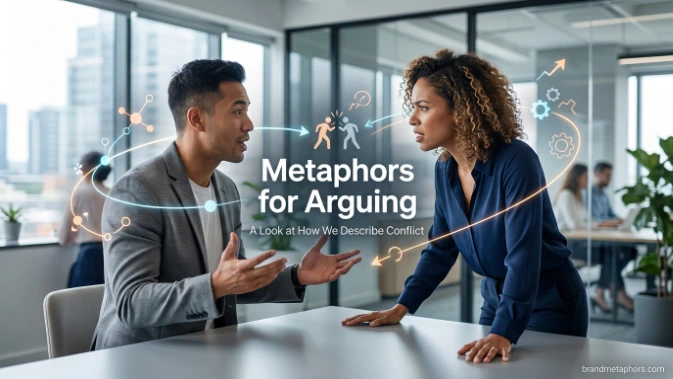
The Sound of a Clash: Why Arguments Feel Like Storms
It begins with a shift in the air—barely noticeable at first. A raised eyebrow. A clipped word. Then, like thunder rolling in from a distance, tension builds. Voices rise. Thoughts sharpen. Suddenly, you’re not just talking anymore—you’re defending, pushing, resisting. Arguing often feels like stepping into a storm: chaotic, loud, and emotionally charged.
But what if we could reframe that storm?
What if arguing wasn’t always a battle to win—but sometimes a bridge to cross, a dance to navigate, or even a puzzle to solve?
That’s where metaphors come in. They don’t just decorate language—they reshape how we think, feel, and respond. When we change the metaphor, we change the mindset. And when we change the mindset, we transform the argument itself.
This article explores powerful metaphors for arguing—tools that help you communicate more thoughtfully, write more creatively, and engage more meaningfully in everyday disagreements.
What Are Metaphors for Arguing (and Why They Matter)
A metaphor is more than a comparison—it’s a lens. When we say “an argument is a war,” we unconsciously adopt strategies of attack, defense, and victory. But if we say “an argument is a journey,” we start thinking about direction, progress, and shared destinations.
Metaphors for arguing matter because they:
- Shape emotional tone (hostile vs collaborative)
- Influence behavior (aggressive vs curious)
- Improve communication clarity
- Enhance writing and storytelling
- Help de-escalate conflicts
By choosing better metaphors, you gain control over not just what you say—but how it lands.
Common Metaphors for Arguments: From War to Dance
Before we dive deeper, let’s explore a few familiar metaphors:
- Argument as war → “He shot down my idea.”
- Argument as game → “She scored a point.”
- Argument as performance → “He delivered a strong rebuttal.”
- Argument as dance → “We moved around the issue.”
Each metaphor carries its own emotional and psychological weight. The key is choosing the one that serves your purpose.
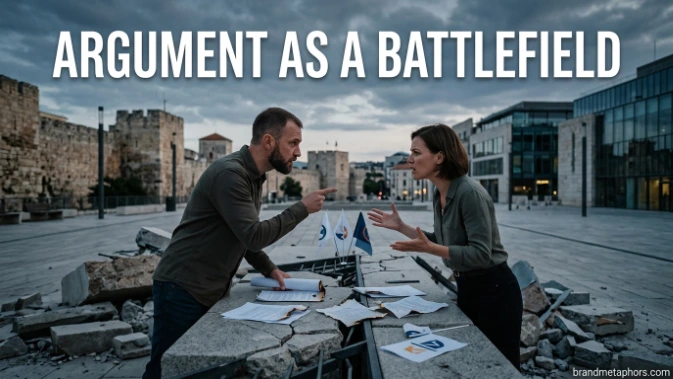
Metaphor 1: Argument as a Battlefield
Meaning and Explanation
This is perhaps the most common metaphor. Here, arguing is seen as combat. There are winners and losers, attacks and defenses, strategies and casualties.
While it can energize debate, it often escalates conflict and shuts down empathy.
Example Scenario
Imagine a workplace meeting:
“I demolished his proposal in front of everyone.”
The speaker sees themselves as victorious—but what about the relationship damage?
Alternative Expressions
- “I challenged his idea constructively.”
- “We examined the weaknesses together.”
- “We explored the gaps in the proposal.”
Sensory/Emotional Details
Think of clashing swords, raised voices, adrenaline. It feels intense—but also exhausting.
Mini Story
In many political debates, candidates use war metaphors to appear strong. But this often leads to division rather than understanding. Viewers remember the clash, not the clarity.
Metaphor 2: Argument as a Journey

Meaning and Explanation
This metaphor reframes arguing as a shared exploration. Instead of opponents, participants become travelers.
The goal is not to defeat—but to arrive somewhere meaningful.
Example Scenario
“Let’s see where this conversation takes us.”
This invites openness rather than resistance.
Alternative Expressions
- “We’re moving toward a solution.”
- “Let’s navigate this together.”
- “We’re on different paths—let’s find common ground.”
Sensory/Emotional Details
Picture walking along a winding path, pausing at crossroads, adjusting direction together. It feels calmer, more collaborative.
Real-Life Application
In therapy or mediation, professionals often use journey-based language to reduce defensiveness and build trust.
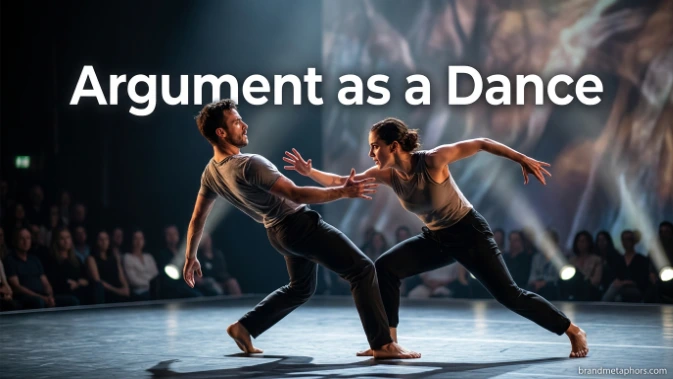
Metaphor 3: Argument as a Dance
Meaning and Explanation
Here, arguing becomes a coordinated interaction—fluid, responsive, and rhythmic.
It emphasizes listening, timing, and mutual awareness.
Example Scenario
“We kept stepping on each other’s toes in that conversation.”
This suggests misalignment rather than hostility.
Alternative Expressions
- “We need to find our rhythm.”
- “Let’s slow down and listen.”
- “We’re out of sync—let’s reset.”
Sensory/Emotional Details
Music in the background, shifting steps, moments of harmony and misstep. It’s dynamic but not destructive.
Cultural Reference
In many storytelling traditions, dialogue is described as a dance—especially in romantic or philosophical exchanges.
How Metaphors Shape the Outcome of Arguments
The metaphor you choose isn’t just stylistic—it’s strategic.
- War metaphors → escalate conflict
- Journey metaphors → encourage collaboration
- Dance metaphors → promote balance and responsiveness
By consciously selecting your metaphor, you guide the emotional direction of the conversation.
Tips for Using Argument Metaphors Effectively
1. Match the Metaphor to Your Goal
- Want to persuade strongly? Use structured metaphors like “building a case.”
- Want to connect? Use softer metaphors like “exploring ideas.”
2. Avoid Overly Aggressive Language
Words like “destroy,” “attack,” or “crush” can trigger defensiveness.
3. Use Metaphors to De-escalate
Shift from “fight” to “discussion” mid-conversation:
“Let’s step back—this doesn’t have to be a battle.”
4. Be Creative but Clear
Unusual metaphors can be powerful—but only if they’re understandable.
Interactive Exercises: Practice Using Metaphors for Arguing
Exercise 1: Rewrite the Argument
Original sentence:
“She tore apart my argument.”
Rewrite it using:
- Journey metaphor
- Dance metaphor
Exercise 2: Create Your Own Metaphor
Think of arguing as:
- A sport
- A puzzle
- A cooking process
Write one sentence for each.
Exercise 3: Reflect on a Past Argument
Ask yourself:
- What metaphor was I using?
- How did it affect my behavior?
- What metaphor would have worked better?
Bonus Tips for Writing, Social Media, and Daily Life
In Writing
Use metaphors to:
- Add emotional depth
- Clarify complex ideas
- Engage readers
Example:
“Their debate wasn’t a war—it was a slow, careful excavation of truth.”
On Social Media
Avoid inflammatory metaphors. Instead of:
“I destroyed that comment,”
Try:
“I offered a different perspective.”
In Daily Conversations
Use metaphors to soften tone:
“Let’s untangle this together.”
Creative Metaphor Ideas for Arguing
Here are a few fresh metaphors you can experiment with:
- Argument as gardening → nurturing ideas, removing weeds
- Argument as cooking → mixing ingredients, adjusting flavors
- Argument as architecture → building strong foundations
- Argument as weather → passing storms, clearing skies
Each opens new emotional and communicative possibilities.
Why Mastering Metaphors for Arguments Makes You a Better Communicator
When you shift from “winning arguments” to “shaping conversations,” everything changes.
You become:
- More persuasive
- More empathetic
- More creative
- More effective in both writing and speech
Metaphors are not just tools—they are transformations.
FAQs About Metaphors for Arguing
1. Why are war metaphors so common in arguments?
Because conflict naturally feels competitive. War metaphors reflect instinctive reactions—but they’re not always helpful.
2. Can metaphors really change how people argue?
Yes. Language influences thought. Changing metaphors can reduce tension and improve understanding.
3. What is the best metaphor for arguing?
It depends on your goal. For collaboration, journey or dance metaphors work best.
4. How can I avoid aggressive metaphors?
Be mindful of your language. Replace words like “attack” with “explore” or “discuss.”
5. Are metaphors useful in professional settings?
Absolutely. They can clarify ideas, improve teamwork, and reduce conflict.
Conclusion
Arguments don’t have to feel like storms tearing everything apart. With the right metaphors, they can become bridges, dances, journeys—even opportunities for growth.
The next time you feel tension rising, pause and ask yourself:
What metaphor am I using right now?
Because in that quiet moment of awareness, you gain something powerful—the ability to transform not just the argument, but the relationship itself.
And sometimes, that makes all the difference.