
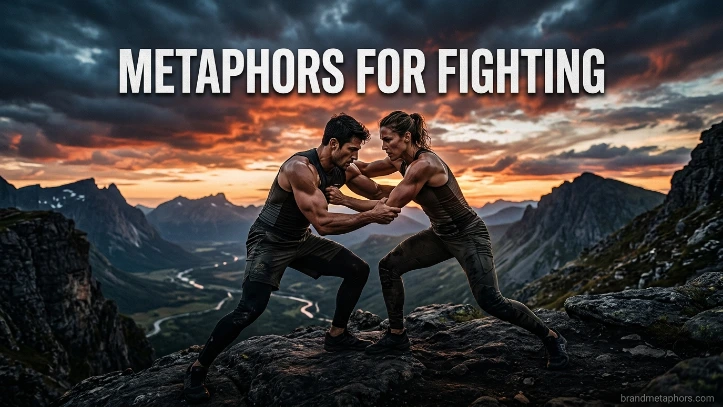
The room went quiet before the first word was spoken. Then came the sharp exchange, the raised voices, the tense silence that seemed to crackle like electricity. Fighting does not always begin with fists. Sometimes it starts with two people defending opposite ideas, a disagreement between friends, or an inner struggle that no one else can see.
That is why metaphors for fighting are so powerful. They allow us to describe conflict without simply saying, “They were arguing” or “They were struggling.” A good metaphor gives conflict a shape, a sound, and an emotional temperature. It can turn an ordinary disagreement into a storm, a battlefield, a tug-of-war, or a fire.
Whether you are writing a story, poem, social media post, speech, or everyday message, these comparisons can make your language more vivid. They help readers feel the tension rather than merely understand it.
Below are creative metaphors for fighting, along with meanings, examples, alternative expressions, storytelling ideas, and practical exercises.
What Are Metaphors for Fighting? (And Why They Matter)
At their core, metaphors for fighting are figurative expressions that describe conflict using imagery—battlefields, storms, games, or even dances. Instead of saying “we argued,” you might say, “we locked horns,” or “it turned into a battlefield.”
Why does this matter?
Because metaphors shape perception. When you call an argument a “war,” you subconsciously prepare for victory or defeat. When you call it a “conversation,” you leave space for understanding.
Metaphors:
- Add emotional depth
- Make abstract conflict tangible
- Influence how we approach disagreements
- Enhance storytelling and communication
They don’t just describe fights—they define them.
Why Writers and Thinkers Use Fighting Metaphors
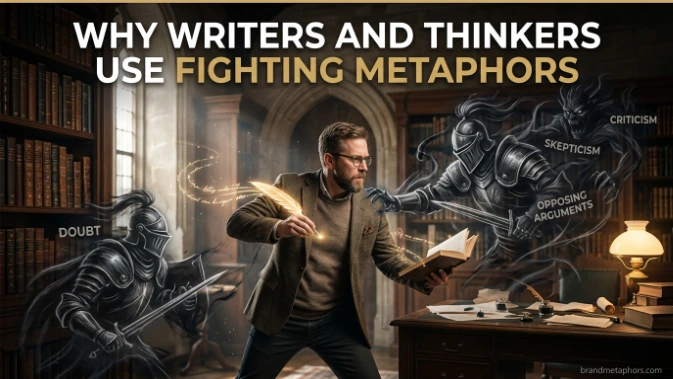
From ancient epics to modern tweets, metaphors of conflict have always been central to human expression. They help us dramatize inner struggles, social tensions, and personal disagreements.
Think about it:
- A student “battles” anxiety before an exam
- A team “fights” for victory
- A person “defends” their beliefs
These aren’t literal fights—but they feel like ones.
Writers use these metaphors to:
- Intensify emotion
- Create vivid imagery
- Connect with readers on a visceral level
Even in everyday speech, we rely on them without noticing.
Fighting as a Storm
Meaning and Explanation
When conflict is described as a storm, it emphasizes unpredictability, intensity, and emotional turbulence. Storms build, break, and eventually pass—just like arguments.
Example Scenario
“Their disagreement rolled in like thunder, loud and sudden, leaving behind a silence as heavy as rain-soaked earth.”
You can almost feel it—the pressure, the release, the aftermath.
Alternative Expressions
- “Tempest of emotions”
- “Lightning struck between them”
- “A brewing storm”
- “Clouds gathered in the room”
Sensory & Emotional Details
Storm metaphors invite sound (thunder), touch (rain), and atmosphere (humidity). They capture tension in a physical way.
Mini Story
Imagine a dinner table where everything seems calm. Then one comment—small, almost harmless—changes the air. Voices rise. Chairs scrape. And just like that, the storm breaks. Later, silence. Not peace—just the quiet after damage.
Why It Works
Storm metaphors remind us that conflict is temporary. Even the fiercest storm eventually clears.
Fighting as a Chess Game
Meaning and Explanation
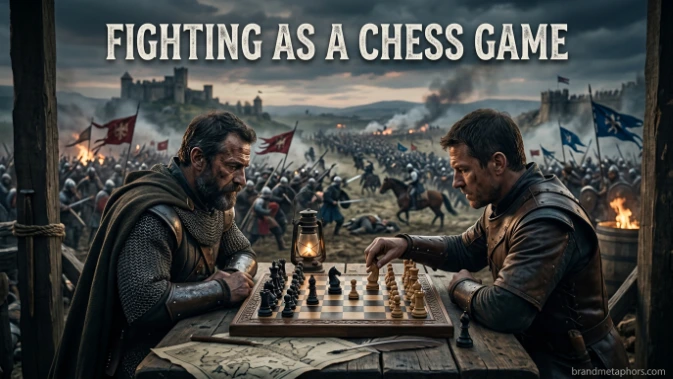
Here, conflict becomes strategic rather than chaotic. Each move is calculated. Words are chosen carefully. Victory depends on foresight, not force.
Example Scenario
“Every sentence he spoke felt like a calculated move, positioning her closer to an emotional checkmate.”
Alternative Expressions
- “A battle of wits”
- “Playing defense”
- “Setting a trap”
- “Anticipating the next move”
Sensory & Emotional Details
This metaphor is quieter—less noise, more tension. The click of a chess piece. The pause before a response.
Mini Story
Two colleagues disagree in a meeting. No raised voices. No anger. Just carefully phrased sentences, subtle implications, and strategic pauses. By the end, one has subtly “won”—without ever raising their voice.
Why It Works
It reframes conflict as thoughtful rather than reactive—encouraging control and awareness.
Fighting as a Fire
Meaning and Explanation
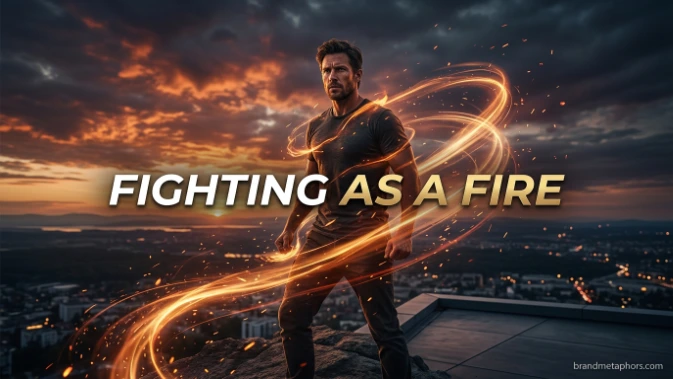
Fire metaphors highlight passion, escalation, and danger. Conflict starts as a spark and can quickly spread if not controlled.
Example Scenario
“What began as a spark of irritation quickly turned into a wildfire neither of them could contain.”
Alternative Expressions
- “Adding fuel to the fire”
- “Igniting an argument”
- “Burning with anger”
- “Letting it smolder”
Sensory & Emotional Details
Heat, light, crackling sound—fire metaphors are visceral. They evoke urgency and destruction.
Mini Story
A small misunderstanding—just a misread text. But instead of clarifying, both sides react emotionally. Messages get sharper. Accusations flare. Soon, the situation is out of control—a wildfire born from a spark.
Why It Works
It reminds us how quickly conflict escalates—and how important it is to contain it early.
Creative Ways to Use Fighting Metaphors in Writing
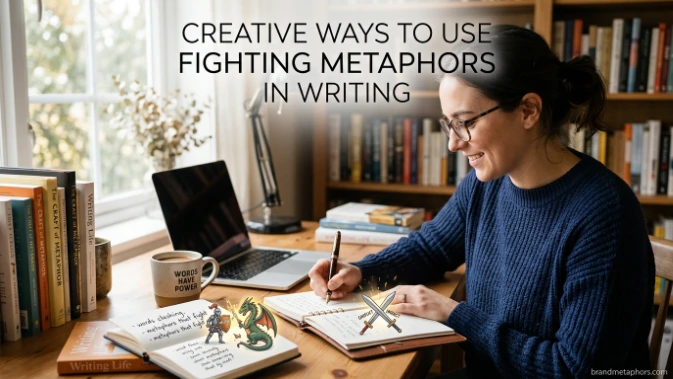
Want to make your writing more vivid? Try these approaches:
- Replace generic words like “argued” with imagery
- Mix metaphors carefully for layered meaning
- Match the metaphor to tone (storm for chaos, chess for strategy)
Example: Instead of “They had a disagreement,” try: “Their words circled each other like wary fighters, waiting for the first strike.”
It’s more engaging—and more memorable.
Turn Conflict into Metaphor
Try this:Think of a recent disagreement
Describe it literally in one sentence
Now rewrite it using a metaphor (storm, game, fire, etc.)
Example:
- Literal: “We argued about being late.”
- Metaphorical: “Our patience snapped like dry wood, and suddenly we were feeding a fire neither of us meant to start.”
Bonus Prompt
Write the same conflict using three different metaphors:
- As a storm
- As a game
- As a fire
Notice how the meaning shifts each time.
Using Fighting Metaphors in Daily Life and Communication
Metaphors aren’t just for writing—they shape real conversations.
Instead of saying:
- “We’re fighting”
Try:
- “We’re going through a storm” (softens tone)
- “We’re figuring out our next move” (adds calm strategy)
This shift can:
- Reduce emotional intensity
- Encourage understanding
- Change the outcome of a conversation
Language doesn’t just reflect reality—it creates it.
Cultural and Literary Echoes of Conflict Metaphors
Across cultures, fighting metaphors appear everywhere:
- Wars symbolize internal struggles
- Games represent competition
- Natural forces reflect emotional states
In literature, heroes “battle” inner demons. Lovers “clash.” Societies “struggle.”
These metaphors endure because conflict is universal—and metaphor makes it meaningful.
Tips for Crafting Powerful Metaphors for Fighting
Here are a few practical tips:
Keep It Relatable
Choose imagery your audience understands—storms, games, fire.
Avoid Overuse
Too many metaphors can overwhelm. Use them with intention.
Match Emotion and Image
A quiet disagreement doesn’t need a “war” metaphor.
Add Sensory Detail
Engage sight, sound, touch for stronger impact.
Be Original
Instead of clichés, try fresh combinations:
- “Their silence stretched like a battlefield after retreat.”
Bonus Ideas for Social Media, Journaling, and Storytelling
Metaphors for fighting are perfect for:
- Instagram captions
- Personal journaling
- Poetry and storytelling
Examples:
- “Some fights aren’t battles—they’re storms asking to be understood.”
- “We weren’t enemies, just players who forgot the rules.”
They make emotions shareable, relatable, and memorable.
FAQs About Metaphors for Fighting
What is a metaphor for fighting?
A metaphor for fighting is a figurative way to describe conflict using imagery like storms, games, or fire instead of literal terms.
Why are fighting metaphors important?
They help express emotions vividly, shape perception, and make communication more engaging and meaningful.
Can metaphors reduce conflict?
Yes. Softer metaphors (like storms or journeys) can make conflicts feel less aggressive and more manageable.
Are fighting metaphors useful in everyday speech?
Absolutely. People use them naturally in conversations to describe disagreements, challenges, and struggles.
How can I create my own metaphors?
Think about the feeling of the conflict, then match it to an image (nature, games, objects) that reflects that emotion.
What Is the Difference Between a Fighting Metaphor and a Literal Description?
A literal description states exactly what happened.
“They argued for an hour.”
A metaphor creates an image:
“Their argument became a storm that refused to pass.”
The first gives information. The second gives atmosphere.
Both have value, but metaphors are particularly useful when you want readers to understand the emotional experience behind the conflict.
Can Fighting Metaphors Describe Emotional Struggles?
Absolutely. Fighting does not have to involve physical confrontation.
A person can fight fear, doubt, grief, loneliness, temptation, failure, or uncertainty.
For example:
“She was climbing a mountain made of doubt.”
The metaphor communicates difficulty without needing a long explanation.
This is one reason fighting metaphors are so common in motivational writing. They transform invisible emotional struggles into visible images.
Why Is Fire Such a Common Metaphor for Fighting?
Fire naturally represents heat, anger, energy, and destruction. It can begin with something tiny and become uncontrollable.
That makes it ideal for arguments.
A small insult can become a spark. Repeated accusations can become fuel. Eventually, the disagreement can become a blaze.
The metaphor also allows writers to describe different stages of conflict:
Spark → flame → fire → blaze → ashes
That progression can become an entire storyline.
Are Fighting Metaphors Useful in Poetry?
Yes. Poetry often depends on imagery, symbolism, and emotional compression.
A single metaphor can communicate an entire emotional landscape.
For example:
“We stood on opposite shores,
throwing words across the water.”
The image of two shores immediately suggests distance, separation, and failed communication.
The strongest poetic metaphors often leave enough space for readers to bring their own emotions to the image.
Can Fighting Metaphors Be Used Positively?
Yes. Fighting does not always mean aggression or destruction.
A person may “fight for” something valuable: freedom, justice, family, hope, education, or a dream.
For example:
“She fought like a sunrise refusing to surrender to the night.”
Here, fighting becomes a symbol of resilience.
This positive form of fighting metaphor focuses on endurance rather than defeating another person.
Conclusion
Fighting has many faces. It can roar like thunder, burn like fire, pull like a rope, rise like a mountain, or hide quietly behind a wall of silence.
That is what makes metaphors for fighting so useful. They transform conflict from an abstract idea into something readers can see, hear, and feel.
The next time you describe an argument, struggle, or difficult decision, pause before writing “They fought.” Ask yourself: What does this conflict actually feel like?
Is it a storm gathering in the distance?
A chess match played in silence?
A rope pulled by two stubborn hands?
A mountain standing between someone and their goal?
Find that image, and let it carry the emotion.
The best metaphor does more than describe a fight. It makes the reader feel the tension in the room.