
Introduction
Good writing is more than using correct grammar. It is also about choosing the right words to make your ideas clear, interesting, and memorable. Figurative language, such as metaphors, similes, idioms, and descriptive expressions, helps writers create vivid images and stronger emotions. Whether you are writing a school essay, a story, a poem, or an email, understanding how words work together makes your communication more effective.
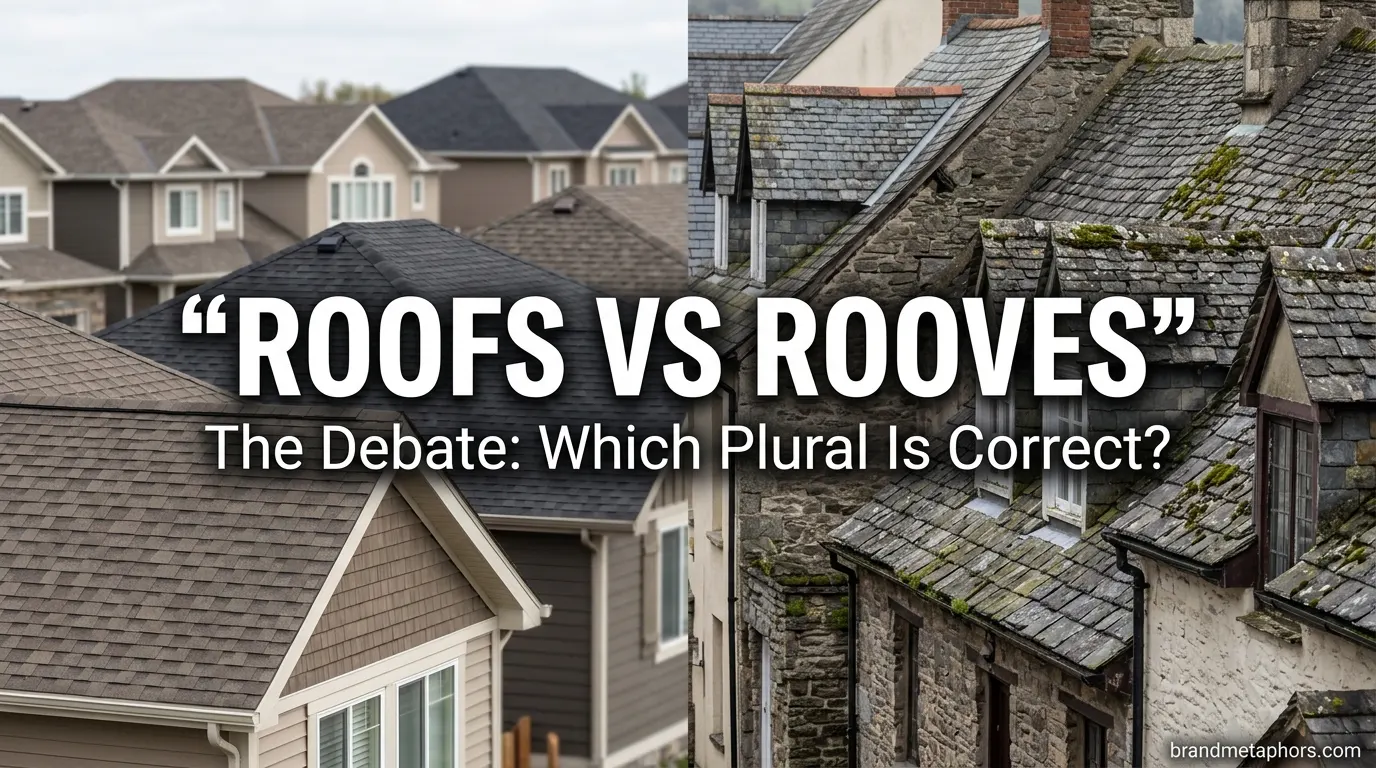
One grammar question that often confuses students, writers, and English learners is the plural of roof. Should you write roofs or rooves? The answer may surprise you because English has many irregular spelling patterns. Some words ending in -f change to -ves, while others simply add -s.
In this guide, you will learn the correct plural form, understand why the confusion exists, explore grammar rules, compare similar words, avoid common mistakes, and practice with real-life examples. Along the way, you’ll also improve your vocabulary, writing skills, and understanding of descriptive language.
What Do “Roofs” and “Rooves” Mean?
Both words attempt to represent the plural of roof, but only one is considered correct in modern English.
WordMeaningCorrect?RoofThe top covering of a building✅ YesRoofsMore than one roof✅ CorrectRoovesAn old or nonstandard plural spelling❌ Rare and generally incorrect
Today, roofs is the accepted plural in standard English.
Examples
- The houses have new roofs.
- Several roofs were damaged during the storm.
- Workers repaired the roofs before winter.
The spelling rooves may appear in very old books or historical texts, but modern dictionaries recommend using roofs.
Why Do People Confuse Roofs and Rooves?
English has many nouns ending in -f or -fe that change to -ves.
Examples include:
SingularPluralLeafLeavesWolfWolvesKnifeKnivesWifeWivesShelfShelves
Because of these patterns, many learners naturally think roof should become rooves.
However, English is full of exceptions.
Words like these simply add -s:
- Roof → Roofs
- Chief → Chiefs
- Belief → Beliefs
- Proof → Proofs
- Safe → Safes
- Cliff → Cliffs
This mixture of regular and irregular patterns is one reason English spelling can be challenging.
The Grammar Rule Behind the Correct Plural
There is no single rule that applies to every word ending in -f.
Instead, English has three groups.
Group 1: Change -f to -ves
Examples:
- Wolf → Wolves
- Leaf → Leaves
- Calf → Calves
- Shelf → Shelves
Group 2: Simply Add -s
Examples:
- Roof → Roofs
- Chief → Chiefs
- Proof → Proofs
- Cliff → Cliffs
Group 3: Either Form Exists
Some nouns allow both forms.
Examples:
- Hoof → Hoofs or Hooves
- Dwarf → Dwarfs or Dwarves
- Scarf → Scarfs or Scarves
Notice that roof is not in this group.
Modern grammar accepts only roofs.
Quick Comparison Table
FeatureRoofsRoovesModern English✅ Yes❌ NoSchool Writing✅ Recommended❌ AvoidBusiness Writing✅ Correct❌ IncorrectAcademic Writing✅ Correct❌ IncorrectNewspapers✅ Used❌ RareFormal English✅ Standard❌ Nonstandard
Sentence Examples in Different Situations

Everyday Conversation
- The neighbors replaced their roofs.
- Snow covered the roofs.
- Birds landed on the roofs.
School Writing
- The earthquake damaged many roofs.
- Green roofs help reduce heat in cities.
- Engineers design strong roofs for safety.
Story Writing
- Rain tapped gently on the old roofs.
- Moonlight shone across the village roofs.
- Smoke curled above the wooden roofs.
Scientific Writing
- Solar panels are installed on many roofs.
- Flat roofs collect rainwater efficiently.
Using the Word in Figurative Language
Although roof is a literal object, writers often use it in figurative language.
Metaphor Examples
A metaphor compares two things without using like or as.
Examples:
- Hope became the roof over her dreams.
- Kindness is the roof that protects every friendship.
- Trust forms the roof of a strong relationship.
Simile Examples
A simile uses like or as.
Examples:
- The shelter felt as safe as a sturdy roof.
- His protection was like a roof during a storm.
- Their friendship covered us like a warm roof.
Idioms Using Roof
Several English idioms include this word.
Hit the roof
Meaning: Become very angry.
Example:
- Dad hit the roof when he saw the broken window.
Through the roof
Meaning: Extremely high.
Examples:
- Gas prices went through the roof.
- Her excitement went through the roof after winning.
Raise the roof
Meaning: Celebrate loudly.
Example:
- The fans raised the roof after the final goal.
Learning idioms helps improve speaking, reading, and writing skills.
Creative Writing and Descriptive Language
Writers often use roof to create strong images.
Instead of writing:
“The house looked old.”
Try:
“The cracked roof sagged beneath years of rain and wind.”
Instead of:
“It rained.”
Write:
“Raindrops danced across the rooftops like tiny drummers.”
Descriptive writing helps readers imagine scenes more clearly.
Descriptive Words Related to Roof
- Wooden
- Flat
- Steep
- Colorful
- Broken
- Snow-covered
- Ancient
- Modern
- Leaking
- Strong
- Shiny
- Weathered
These adjectives improve storytelling and essays.
Common Mistakes Students Make
Mistake 1
❌ The houses have rooves.
✅ The houses have roofs.
Mistake 2
❌ Many rooves were repaired.
✅ Many roofs were repaired.
Mistake 3
Assuming every -f word changes to -ves.
Remember:
Some do.
Some don’t.
Always check unfamiliar words.
Mistake 4
Using old spellings in school assignments.
Modern English prefers roofs.
When Should You Use Roofs?
Use roofs in nearly every type of writing.
Examples include:
- School assignments
- Exams
- Business reports
- Newspapers
- Blogs
- Emails
- Research papers
- Novels
- Magazines
Professional writers and editors almost always use roofs.
When Should You Avoid Rooves?
Avoid rooves in:
- Essays
- Homework
- Professional writing
- Academic papers
- Online articles
- Business communication
- Formal speeches
You might only encounter it when reading:
- Very old books
- Historical literature
- Rare poetic works
- Older regional writing
Even then, it is usually kept for historical accuracy.
Comparison with Similar Plural Words
SingularCorrect PluralRoofRoofsProofProofsChiefChiefsCliffCliffsSafeSafesBeliefBeliefsWolfWolvesLeafLeavesKnifeKnivesShelfShelves
Practice reading these aloud to remember which ones change.
Practice Exercises
Exercise 1: Choose the Correct Word
- The builders repaired the ______.
a) roofs
b) rooves
Answer: roofs
- Snow covered the ______ of every cabin.
a) roofs
b) rooves
Answer: roofs
- The storm damaged several ______.
a) roofs
b) rooves
Answer: roofs
Exercise 2: Correct the Sentence
Incorrect:
The old rooves leaked after the rain.
Correct:
The old roofs leaked after the rain.
Exercise 3: Fill in the Blank
- Birds rested on the ______.
Answer:
roofs
- Workers painted the ______ blue.
Answer:
roofs
Exercise 4: Create Your Own Sentences
Write one sentence about:
- A snowy roof
- A broken roof
- A house with solar panels
- A colorful neighborhood
- A rainy day
This exercise improves vocabulary and sentence-building skills.
Tips for Remembering the Correct Form
Here are a few easy memory tricks.
- Think of proof → proofs.
- Think of chief → chiefs.
- Remember that roof follows the same pattern.
- Read books and articles to reinforce correct spelling.
- Practice writing the word several times.
A simple phrase to remember is:
“A roof gets an S, not a V.”
Why Learning Correct Plurals Matters
Correct grammar helps readers understand your ideas.
Using the right plural:
- Improves writing accuracy.
- Builds confidence.
- Helps in school exams.
- Makes professional writing stronger.
- Improves communication.
- Supports vocabulary growth.
- Helps English learners sound more natural.
Even small grammar choices can make a big difference in how your writing is received.
Frequently Asked Questions
Is “rooves” ever correct?
It appears in some old texts and historical writing, but modern English almost always uses roofs.
Why doesn’t roof become rooves?
Because English developed through many historical spelling changes. Not every word ending in -f follows the same rule.
Which form should students use in exams?
Always write roofs.
Do dictionaries accept rooves?
Most modern dictionaries list it as an old, rare, or nonstandard variant while recommending roofs as the standard plural.
How can I remember the correct spelling?
Compare it with chiefs and proofs. These words also keep the -f and simply add -s.
Conclusion
Learning the correct plural of roof is a small but important step toward mastering English grammar. Although many words ending in -f change to -ves, this is not a universal rule. The accepted modern plural is roofs, while rooves is an outdated and uncommon spelling that should usually be avoided.
Understanding these differences helps students write more accurately, communicate more confidently, and avoid common grammar mistakes. It also strengthens vocabulary and improves overall writing skills. As you continue learning English, remember that careful word choice, descriptive language, figurative expressions, and correct grammar all work together to make your writing clear, engaging, and effective. The more you read, practice, and write, the easier these patterns become, helping you express your ideas with confidence in school, at work, and in everyday communication.