
Introduction
Good writing is more than putting words on a page. It is about choosing the right words to communicate clearly and effectively. Whether you are writing a school essay, a creative story, a poem, a blog post, or a professional document, strong vocabulary and descriptive language make your message more engaging.
Many English learners and writers become confused when they see words like passerby, passersby, and passerbyers. Which one is correct? Which one should be used in formal writing? Can any of them appear in creative writing or poetic expression?
Understanding the correct form helps improve writing skills, vocabulary enhancement, and communication. It also prevents common grammar mistakes that can weaken your writing.
This guide explains the meaning, grammar, sentence examples, comparison charts, literary uses, figurative language applications, common errors, and practical exercises related to these words. By the end, you will know exactly which form to use and when to use it.
Understanding the Meaning of the Word
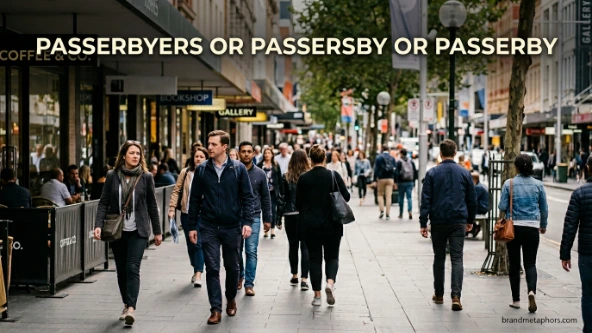
A passerby is a person who is passing through an area or walking past a place.
The word often describes someone who is not directly involved in an event but happens to be nearby.
Simple Definition
A passerby is:
- A person walking past
- An observer who happens to be present
- Someone passing through an area
Examples
- A passerby helped the lost child.
- The passerby stopped to watch the street performance.
- A passerby reported the accident.
The word is commonly used in everyday English, news reports, storytelling, and formal writing.
Which Form Is Correct?
Many people wonder whether they should write:
WordCorrect?MeaningPasserbyYesOne person passing byPassersbyYesMore than one person passing byPasserbyersNoNot a standard English word
Quick Answer
- Passerby = singular
- Passersby = plural
- Passerbyers = incorrect
The confusion happens because English usually forms plurals by adding -s to the end of a word. However, this word follows a different pattern.
Why Is the Plural Passersby?
English contains several compound nouns.
A compound noun combines two words into one expression.
Examples include:
SingularPluralMother-in-lawMothers-in-lawAttorney generalAttorneys generalPasserbyPassersby
In these words, the main noun receives the plural ending.
In passerby, the noun is passer, while by functions as an adverb.
Therefore:
- One passerby
- Two passersby
- Many passersby
Sentence Examples
- Several passersby watched the parade.
- The musician entertained curious passersby.
- Passersby gathered around the fountain.
Common Mistakes Writers Make
Understanding frequent errors can strengthen writing skills.
Mistake 1: Using “Passerbyers”
❌ The passerbyers stopped to listen.
✅ The passersby stopped to listen.
Mistake 2: Adding an Apostrophe
❌ Passer’s by
✅ Passerby
Mistake 3: Using Singular for Multiple People
❌ Many passerby were watching.
✅ Many passersby were watching.
Mistake 4: Confusing It with Bystander
Although similar, these words are not identical.
A bystander usually witnesses an event.
A passerby may simply be passing through.
How to Use the Word in Everyday Writing

The term appears naturally in many situations.
News Writing
- A passerby discovered the missing wallet.
- Several passersby witnessed the incident.
Academic Writing
- Researchers interviewed passersby in the city center.
- The survey collected responses from passersby.
Business Writing
- The advertisement attracted passersby.
- Store displays encouraged passersby to enter.
Everyday Conversation
- A passerby gave me directions.
- Friendly passersby smiled as we walked.
Using the Word in Creative Writing
Creative writing often depends on vivid descriptions and storytelling.
The term can help create realistic scenes.
Example 1
The lonely violinist played beneath the bridge while passersby hurried through the rain.
Example 2
A passerby glanced at the old house and wondered who lived inside.
Example 3
The mysterious painting caught the attention of every passerby who entered the square.
These examples add movement and realism to a scene.
Figurative Language and Literary Devices
Writers often use ordinary words in extraordinary ways.
The idea of a passerby can become a symbol in literature.
Symbolism
A passerby may symbolize:
- Temporary relationships
- Missed opportunities
- Life’s constant movement
- Human connection
Example
“She remained only a passerby in his life.”
Meaning: She was present briefly and then disappeared.
Personification
“The city greeted every passerby with bright lights.”
The city is given human qualities.
Imagery
“Passersby drifted through the fog like shadows.”
This creates a visual image for readers.
Simile Examples
A simile compares two things using like or as.
Simile Examples with Passersby
- Passersby moved like leaves in the wind.
- The crowd flowed like a river of passersby.
- She disappeared as quickly as a passerby crossing a street.
- The tourists wandered like curious passersby.
- The shoppers moved like colorful waves.
These comparisons strengthen descriptive language.
Metaphor Examples
A metaphor makes a direct comparison.
Metaphor Examples
- The city was a river of passersby.
- The station became a sea of moving faces.
- Life is a street of endless passersby.
- The marketplace was a living stream.
- Humanity is a parade of passersby.
These metaphor examples create powerful poetic expression.
Tone and Style Considerations
The word can fit many tones.
Formal Tone
- A passerby notified emergency services.
Neutral Tone
- Several passersby stopped to watch.
Narrative Tone
- A lone passerby disappeared into the mist.
Poetic Tone
- Passersby floated through twilight like forgotten dreams.
Choosing the right tone helps improve communication and audience engagement.
When to Use and When to Avoid
Use It When
Describing people walking past
Writing news reports
Creating realistic scenes
Discussing witnesses or observers
Improving vocabulary variety
Avoid It When
Referring to people actively involved in an event
Describing residents or employees
Using the incorrect form “passerbyers”
Better Alternatives
Depending on context, consider:
- Pedestrian
- Observer
- Witness
- Onlooker
- Traveler
- Visitor
- Bystander
Comparison Table: Similar Words
WordMeaningBest UsePasserbyPerson passing byGeneral situationsPassersbyMultiple people passing byPlural situationsBystanderWitness nearbyEvents and incidentsOnlookerSomeone watchingCrowds and spectatorsPedestrianPerson walkingTraffic and transportationObserverPerson observingFormal contexts
Understanding these differences improves vocabulary enhancement and precision.
Practice Exercises for Students

Exercise 1: Choose the Correct Word
- The ______ stopped to help.
- Several ______ watched the parade.
- The ______ noticed the smoke.
Answers:
- passerby
- passersby
- passerby
Exercise 2: Correct the Mistake
- Many passerbyers gathered nearby.
- Three passerby watched the event.
- The passer’s by called for help.
Answers:
- Many passersby gathered nearby.
- Three passersby watched the event.
- The passerby called for help.
Exercise 3: Create Your Own Sentences
Write one sentence using:
- passerby
- passersby
- a simile involving passersby
- a metaphor involving passersby
This exercise improves writing fluency and creativity.
Vocabulary Enhancement Tips
Learning one word often leads to learning many related words.
Related Vocabulary
- Pedestrian
- Wanderer
- Observer
- Witness
- Traveler
- Visitor
- Spectator
- Onlooker
- Stranger
Learning Strategy
- Read examples daily.
- Write original sentences.
- Use words in conversations.
- Practice creative writing.
- Review context clues.
These habits strengthen long-term vocabulary growth.
Frequently Asked Questions
1. Is “passerbyers” a real English word?
No. It is not recognized in standard English. Use passersby instead.
2. What is the plural of passerby?
The correct plural form is passersby.
3. Can passerby be used in formal writing?
Yes. It is commonly used in news reports, academic writing, and professional communication.
4. What is the difference between a passerby and a bystander?
A passerby is simply passing through. A bystander is usually present while observing an event.
5. Can the word be used in poetry and creative writing?
Yes. Writers often use it in symbolism, imagery, metaphors, similes, and other literary devices.
Conclusion
Understanding the difference between singular and plural forms is an important part of mastering English grammar. The singular form refers to one person passing through an area, while the plural form refers to multiple people. The commonly seen form “passerbyers” is incorrect and should be avoided in both formal and informal writing.
Beyond grammar, this word offers excellent opportunities for creative expression. It can be used in storytelling, poetry, figurative language, descriptive language, simile examples, metaphor examples, and literary analysis. Whether you are a student, writer, teacher, or English learner, mastering this vocabulary helps improve clarity, writing skills, and communication.
The next time you encounter someone walking past on a busy street, you’ll know exactly which word to use—and how to use it correctly in any piece of writing.