
Introduction
Strong communication depends on choosing the right words and expressions. Whether you are a student, writer, teacher, or English learner, understanding subtle differences in language can significantly improve your writing skills and speaking confidence. Small prepositions such as at and in may seem simple, but they can completely change the meaning of a sentence.
Mastering these distinctions helps create more accurate descriptions, clearer communication, and more natural English. It also strengthens vocabulary enhancement, descriptive language, and overall language fluency. Just as figurative language, simile examples, metaphor examples, poetic expression, and other literary devices enrich writing, correct preposition usage improves clarity and precision.
One of the most common questions English learners ask is when to use a phrase that refers to a person’s home or location. Understanding the difference allows writers to create accurate narratives, avoid confusion, and produce polished content. This guide explains meanings, usage patterns, sentence examples, common mistakes, exercises, and practical tips to help you use these expressions correctly.
What Do These Expressions Mean?
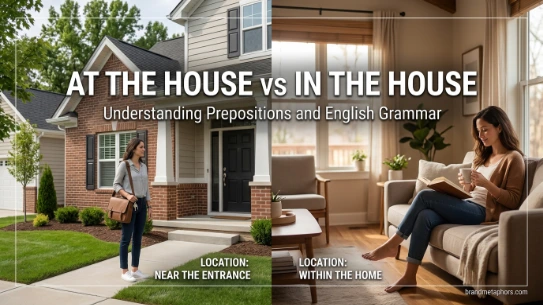
Although both expressions relate to a house, they focus on different ideas.
- One expression emphasizes a person’s general location or presence at a property.
- The other emphasizes being physically inside the building.
The distinction may seem minor, but native speakers use them differently depending on context.
Simple Rule
ExpressionPrimary MeaningAt the houseRefers to a location or property in generalIn the houseRefers to being physically inside the building
Understanding this difference is essential for accurate communication.
Why Prepositions Matter in English
Prepositions are among the most frequently used words in English. They show relationships between people, objects, places, and ideas.
Correct preposition use helps:
- Improve sentence accuracy
- Enhance writing quality
- Reduce misunderstandings
- Build fluency
- Strengthen academic writing
Consider these examples:
- We met at the house.
- We stayed in the house.
Both are correct, but they communicate different ideas.
The first sentence focuses on the meeting location.
The second sentence focuses on being inside the structure.
Understanding Location vs Physical Position
The key difference involves perspective.
General Location
When referring to a place as a destination or meeting point, English speakers often use “at.”
Examples:
- I’ll meet you at the house.
- Everyone arrived at the house by noon.
- The delivery driver stopped at the house.
The focus is the property itself.
Physical Interior
When referring to someone’s position inside the building, English speakers use “in.”
Examples:
- She is in the house right now.
- The children are playing in the house.
- We remained in the house during the storm.
The focus is being within the walls of the building.
Common Situations Where Each Expression Is Used
Situations for “At”
Use it when discussing:
- Arrivals
- Meetings
- Events
- Locations
- Destinations
Examples:
- Let’s gather at the house before dinner.
- The guests arrived at the house early.
- I left my bike at the house.
Situations for “In”
Use it when discussing:
- Activities occurring indoors
- Physical presence
- Safety indoors
- Interior spaces
Examples:
- They are sleeping in the house.
- The dog is in the house.
- We spent the afternoon in the house.
Comparison Examples in Everyday English
The easiest way to understand the difference is through side-by-side comparison examples.
SentenceMeaningI’m at the house.I am at the property or location.I’m in the house.I am physically inside the building.We met at the house.The house is the meeting location.We stayed in the house.We remained inside the building.She arrived at the house.She reached the property.She is in the house.She is inside.
These examples demonstrate how small preposition changes affect meaning.
Sentence Examples for Students and Writers
Academic Examples
- Researchers gathered at the house to conduct interviews.
- Participants remained in the house during the observation period.
- The team met at the house before beginning the project.
- Several records were stored in the house.
Daily Conversation Examples
- Are you at the house yet?
- Everyone is waiting at the house.
- Is your brother in the house?
- The lights are on in the house.
Story Writing Examples
- The detective arrived at the house shortly after sunset.
- Strange sounds echoed in the house throughout the night.
- Villagers gathered at the house to discuss the mystery.
- Shadows moved silently in the house.
Creative Writing and Descriptive Language Applications
Writers often use these phrases to create vivid imagery and immersive scenes.
Narrative Writing
Example:
“The travelers stopped at the house after a long journey.”
This emphasizes arrival.
Descriptive Writing
Example:
“A warm fire crackled in the house while snow covered the landscape outside.”
This emphasizes the interior setting.
Using precise location language strengthens descriptive language and improves reader understanding.
Relationship to Figurative Language and Literary Devices
Although these expressions themselves are not figurative language, they frequently appear in creative writing alongside literary devices.
Metaphor Examples
- The house was a fortress against fear.
- Her home was a lighthouse in difficult times.
Simile Examples
- The house stood like a silent guardian.
- The room felt as warm as a blanket.
Poetic Expression
Writers may combine literal location descriptions with figurative imagery:
- She stood at the house, watching memories return like waves.
- Hope lingered in the house long after the storm ended.
These techniques enrich storytelling and improve reader engagement.
Tone and Context Usage
Different situations require different tones.
Formal Tone
Examples:
- The committee met at the house to discuss community issues.
- Important documents were secured in the house.
Informal Tone
Examples:
- I’m at the house now.
- Everyone’s hanging out in the house.
Narrative Tone
Examples:
- The messenger arrived at the house before dawn.
- A mysterious silence filled the house.
Choosing the appropriate expression helps maintain the intended tone.
When to Use Each Expression
Use “At” When:
Referring to a destination
Discussing arrival
Identifying a location
Talking about events
Examples:
- Meet me at the house.
- We arrived at the house early.
- The party starts at the house.
Use “In” When:
Referring to indoor activities
Describing physical presence
Discussing interior spaces
Talking about things located inside
Examples:
- Everyone is in the house.
- The furniture is in the house.
- We stayed in the house all day.
When to Avoid Incorrect Usage

Avoid using one expression when the other better communicates the intended meaning.
Incorrect
- She is at the house watching television.
Possible but less precise if emphasizing being indoors.
Better
- She is in the house watching television.
Incorrect
- The guests arrived in the house.
This sounds unusual when emphasizing arrival.
Better
- The guests arrived at the house.
Understanding context helps avoid awkward wording.
Common Mistakes English Learners Make
Mistake 1: Using Them Interchangeably
Incorrect:
- Everyone arrived in the house.
Better:
- Everyone arrived at the house.
Mistake 2: Ignoring Context
Incorrect:
- The children are playing at the house.
This can be correct, but if they are indoors:
Better:
- The children are playing in the house.
Mistake 3: Translating Directly
Many learners translate prepositions directly from their native language, which often causes errors.
Instead, focus on English usage patterns and context.
Vocabulary Enhancement Through Related Expressions
Learning related phrases expands vocabulary.
Examples include:
- At home
- Inside the building
- On the property
- Within the residence
- Indoors
- Around the house
- Near the house
- Inside the home
Using varied expressions improves writing quality and prevents repetition.
Example Sentences
- We stayed indoors all afternoon.
- The guests gathered on the property.
- She remained inside the residence.
Practice Exercises
Exercise 1: Fill in the Blank
Choose the correct expression.
- We arrived ___ the house at noon.
- The family stayed ___ the house during the storm.
- The guests met ___ the house before dinner.
- The cat is ___ the house.
Answers
- at
- in
- at
- in
Exercise 2: Correct the Sentence
- Everyone arrived in the house at six.
- The children are at the house watching a movie.
Possible corrections:
- Everyone arrived at the house at six.
- The children are in the house watching a movie.
Exercise 3: Create Your Own Sentences
Write:
- Three sentences referring to arrival.
- Three sentences referring to indoor activities.
- Three sentences describing a story setting.
This exercise strengthens writing skills and reinforces correct usage.
Quick Reference Table
SituationPreferred ChoiceArrivalAtDestinationAtMeeting pointAtPhysical location indoorsInIndoor activitiesInObjects inside a buildingInGeneral property referenceAtInterior descriptionIn
This table provides a fast way to remember the difference.
Frequently Asked Questions
1. Are both expressions grammatically correct?
Yes. Both are correct, but they communicate different meanings depending on context.
2. Which expression refers to being inside a building?
The expression with “in” refers to physical presence inside the structure.
3. Which expression is better for arrival?
The expression with “at” is generally preferred when discussing arrival or destination.
4. Can native speakers use either one?
Sometimes both may be possible, but one is usually more precise based on the intended meaning.
5. How can I remember the difference?
Think of “at” as a point on a map and “in” as being inside walls or boundaries.
Conclusion
Understanding the distinction between these two common English expressions is an important step toward fluent communication. One focuses on a location or destination, while the other emphasizes physical presence inside a building. By learning the difference, students, writers, and English learners can improve accuracy, strengthen writing skills, and communicate more naturally.
Whether you are writing essays, creating stories, studying grammar, or enhancing vocabulary, mastering prepositions contributes to clearer and more effective language use. Combined with descriptive language, figurative language, metaphor examples, simile examples, poetic expression, and other literary devices, precise word choice helps transform ordinary writing into engaging and professional communication.
This article is structured for SEO, readability, educational value, and learner-focused understanding.