
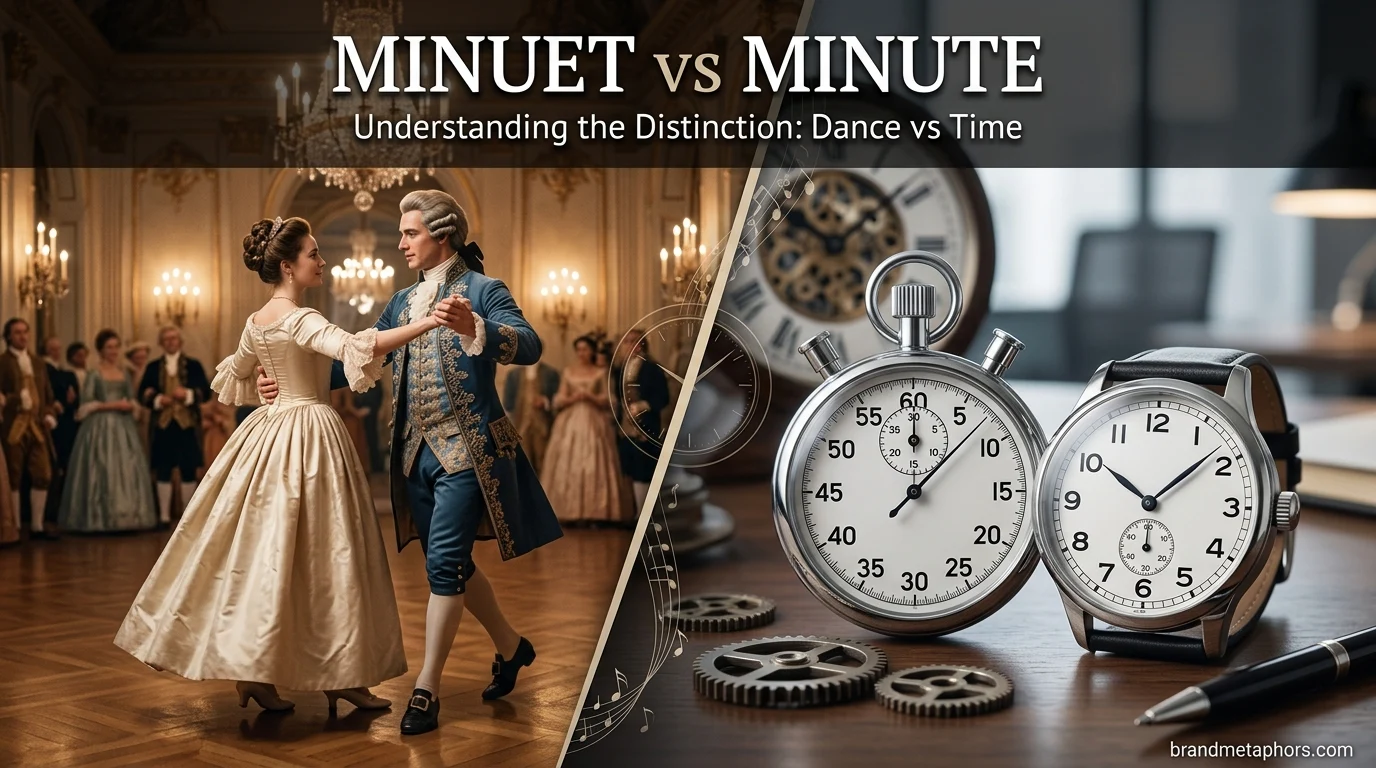
Language becomes more powerful when writers understand how words work in different contexts. Whether you are writing essays, poems, stories, emails, or academic papers, choosing the right word improves clarity and style. Strong vocabulary, descriptive language, figurative language, and creative writing techniques help readers understand ideas more effectively.
One pair of words that often confuses English learners is minuet vs minute. Although they look somewhat similar, they have completely different meanings, pronunciations, and uses.
This guide explains their definitions, pronunciation, usage, comparison examples, sentence examples, common mistakes, literary applications, and practical exercises to help students, writers, and English learners master these terms.
What Does Minuet Mean?
A minuet is a slow, elegant dance that became popular in Europe during the 17th and 18th centuries. It is also the musical composition written to accompany that dance.
The word comes from the French language and is strongly associated with classical music and formal dancing.
Key Characteristics of a Minuet
- Formal ballroom dance
- Popular during the Baroque and Classical periods
- Usually performed by couples
- Accompanied by music in triple meter
- Associated with elegance and grace
Example Sentences
- The dancers performed a beautiful minuet at the historical event.
- The orchestra played a traditional minuet by Mozart.
- Students learned the steps of the minuet during the cultural festival.
- The royal guests watched the minuet with admiration.
- Her movements were as graceful as a minuet.
What Does Minute Mean?
The word minute has multiple meanings depending on pronunciation and context.
Meaning 1: A Unit of Time
A minute equals sixty seconds.
Examples
- I will be ready in one minute.
- The meeting lasted thirty minutes.
- Please wait a minute.
Meaning 2: Extremely Small
When pronounced differently, minute means very tiny or extremely detailed.
Examples
- Scientists observed minute particles.
- The report included minute details.
- There was only a minute difference between the two designs.
Pronunciation Difference

One major reason for confusion is pronunciation.
WordPronunciationMeaningMinuetmin-yoo-ETA dance or musical compositionMinute (time)MIN-itUnit of timeMinute (small)my-NOOTVery tiny
Understanding pronunciation helps avoid misunderstandings in speaking and writing.
Quick Comparison Table
FeatureMinuetMinutePart of SpeechNounNoun/AdjectiveMain MeaningClassical danceTime unit or very smallOriginFrenchLatinUsed in MusicYesNoUsed in Time MeasurementNoYesUsed as AdjectiveNoYesCommon in Daily ConversationRareVery Common
This comparison makes it easier to distinguish between the two words.
Historical Background of Minuet
The minuet originated in France during the 1600s. It became one of the most fashionable dances among European nobility.
Famous composers who included minuets in their works include:
- Johann Sebastian Bach
- Wolfgang Amadeus Mozart
- Ludwig van Beethoven
In classical music, many symphonies and chamber pieces contained a minuet movement.
The dance symbolized sophistication, social status, and refined manners.
How Minute Is Used in Everyday English
Unlike minuet, minute appears constantly in everyday communication.
Time-Related Uses
- One minute
- Five minutes
- Ten-minute break
- Last minute
- Minute by minute
Detailed Uses
- Minute inspection
- Minute analysis
- Minute differences
- Minute observations
Because it has both noun and adjective forms, minute is much more versatile in modern English.
Sentence Examples for Better Understanding
Minuet Examples
- The ballroom echoed with the rhythm of a minuet.
- The dancers practiced the minuet for weeks.
- The music teacher introduced a famous minuet composition.
- The historical drama featured a traditional minuet scene.
- The audience applauded the elegant minuet performance.
Minute (Time) Examples
- Give me a minute to finish my homework.
- The train arrives every fifteen minutes.
- The speech lasted only one minute.
- She called me a minute ago.
- We completed the task in twenty minutes.
Minute (Small) Examples
- The scientist studied minute organisms.
- There was a minute crack in the wall.
- Engineers noticed a minute error in the design.
- The difference was so minute that nobody saw it.
- The detective examined minute details.
Using These Words in Creative Writing
Creative writing relies heavily on vocabulary enhancement and descriptive language. Knowing the difference between similar words improves writing quality.
Example with Minuet
“The grand hall shimmered beneath crystal chandeliers as couples glided through a graceful minuet.”
This sentence creates a vivid image and adds elegance to the scene.
Example with Minute
“A minute crack spread slowly across the ancient mirror.”
Here, minute helps create precise imagery.
Both words contribute differently to storytelling.
Figurative Language and Literary Devices
Writers often combine these words with figurative language to create stronger imagery.
Metaphor Examples
A metaphor compares two things without using “like” or “as.”
Examples:
- Her life was a minuet of carefully planned movements.
- Time is a minute slipping through your fingers.
These metaphors create poetic expression and deeper meaning.
Simile Examples
A simile uses “like” or “as.”
Examples:
- She moved like a dancer performing a minuet.
- The particle was as minute as a grain of dust.
Similes make descriptions more vivid and memorable.
Tone and Style Considerations

Different words create different tones.
Minuet Creates
- Elegant tone
- Historical tone
- Artistic tone
- Formal atmosphere
Example:
“The guests entered the ballroom as a minuet began.”
Minute Creates
- Practical tone
- Scientific tone
- Informational tone
- Everyday conversational tone
Example:
“The experiment revealed minute changes in temperature.”
Choosing the right tone helps writers communicate effectively.
When to Use Minuet
Use minuet when discussing:
- Classical music
- Historical dances
- Ballroom culture
- European history
- Artistic performances
Correct Usage
✔ The orchestra performed a minuet.
✔ The dancers practiced a minuet.
Incorrect Usage
✘ Wait a minuet.
✘ The meeting lasted five minuets.
Those examples should use “minute.”
When to Use Minute
Use minute when discussing:
Time
✔ Wait a minute.
✔ The lesson lasted forty minutes.
Tiny Size
✔ Scientists observed minute particles.
✔ There was a minute difference.
Incorrect Usage
✘ The orchestra played a minute.
✘ The dancers performed a minute.
These examples should use “minuet.”
Common Mistakes and How to Avoid Them
Many learners make similar errors.
Mistake 1: Confusing Spelling
Incorrect:
- The dance was a minute.
Correct:
- The dance was a minuet.
Mistake 2: Confusing Pronunciation
Remember:
- Minuet = dance
- Minute = time
- Minute = tiny
Mistake 3: Using the Wrong Context
Incorrect:
- Wait a minuet.
Correct:
- Wait a minute.
Mistake 4: Ignoring Pronunciation Changes
The adjective minute (tiny) is pronounced differently from the noun minute (time).
Practice reading both aloud.
Vocabulary Enhancement Through Related Words
Learning related vocabulary improves writing skills.
Words Related to Minuet
- Dance
- Ballet
- Waltz
- Performance
- Orchestra
- Symphony
- Ballroom
Terms Related to Minute (Time)
- Second
- Hour
- Moment
- Duration
- Period
Words Related to Minute (Small)
- Tiny
- Microscopic
- Miniature
- Minute-sized
- Minuscule
Using related words enriches communication and improves vocabulary development.
Practice Exercises
Exercise 1: Fill in the Blank
- The dancers performed a ______.
- Please wait one ______.
- Scientists observed ______ particles.
- The orchestra played a beautiful ______.
- The meeting lasted twenty ______.
Answers
- minuet
- minute
- minute
- minuet
- minutes
Exercise 2: Choose the Correct Word
- The ballroom featured a (minuet/minute).
- Wait a (minuet/minute).
- A (minuet/minute) crack appeared.
- Mozart composed a (minuet/minute).
- Ten (minuets/minutes) passed.
Answers
- minuet
- minute
- minute
- minuet
- minutes
Why Understanding This Difference Improves Writing

Knowing the distinction between these words offers several benefits:
Better Accuracy
Correct word choice prevents confusion.
Improved Writing Skills
Readers understand your message more clearly.
Stronger Vocabulary
You gain confidence using advanced words.
Enhanced Communication
Both academic and creative writing become more effective.
Better Reading Comprehension
You can understand literature, history, and music-related texts more easily.
These advantages help students, professionals, and English learners communicate more successfully.
Frequently Asked Questions (FAQs)
1. What is the main difference between minuet and minute?
A minuet is a classical dance or musical composition, while minute refers to a unit of time or something extremely small.
2. Are the two words pronounced the same?
No. Minuet is pronounced “min-yoo-ET.” Minute can be pronounced “MIN-it” or “my-NOOT” depending on meaning.
3. Is minuet commonly used today?
It is mostly used in discussions of classical music, history, dance, and literature.
4. Can minute be both a noun and an adjective?
Yes. As a noun, it means a unit of time. As an adjective, it means extremely small.
5. Which word is more common in everyday English?
Minute is far more common because people frequently discuss time and small details.
Conclusion
Although minuet and minute look similar, they serve entirely different purposes in English. A minuet refers to an elegant historical dance and its accompanying music, while minute either measures time or describes something extremely small. Understanding pronunciation, context, and usage helps avoid common mistakes and strengthens writing skills.
For students, writers, and English learners, mastering these distinctions improves vocabulary enhancement, descriptive language, creative writing, reading comprehension, and overall communication. By practicing sentence examples, literary devices, metaphor examples, simile examples, and figurative language techniques, you can use both words confidently and accurately in any form of writing.