
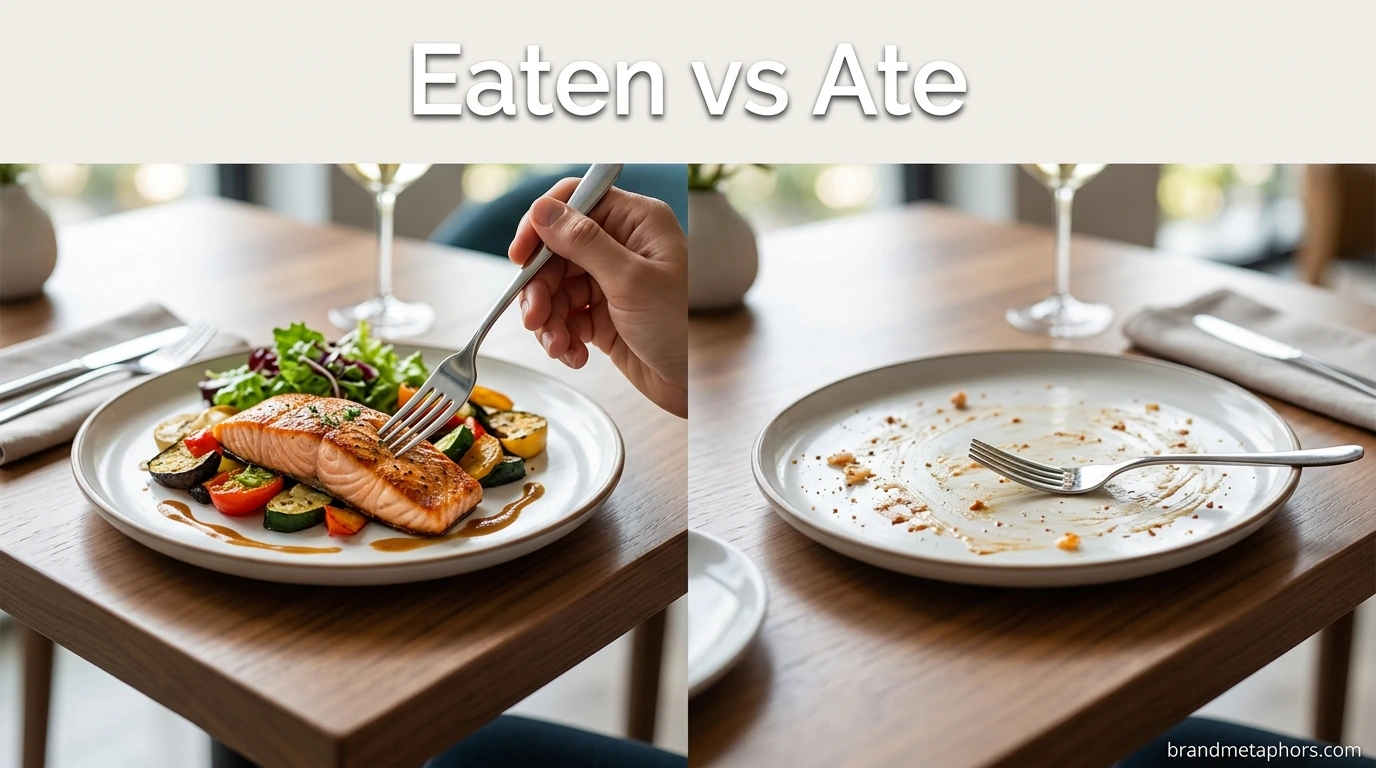
Introduction
Good writing is more than just knowing vocabulary. It also requires using grammar correctly so readers can understand your ideas clearly. Whether you are a student, writer, or English learner, understanding verb forms is essential for improving communication and writing skills.
One of the most common grammar questions involves the difference between eaten and ate. Many learners use these words incorrectly because both come from the verb “eat.” However, they serve different grammatical functions and cannot always be used interchangeably.
Learning the correct usage helps improve sentence structure, descriptive language, creative writing, academic writing, and everyday conversation. This guide explains their meanings, grammatical roles, sentence examples, comparison charts, common mistakes, exercises, and practical tips to help you master these important verb forms.
Understanding the Verb “Eat”
Before comparing the two forms, it is helpful to understand the verb itself.
The verb eat means:
- To consume food
- To chew and swallow something
- To have a meal
Main Forms of the Verb
Verb FormExampleBase FormeatPast SimpleatePast ParticipleeatenPresent Participleeating
Example
- I eat breakfast every morning.
- Yesterday, I ate breakfast late.
- I have eaten breakfast already.
- I am eating breakfast now.
Each form has a specific grammatical purpose.
What Does Ate Mean?
Ate is the simple past tense of the verb “eat.”
It describes an action that happened and finished in the past.
Structure
Subject + Ate + Object
Examples
- I ate pizza yesterday.
- She ate lunch at school.
- We ate dinner at 8 PM.
- They ate all the cookies.
- The dog ate the sandwich.
In each sentence, the action happened in the past and is completely finished.
Time Expressions Often Used with Ate
- Yesterday
- Last night
- Last week
- Two days ago
- Earlier today
- In 2020
Examples
- He ate breakfast yesterday.
- We ate at that restaurant last week.
- She ate ice cream two hours ago.
What Does Eaten Mean?

Eaten is the past participle form of the verb “eat.”
Unlike “ate,” it cannot usually stand alone as the main verb in a sentence.
It is commonly used with helping verbs such as:
- Have
- Has
- Had
- Be
- Been
Structure
Subject + Have/Has/Had + Eaten
Examples
- I have eaten lunch.
- She has eaten already.
- They had eaten before we arrived.
- The cake was eaten quickly.
- The food has been eaten.
Notice that a helping verb is required.
Incorrect Usage
❌ I eaten lunch.
Correct Usage
✅ I have eaten lunch.
Quick Comparison Table
FeatureAteEatenVerb TypePast SimplePast ParticipleCan Stand Alone?YesUsually NoNeeds Helping Verb?NoYesUsed in Simple Past?YesNoUsed in Perfect Tenses?NoYesUsed in Passive Voice?NoYes
Examples
Correct SentenceI ate dinner yesterday.I have eaten dinner already.
When to Use Ate
Use ate when talking about a completed action in the past.
Situations
1. Finished Actions
- I ate breakfast at 7 AM.
- She ate all her vegetables.
2. Historical Events
- The soldiers ate simple meals during the war.
- People ate different foods centuries ago.
3. Storytelling
- The boy ate the apple and ran away.
- The travelers ate dinner before continuing their journey.
Creative Writing Examples
- The dragon ate the treasure hunter in one bite.
- The exhausted explorer ate the last piece of bread.
These examples create vivid imagery and strengthen descriptive language.
When to Use Eaten
Use eaten with helping verbs in perfect tenses or passive voice.
Present Perfect
Used for actions connected to the present.
Examples:
- I have eaten enough.
- She has eaten breakfast already.
Past Perfect
Used for actions completed before another past action.
Examples:
- They had eaten before the movie started.
- We had eaten dinner when the guests arrived.
Passive Voice
Examples:
- The cake was eaten by the children.
- The food has been eaten.
Academic Writing Examples
- The samples had been eaten by insects.
- Most of the food has been eaten already.
Common Sentence Examples
Ate Examples
- I ate lunch at noon.
- He ate an orange.
- They ate together.
- We ate at a restaurant.
- She ate too quickly.
Eaten Examples
- I have eaten lunch.
- He has eaten an orange.
- They had eaten before leaving.
- We have eaten there before.
- She has eaten too much.
Comparison
AteEatenI ate breakfast.I have eaten breakfast.She ate lunch.She has eaten lunch.They ate dinner.They have eaten dinner.
Understanding Through Real-Life Situations
Situation 1: Yesterday’s Meal
Correct:
- I ate pizza yesterday.
Incorrect:
- I eaten pizza yesterday.
Reason: The action happened in the simple past.
Situation 2: Meal Completed Recently
Correct:
- I have eaten pizza already.
Incorrect:
- I ate pizza already. (Less natural in some contexts.)
Reason: Present perfect emphasizes the connection to the present.
Situation 3: Before Another Past Event
Correct:
- I had eaten before the meeting started.
Incorrect:
- I ate before the meeting started. (Possible but less precise.)
Reason: Past perfect shows sequence clearly.
Common Mistakes and How to Avoid Them

Many learners confuse these forms because both refer to past actions.
Mistake 1
❌ I eaten breakfast.
✅ I have eaten breakfast.
Mistake 2
❌ She eaten all the cake.
✅ She has eaten all the cake.
Mistake 3
❌ They have ate dinner.
✅ They have eaten dinner.
Mistake 4
❌ We had ate lunch before school.
✅ We had eaten lunch before school.
Memory Tip
Think of it this way:
- Ate = works alone.
- Eaten = needs a helper.
Examples:
- I ate lunch.
- I have eaten lunch.
Role in Writing Skills and Vocabulary Enhancement
Correct grammar improves:
- Writing skills
- Communication
- Academic performance
- Reading comprehension
- Professional writing
Using the correct verb form helps readers understand time relationships clearly.
Weak Example
- I eaten dinner yesterday.
Strong Example
- I ate dinner yesterday.
The second sentence sounds natural and grammatically correct.
Figurative Language and Creative Writing Examples
Although these words are mostly grammatical forms, they can appear in figurative language, metaphor examples, simile examples, idiom meaning, and poetic expression.
Metaphor Examples
- Jealousy had eaten his happiness.
- Fear ate away at her confidence.
Simile Examples
- The worry consumed him like a fire eating dry wood.
- The sadness spread like insects eating leaves.
Poetic Expression
- Time had eaten the edges of memory.
- Regret ate at his heart every night.
Literary Devices
Writers often use “eat” figuratively to create stronger emotional effects.
Examples:
- Guilt ate away at him.
- Anxiety had eaten all her peace.
Such expressions enrich descriptive language and improve storytelling.
Tone and Style Usage
Different tenses create different tones.
Simple Past (Ate)
Tone:
- Direct
- Clear
- Narrative
- Conversational
Example:
- I ate lunch at school.
Perfect Tenses (Eaten)
Tone:
- Reflective
- Formal
- Precise
- Academic
Example:
- I have eaten lunch already.
Writers choose the form depending on the context and purpose.
Practice Exercises
Exercise 1: Fill in the Blank
- I _____ breakfast at 8 AM.
- She has _____ dinner already.
- They _____ lunch yesterday.
- We had _____ before the guests arrived.
- The cake was _____ quickly.
Answers
- ate
- eaten
- ate
- eaten
- eaten
Exercise 2: Correct the Mistakes
- I have ate lunch.
- She eaten breakfast.
- They had ate dinner.
- We eaten all the food.
- He has ate the apple.
Correct Answers
- I have eaten lunch.
- She has eaten breakfast.
- They had eaten dinner.
- We have eaten all the food.
- He has eaten the apple.
Easy Rules to Remember

Use Ate When
- The action happened in the past.
- No helping verb is present.
- The action is completed.
Examples:
- I ate lunch.
- She ate breakfast.
- We ate dinner.
Use Eaten When
- A helping verb is used.
- Present perfect is needed.
- Past perfect is needed.
- Passive voice is used.
Examples:
- I have eaten lunch.
- She has eaten breakfast.
- The cake was eaten.
Frequently Asked Questions (FAQs)
1. Is “eaten” a real word?
Yes. It is the past participle form of the verb “eat.”
2. Can I say “I eaten lunch”?
No. The correct form is:
- I have eaten lunch.
3. Which is correct: “have ate” or “have eaten”?
Correct:
- Have eaten
Incorrect:
- Have ate
4. Why does “eaten” need a helping verb?
Because it is a past participle, not a simple past verb.
Examples:
- Have eaten
- Has eaten
- Had eaten
5. Which form is more common in daily conversation?
Both are common, but they are used in different situations.
- I ate lunch yesterday.
- I have eaten already.
Conclusion
Understanding the difference between eaten vs ate is an important step toward mastering English grammar. While both forms come from the verb “eat,” they serve different purposes. Ate is the simple past tense used for completed actions in the past, while eaten is the past participle used with helping verbs in perfect tenses and passive constructions.
By learning the rules, studying examples, practicing exercises, and recognizing common mistakes, students, writers, and English learners can improve grammar accuracy, writing skills, vocabulary enhancement, descriptive language, and overall communication. Consistent practice will make choosing the correct form natural and effortless in both speaking and writing.