

At first light, work often feels like a city waking up. Kettles hiss in quiet kitchens, keyboards begin their soft tapping, traffic thickens into the morning, and somewhere inside all that motion, people are carrying hopes, deadlines, invoices, dreams.
Work is never just work. It is pressure and purpose, routine and reinvention, fatigue and pride. That is why metaphors for work matter so much: they give language to something deeply human.
A good metaphor can turn a plain sentence into something memorable. Instead of saying, “I was busy,” you can say, “I was juggling flaming torches.” Instead of “the project was hard,” you can say, “it felt like climbing a mountain in the rain.” Metaphors help us explain effort, teamwork, burnout, ambition, and success in ways that feel vivid, emotional, and alive.
They are useful in writing, speeches, social media posts, interviews, essays, and everyday conversation.
Below are three rich metaphors for work, each with meaning, example use, alternative expressions, and a touch of story, imagery, or real-life feeling.
1. Work Is a Marathon, Not a Sprint
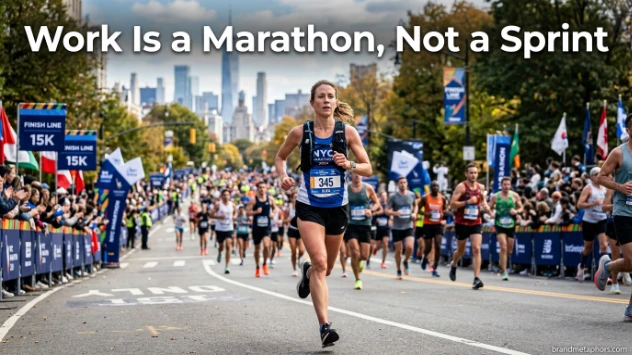
This is one of the most familiar metaphors for work, and for good reason. It reminds us that meaningful progress usually takes time. A marathon asks for pacing, endurance, discipline, and patience. It is not about one burst of speed; it is about sustaining effort over distance.
Meaning and explanation
When you say work is a marathon, you are emphasizing long-term effort over instant results. It suggests that success often comes from steady movement, not frantic rushing. It is especially useful when talking about careers, big projects, entrepreneurship, studying, or creative work.
Example sentence or scenario
“She learned that building her business was a marathon, not a sprint, so she stopped chasing overnight success and started focusing on consistency.”
Imagine an author sitting at a desk late at night, one page at a time. Or a nurse working through a long shift, staying focused hour after hour. In both cases, the metaphor fits: the goal is not dramatic speed, but lasting strength.
Alternative ways to express it
You could also say:
- “It is a long game.”
- “Slow and steady wins the race.”
- “Success is built step by step.”
- “It is a journey, not a race.”
Sensory or emotional details
This metaphor often carries the feeling of tired legs, deep breathing, and the quiet satisfaction of keeping pace. It can also bring a sense of resilience: the runner who keeps going, even when the finish line is far away.
Mini storytelling note
Think of a young teacher preparing lessons, answering emails, grading papers, and learning classroom rhythms. In the beginning, everything feels urgent. But after months, she realizes the real challenge is not one difficult week; it is the endurance to keep showing up with care. That is the marathon of work.
2. Work Is a Toolbox
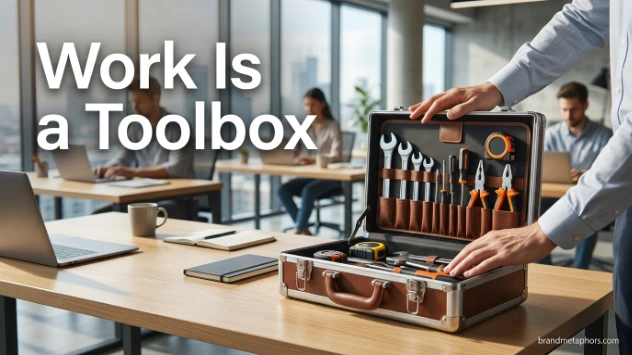
This metaphor makes work feel practical, flexible, and skill-based. A toolbox contains different tools for different problems. A hammer is not useful for every task, and a screwdriver cannot do the job of pliers. In the same way, work requires different abilities, habits, and strategies.
Meaning and explanation
When work is described as a toolbox, the idea is that people carry a set of skills they can use depending on the situation. Communication, time management, creativity, patience, technical knowledge, leadership, and adaptability are all tools. This metaphor is especially strong in writing about learning, professional growth, and problem-solving.
Example sentence or scenario
“Her calm voice was one of the most valuable tools in her toolbox; it helped her handle tense meetings without losing control.”
This metaphor works beautifully in real life. A project manager might need a spreadsheet one moment and empathy the next. A writer might need research, intuition, and revision. A mechanic, a doctor, and a designer all rely on different tools, but the principle is the same: the right tool matters.
Alternative ways to express it
You could also say:
- “Skills are your instruments.”
- “Your experience is your toolkit.”
- “You need the right tool for the job.”
- “Every challenge asks for a different approach.”
Sensory or emotional details
This metaphor has the feel of metal clicking against metal, hands reaching into a worn box, and the quiet confidence of being prepared. Emotionally, it suggests competence and readiness.
Mini cultural reference
In many crafts and professions, the toolbox is almost sacred. A carpenter measures twice and cuts once. A chef chooses a knife, a spoon, a pan. A musician chooses notes the way a worker chooses tools. Across cultures, the message is the same: mastery is not random. It is assembled.
3. Work Is a Fire You Must Tend
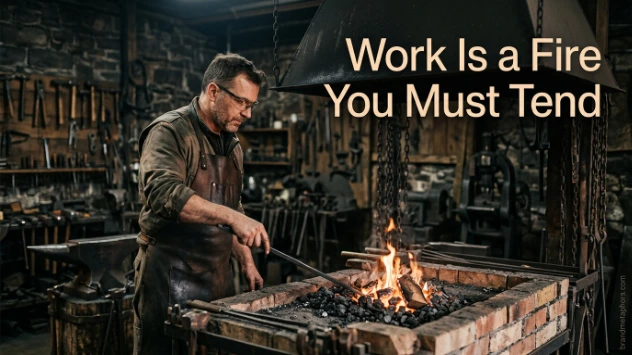
This metaphor is especially vivid because it captures both energy and danger. Fire can warm a home, light a room, and power creation. But if neglected, it dims. If uncontrolled, it burns.
Meaning and explanation
When work is a fire you must tend, it means effort needs attention, care, and balance. Motivation cannot be left alone forever. Just as a fire needs fuel and air, work needs rest, purpose, and renewal. This metaphor is excellent for discussing motivation, ambition, burnout, and creative drive.
Example sentence or scenario
“His passion for photography was like a fire he had to tend carefully; when he ignored rest, the flame shrank into exhaustion.”
This image feels especially true for artists, entrepreneurs, teachers, caregivers, and anyone who pours emotional energy into what they do. A fire can become a campfire story, a kitchen flame, or a forge. It suggests warmth and creation, but also responsibility.
Alternative ways to express it
You could also say:
- “Keep the spark alive.”
- “Protect your energy.”
- “Feed your motivation.”
- “Do not let the flame go out.”
Sensory or emotional details
This metaphor brings the smell of wood smoke, the crackle of embers, and the glow on tired faces. It can feel comforting, but also fragile. That emotional tension makes it powerful.
Mini storytelling note
In many old stories, fire is a symbol of knowledge and survival. Think of ancient hearths where families gathered, or mythic tales where a spark meant hope in the dark. Work, too, can be like that spark: useful, beautiful, and worth protecting.
Why Metaphors for Work Matter in Writing and Life
Metaphors do more than decorate language. They shape how we think.
At work is a battle, we may feel we must always fight. When work is a race, we may feel constant pressure to be first. When work is a garden, we may think in seasons, patience, and growth.At work is a staircase, we may see progress as upward and deliberate.
The metaphor you choose changes the emotional tone of your message. That is why writers, marketers, teachers, and speakers use them so often. A strong metaphor can make a reader feel seen. It can also make an abstract idea feel concrete enough to remember.
Interactive Exercises to Practice Metaphors for Work
Try these creative prompts to make the idea your own.
1. Rewrite a plain sentence
Take a sentence like:
“I am tired of my job.”
Now transform it with a metaphor:
“I feel like a machine that has been running too long without a pause.”
Or:
“My workweek feels like carrying a backpack full of stones.”
2. Match the metaphor to the mood
Choose one feeling and write a metaphor for it:
- Stress
- Motivation
- Teamwork
- Burnout
- Achievement
For example, teamwork might be “a rowboat moving only when everyone pulls together.”
3. Observe your workplace
Look around your desk, office, kitchen, studio, or worksite. Pick one object and turn it into a metaphor for work.
A stapler might become “the tiny machine that holds chaos together.” A coffee mug might become “a morning lifeline in ceramic form.”
4. Finish this sentence
“Work, to me, is like __________ because __________.”
This simple prompt often unlocks surprisingly poetic language.
Bonus Tips for Using Work Metaphors in Writing, Social Media, and Daily Life
In writing, choose metaphors that match your audience. A corporate blog may suit “toolbox,” “foundation,” or “framework,” while a personal essay may feel stronger with “fire,” “storm,” or “marathon.”
For social media, keep metaphors short and sharp. A post like “Some weeks are marathons, not sprints” is easy to share and remember.
In daily life, metaphors can help you explain how you feel without sounding flat. Saying “I’m running on empty” or “I need to refill my energy tank” instantly communicates more than “I’m tired.”
The best metaphors are not just clever. They are clear, human, and true enough that others recognize themselves in them.
Conclusion
Work can be exhausting, meaningful, repetitive, hopeful, frustrating, and transformative all at once. Plain words sometimes struggle to hold all that weight. Metaphors give work shape. They let us talk about ambition as a road, skill as a toolbox, and motivation as a flame in the dark.
So the next time you describe a job, a goal, or a long project, do not be afraid to reach for imagery. A good metaphor does not just explain work. It reveals what work feels like.
And often, that is the difference between a sentence people read and a sentence they remember.