
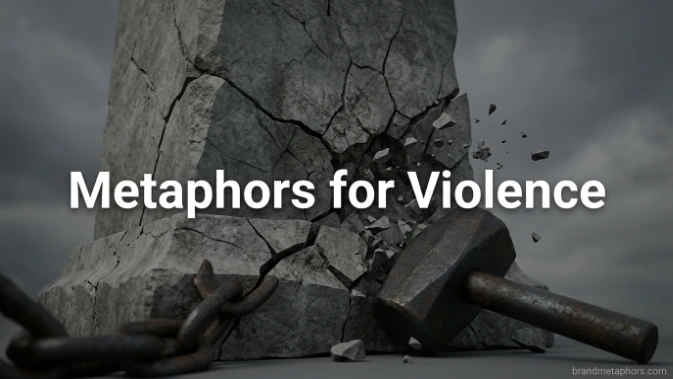
The Sound Before the Storm: A Hook into Violence
The room is quiet—too quiet. Then a glass shatters, sharp as a scream. No one moves, but everything has changed. Violence rarely begins with a punch; it begins with tension, with pressure building like a storm that hasn’t yet broken. You can feel it in the air, in the tightening of jaws, in the silence that hums louder than noise.
Violence is not just physical. It lives in words, in systems, in relationships, in the slow erosion of safety. And sometimes, the most powerful way to understand or describe it isn’t through literal language—but through metaphor.
Metaphors allow us to approach violence without glorifying it. They soften the edges just enough to make it discussable, while still preserving its emotional weight. They help writers, speakers, and thinkers communicate intensity, fear, disruption, and consequence in ways that resonate deeply.
This article explores how metaphors for violence can be used thoughtfully and creatively—whether in storytelling, essays, social media, or everyday expression. You’ll find vivid examples, practical tips, and exercises to sharpen your voice and deepen your impact.
Why Use Metaphors for Violence in Writing?
Violence can be difficult to describe directly. Literal descriptions can feel harsh, overwhelming, or even numbing. Metaphors step in as a bridge—they translate raw experience into imagery that readers can feel and interpret.
Using metaphors for violence helps:
- Convey emotional intensity without graphic detail
- Create distance for sensitive topics
- Engage readers’ imagination
- Highlight deeper meanings, such as power, fear, or chaos
Think of metaphor as a lens. Instead of showing violence head-on, it refracts it—revealing patterns, consequences, and emotions that might otherwise go unnoticed.
Storms and Tempests: Violence as Nature’s Fury
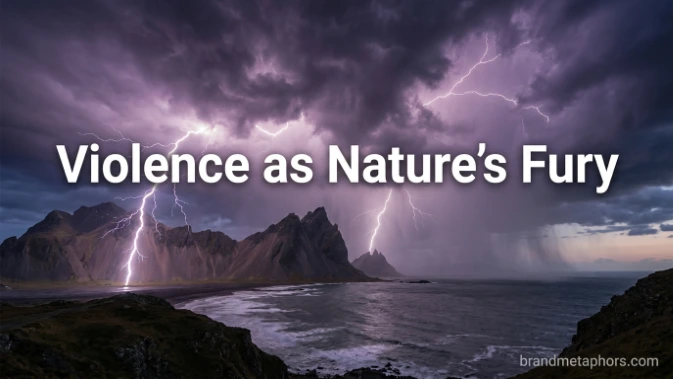
One of the most common and effective metaphors for violence is the storm. Storms are unpredictable, overwhelming, and often destructive—just like violent acts or situations.
Meaning and Explanation
Comparing violence to a storm emphasizes chaos, lack of control, and sudden escalation. It also suggests that violence can build gradually before exploding.
Example Scenario
“His anger rolled in like thunder, and before anyone could react, the storm had broken.”
Alternative Expressions
- “A hurricane of rage”
- “Lightning in his voice”
- “A gathering storm of tension”
Sensory Details
You might describe the heaviness of the air, the crack of thunder, the blinding flash of lightning—mirroring the emotional environment of violence.
Mini Storytelling
In many novels, conflict begins with subtle signs—dark clouds on the horizon. The storm metaphor allows writers to foreshadow violence, making it feel inevitable rather than sudden.
Fire and Wildfire: The Spread of Destruction
Fire is another powerful metaphor for violence, especially when it spreads quickly and uncontrollably.
Meaning and Explanation
Violence as fire suggests intensity, danger, and the ability to grow beyond its origin. It also reflects how violence can consume everything in its path.
Example Scenario
“The argument sparked, then spread like wildfire, leaving nothing untouched.”
Alternative Ways to Express It
- “Flames of anger”
- “A blaze of destruction”
- “Smoldering resentment”
Emotional Details
Fire metaphors often evoke heat, suffocation, and urgency—perfect for conveying emotional escalation.
Real-Life Connection
Think of how quickly a small disagreement online can escalate into a full-blown conflict. The wildfire metaphor captures that rapid, uncontrollable spread.
War and Battlefield: Violence as Conflict
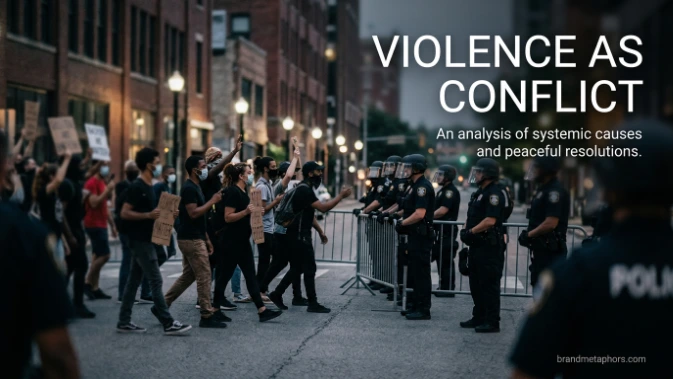
War metaphors are deeply embedded in language. We “fight battles,” “defend positions,” and “attack arguments.”
Meaning and Explanation
This metaphor frames violence as strategic, intentional, and often prolonged. It highlights power dynamics and survival instincts.
Example Scenario
“Their home had become a battlefield, every word a weapon.”
Alternative Expressions
- “Emotional warfare”
- “A silent war”
- “Lines drawn in the sand”
Sensory Elements
Clashing sounds, tension, silence before attack—these details enhance the metaphor.
Cultural Reference
Many speeches and writings use war metaphors to describe social struggles, emphasizing resilience and resistance.
Cracks and Earthquakes: Violence as Sudden Rupture
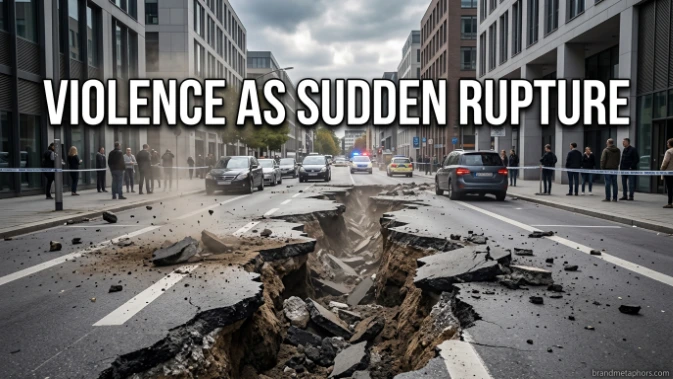
Sometimes violence isn’t gradual—it’s sudden, shocking, and irreversible.
Meaning and Explanation
Earthquake metaphors capture the unpredictability and aftermath of violence. They show how quickly stability can collapse.
Example Scenario
“The news hit like an earthquake, shaking the foundation of everything she believed.”
Alternative Expressions
- “A fault line of tension”
- “Ground splitting beneath them”
- “Aftershocks of fear”
Sensory Details
Tremors, collapsing structures, dust in the air—these details mirror emotional upheaval.
Poison and Disease: Violence as Corruption
Violence isn’t always loud. Sometimes it’s slow, quiet, and insidious.
Meaning and Explanation
Comparing violence to poison or disease highlights its ability to spread and damage over time.
Example Scenario
“His words were poison, seeping into her confidence day by day.”
Alternative Ways
- “A toxic environment”
- “Infected by hatred”
- “A virus of aggression”
Emotional Depth
This metaphor works especially well for psychological or emotional violence, where harm isn’t immediately visible.
Machines and Pressure: Violence as Mechanical Force
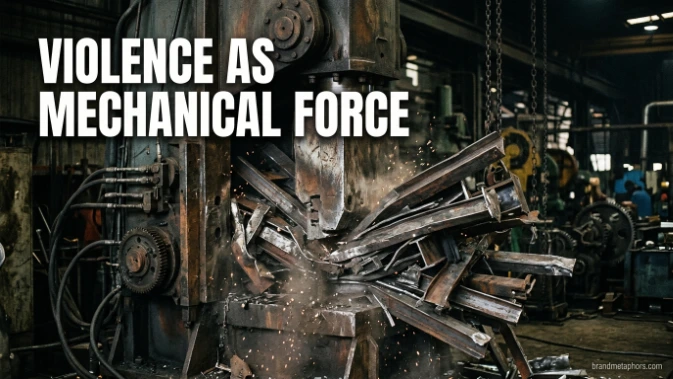
Violence can feel impersonal, relentless, and unstoppable—like a machine.
Meaning and Explanation
Machine metaphors emphasize inevitability and lack of empathy. Pressure metaphors highlight buildup and explosion.
Example Scenario
“The system crushed him like gears grinding without pause.”
Alternatives
- “Under pressure”
- “A ticking time bomb”
- “Crushing weight”
Mini Insight
These metaphors are powerful when discussing systemic or institutional violence.
Animal Instincts: Violence as Primal Behavior
Sometimes violence is portrayed as something instinctive, raw, and animalistic.
Meaning and Explanation
This metaphor suggests loss of control and reversion to primal instincts.
Example Scenario
“He lashed out like a cornered animal, driven by fear.”
Alternatives
- “Predator and prey”
- “A pack mentality”
- “Claws out”
Emotional Layer
Animal metaphors often evoke fear, survival, and instinct.
Shadows and Darkness: Violence as Hidden Threat
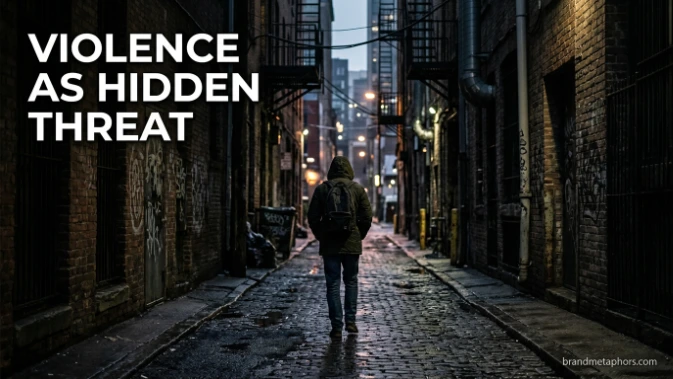
Not all violence is visible. Some lurks in the shadows.
Meaning and Explanation
Darkness metaphors emphasize secrecy, fear, and the unknown.
Example Scenario
“Violence crept in like a shadow, unnoticed until it was too late.”
Alternatives
- “A dark cloud hanging overhead”
- “Shadows of fear”
- “Hidden in the dark”
Chains and Cages: Violence as Control
Violence can also be about restriction and power.
Meaning and Explanation
These metaphors highlight how violence traps, limits, or controls individuals.
Example Scenario
“She felt chained by his threats, unable to escape.”
Alternatives
- “A prison of fear”
- “Bound by control”
- “Locked in silence”
Echoes and Ripples: The Lasting Impact of Violence
Violence doesn’t end when the act is over—it lingers.
Meaning and Explanation
Ripple metaphors show how violence spreads outward, affecting more than just the immediate moment.
Example Scenario
“Their actions sent ripples through the community, touching lives far beyond their own.”
Alternatives
- “Echoes of pain”
- “Waves of consequence”
- “Lingering shadows”
Interactive Exercises: Practice Using Metaphors for Violence
Exercise 1: Rewrite the Scene
Take a simple sentence like: “He was very angry and shouted.”
Rewrite it using a metaphor:
- “His anger erupted like a volcano, words spilling over in molten fury.”
Exercise 2: Match the Emotion
Choose an emotion (fear, anger, tension) and match it with a metaphor (storm, fire, shadow). Write a sentence combining them.
Exercise 3: Build a Mini Story
Write a short paragraph where violence is implied only through metaphor—no direct mention.
Bonus Tips for Writers and Creators
- Be mindful of tone: Avoid glamorizing violence
- Choose fresh metaphors: Avoid clichés when possible
- Match metaphor to context: A wildfire may suit chaos, but not quiet tension
- Use sparingly: Too many metaphors can overwhelm
- Adapt for platforms: Short, punchy metaphors work well on social media
FAQs About Metaphors for Violence
1. Why should I use metaphors instead of direct descriptions?
Metaphors make difficult topics more approachable and emotionally resonant without being overly graphic.
2. Can metaphors reduce the seriousness of violence?
If used carefully, they enhance understanding rather than diminish seriousness.
3. Are some metaphors better than others?
Yes—choose metaphors that fit the tone, context, and message you want to convey.
4. How do I avoid clichés?
Try combining unexpected elements or drawing from personal experiences.
5. Can metaphors be used in non-fiction writing?
Absolutely—they can clarify complex ideas and engage readers effectively.
Conclusion
Violence is a heavy subject—but language gives us tools to explore it with care, depth, and meaning. Metaphors don’t just decorate writing; they transform it. They allow us to speak about difficult realities in ways that connect, illuminate, and resonate.
Whether you’re crafting a story, writing an article, or expressing a feeling, metaphors for violence can help you go beyond the surface. They let you show not just what happens—but how it feels, how it spreads, and how it lingers.
And perhaps most importantly, they remind us that words—unlike violence—can build understanding instead of breaking it.