
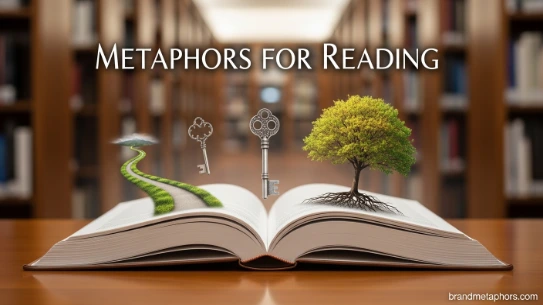
The book lay open on the table, its pages whispering faintly as a fan stirred the air. Outside, rain tapped gently against the window like impatient fingers. Inside that small room, a reader wasn’t just sitting still—they were traveling.
Crossing oceans without water, meeting strangers without moving an inch, hearing voices from centuries ago as if they were sitting nearby. Reading, in that moment, wasn’t an activity. It was an experience that dissolved the boundaries of time, place, and even identity.
This is where metaphors for reading begin to matter.
Because reading is rarely just “reading.” It is a bridge, a journey, a conversation, a mirror, a storm, a shelter—depending on who is holding the book and what world they are entering.
In this article, we’ll explore metaphors for reading that help us understand the deeper emotional, intellectual, and imaginative experience of engaging with text. These metaphors don’t just decorate language; they shape how we think about learning, storytelling, and even ourselves.
Understanding Metaphors for Reading: Why They Matter in Language and Life
A metaphor is a way of understanding one thing in terms of another. When we say “reading is a journey,” we’re not speaking literally—we’re revealing how reading feels: exploratory, unfolding, sometimes unpredictable.
Metaphors for reading are especially powerful because reading itself is invisible. You can’t see comprehension happening, but you can feel it. You can sense when a sentence changes you, when a paragraph opens something inside your mind, when a story lingers long after the page is closed.
These metaphors matter because they:
- Help students and learners connect emotionally with reading
- Inspire writers to describe experiences more vividly
- Encourage deeper appreciation of literature
- Turn a simple act into something meaningful and memorable
When reading becomes more than decoding words—when it becomes travel, light, or transformation—it becomes alive.
Metaphor 1: Reading as a Journey Through Unknown Worlds
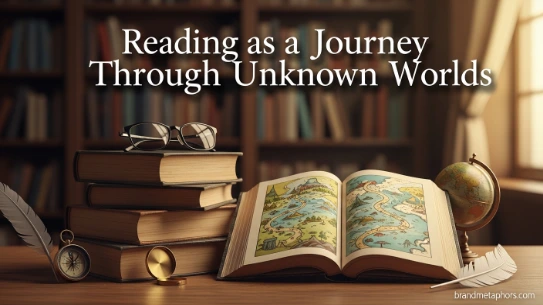
Reading is often described as a journey, and for good reason. Eny book is a mapless land. Every chapter is a turning path. Every page is a step forward into something you cannot fully predict.
Meaning and Explanation
This metaphor highlights exploration, progress, and discovery. Like a traveler, the reader leaves behind their familiar world and steps into new landscapes of thought, culture, emotion, and imagination.
Example Sentence or Scenario
A teenager opens a fantasy novel on a quiet evening. Within minutes, their bedroom fades away. Suddenly, they are walking through enchanted forests, facing mythical creatures, and making impossible choices. The book becomes a passport, and every page a new destination.
Alternative Ways to Express It
- Reading is a voyage across unseen seas
- Books are maps to hidden continents of imagination
- Every story is a road that leads somewhere unexpected
Sensory and Emotional Detail
There is a feeling of movement even while sitting still—the sense that your mind is stepping forward while your body remains anchored. It can feel like wind against your thoughts, like turning corners in a city you’ve never visited.
Mini Storytelling Moment
A young reader once described finishing a novel and feeling disoriented, as if returning from a long trip. For a moment, they looked around their room and wondered how everything had stayed so unchanged while they had been somewhere entirely different.
Metaphor 2: Reading as a Mirror of the Self
Reading is also a mirror—but not a simple reflection. It is a shifting mirror that shows not only who you are, but who you might become.
Meaning and Explanation
This metaphor emphasizes introspection. When we read, we often recognize parts of ourselves in characters, ideas, and conflicts. Sometimes books reveal feelings we couldn’t previously name.
Example Sentence or Scenario
A reader encounters a character struggling with loneliness. As the story unfolds, they realize they have felt the same emotions but never expressed them. The book doesn’t just tell a story—it reflects their inner world back to them.
Alternative Ways to Express It
- Books reflect hidden corners of the soul
- Reading is a dialogue with yourself
- Stories hold up a glass to human experience
Sensory and Emotional Detail
This metaphor often carries emotional weight. It can feel like a quiet shock—recognizing yourself in a sentence you didn’t expect. Sometimes it is comforting, other times unsettling, like discovering a forgotten photograph of your own mind.
Cultural or Literary Connection
Many readers describe classics like those by Jane Austen or Fyodor Dostoevsky as mirrors because they expose social behavior, moral struggle, and emotional complexity that still feels relevant today.
Metaphor 3: Reading as Light in Darkness
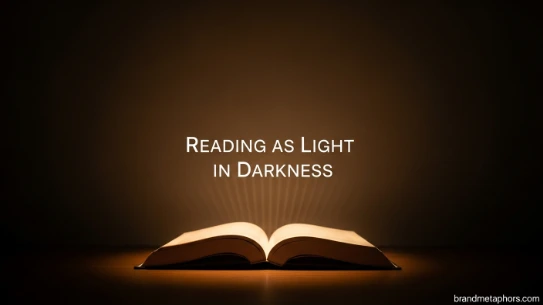
Reading is frequently imagined as light, especially in moments of confusion, loneliness, or uncertainty. A book becomes a lamp in a dark room, illuminating thoughts that were previously unclear.
Meaning and Explanation
This metaphor emphasizes clarity, guidance, and hope. Reading helps us understand complex ideas, navigate emotions, and find direction when life feels uncertain.
Example Sentence or Scenario
A student struggling with anxiety finds a self-help book that explains emotions in simple, compassionate language. Suddenly, their confusion feels less heavy. The words don’t erase the darkness—but they make it easier to see.
Alternative Ways to Express It
- Books are lanterns in the fog of confusion
- Reading brings illumination to the mind
- Stories are sparks in mental darkness
Sensory and Emotional Detail
This metaphor often feels warm and gentle. It is like sitting near a small lamp during a storm—safe, steady, and quietly reassuring.
Mini Storytelling Moment
An older reader once said that during a difficult period of life, they read every night just to feel less alone. The books didn’t fix everything—but they made the nights feel less endless.
Interactive Exercises: Practicing Metaphors for Reading
To truly understand metaphors for reading, try creating your own. Here are some simple exercises:
Exercise 1: Complete the Metaphor
Finish these sentences creatively:
- Reading is like ______ because ______
- A book feels like ______ when ______
- Turning a page is like ______
Exercise 2: Sensory Expansion
Choose one metaphor (journey, mirror, or light) and describe it using senses:
- What does it sound like?
- What does it feel like physically or emotionally?
- What colors or images come to mind?
Exercise 3: Personal Connection
Write a short paragraph describing your favorite reading experience using at least one metaphor from this article.
Exercise 4: Social Media Challenge
Create a one-line metaphor about reading and imagine it as an Instagram caption or tweet. Example:
“Reading is traveling without packing a single bag.”
Bonus Tips: Using Reading Metaphors in Writing and Daily Life
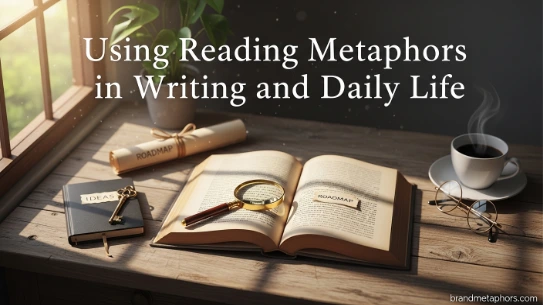
Metaphors for reading aren’t just literary tools—they’re practical creative devices.
Writing
- Use metaphors to make essays and stories more vivid
- Replace plain descriptions with imagery (e.g., “understanding grew” → “understanding blossomed like dawn”)
- Build emotional tone quickly in introductions
Social Media
- Share reading quotes with metaphor captions
- Make book reviews more engaging (“This novel felt like stepping into a storm of memories”)
- Use metaphors to summarize reading experiences in one line
Daily Life
- Think of difficult books as “mountains to climb” rather than chores
- See slow reading days as “wandering paths” instead of failure
- Treat each book as a “season” in your mental landscape
When reading becomes metaphorically rich, it becomes easier to stay motivated and curious.
Conclusion
Reading is not a single experience—it is many layered experiences happening at once. It is movement and stillness. It is reflection and discovery. This is darkness and light sharing the same page.
When we describe reading as a journey, a mirror, or a light, we are not just being poetic. We are acknowledging what readers have always known: that words are not passive. At act on us. They reshape us. They accompany us long after the page is turned.
A book is never just paper and ink. It is a space where minds meet across distance and time. And every time you open one, you are not just reading—you are entering a living metaphor.
FAQs About Metaphors for Reading
What are metaphors for reading?
Metaphors for reading are imaginative comparisons that describe reading as something else—like a journey, mirror, or light—to express its deeper meaning and emotional impact.
Why are metaphors important in describing reading?
They help readers understand the emotional and intellectual experience of reading in a more vivid and relatable way than literal explanations.
Can I create my own metaphors for reading?
Yes. In fact, creating your own metaphors strengthens creativity and helps you express personal reading experiences more meaningfully.
How do metaphors improve writing skills?
Metaphors make writing more engaging, expressive, and memorable by adding imagery and emotional depth to ordinary descriptions.
What is the most common metaphor for reading?
One of the most common metaphors is “reading as a journey,” because it reflects exploration, discovery, and progression through ideas and stories.