

1. What Are Metaphors for Pregnancy? Understanding the Language of Creation
Pregnancy is one of those human experiences that stretches language to its limits. It is physical, emotional, mysterious, and deeply personal all at once. Because of this, people often reach for metaphors—comparisons that help us understand something complex by relating it to something familiar.
Metaphors for pregnancy are not just poetic decorations. They are emotional bridges. They turn abstract sensations—like anticipation, change, and transformation—into images the mind can see and feel. Instead of saying “pregnancy is hard,” a metaphor might say, “pregnancy is like carrying a secret sunrise inside your body.”
That shift matters. It gives shape to emotions that often feel too big or too quiet for ordinary words.
In writing, storytelling, journaling, or even conversation, pregnancy metaphors help people express what is often felt more than spoken. They can bring comfort, clarity, and even celebration to a journey that is both universal and deeply individual.
2. Why Metaphors Matter in Describing Pregnancy
Pregnancy is not just a biological process—it is a transformation of identity, rhythm, and perception. Metaphors help translate that transformation into emotional language.
They matter because they:
- Give voice to complex emotions
- Help partners, families, and communities understand the experience
- Allow writers to express depth beyond clinical descriptions
- Offer comfort by framing challenges in meaningful ways
For example, saying “pregnancy is like winter slowly turning into spring” immediately creates emotional understanding. It suggests waiting, change, patience, and eventual renewal—all without needing medical explanation.
Metaphors also help expecting parents themselves process change. When feelings become overwhelming or unfamiliar, imagery can act like emotional grounding.
3. Pregnancy as a Garden in Bloom 🌱 (Metaphor 1)
One of the most common and powerful metaphors for pregnancy is that of a garden.
Meaning & Explanation
In this metaphor, the body becomes fertile soil, and the growing baby is a seed slowly developing into life. Pregnancy becomes a process of nurturing, patience, and natural unfolding.
It emphasizes growth that cannot be rushed.
Example Scenario
A woman notices how her body changes week by week and says, “I feel like I am a garden finally learning how to bloom from the inside.”
Alternative Expressions
- “My body is a field preparing for spring.”
- “Life is quietly blooming within me.”
- “I am growing a secret orchard inside.”
Sensory & Emotional Detail
This metaphor often carries earthy imagery—warm soil, gentle rain, sunlight filtering through leaves. It suggests softness, patience, and quiet transformation rather than urgency.
Mini Storytelling Moment
Imagine a woman walking barefoot in a small backyard garden. She notices how plants respond differently each morning—some stretching toward light, others slowly unfurling. She begins to see her own body the same way: not something changing randomly, but something growing with intention and rhythm.
Why It Works
The garden metaphor comforts because it normalizes slow progress. It reminds us that growth is not always visible, but always happening.
4. Pregnancy as a Journey Across Seas 🌊 (Metaphor 2)
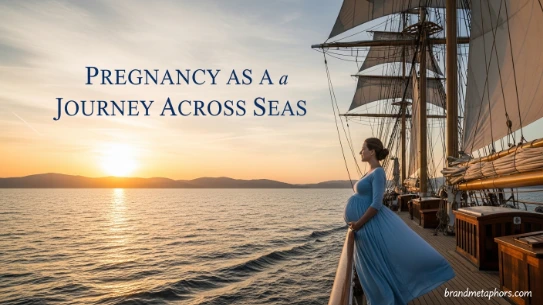
Another powerful metaphor is pregnancy as a voyage across water—an ocean, river, or sea.
Meaning & Explanation
Here, pregnancy becomes a journey. The body is a vessel, and each stage is a new wave or current. There may be calm waters, storms, and moments of stillness.
This metaphor highlights uncertainty, courage, and movement toward a destination.
Example Scenario
An expecting parent might say, “Some days feel like calm sailing, and others like navigating storms I didn’t expect—but I’m still moving forward.”
Alternative Expressions
- “I am sailing through nine months of change.”
- “This is a voyage toward a new shore.”
- “My body is a ship carrying precious cargo.”
Sensory & Emotional Detail
You might imagine salt air, rolling waves, wind shifting direction. Emotionally, it captures both fear and excitement—the unknown nature of the future mixed with trust in the journey.
Cultural & Literary Echo
Throughout literature, journeys across seas often symbolize transformation. Pregnancy fits naturally into this tradition—it is a passage from one identity to another.
Mini Storytelling Moment
Picture a traveler on a quiet boat at dawn. The water is uncertain, but the horizon is glowing faintly. The traveler does not know exactly what lies ahead, but trusts the direction of the light.
That is pregnancy in metaphorical form.
5. Pregnancy as a Sacred Flame or Inner Light 🔥 (Metaphor 3)
This metaphor shifts from nature and travel to something more spiritual and internal: pregnancy as a flame.
Meaning & Explanation
Here, life is imagined as a glowing light or flame growing within. It represents warmth, protection, and sacred energy.
This metaphor often emphasizes reverence and emotional depth.
Example Scenario
A parent might reflect, “It feels like I’m carrying a quiet flame inside me that changes everything I do.”
Alternative Expressions
- “A light is growing within me.”
- “I carry a sacred ember of life.”
- “Something warm and bright is unfolding inside.”
Sensory & Emotional Detail
Think of candlelight in a dark room, soft golden glow, heartbeat-like warmth. Emotionally, this metaphor often brings feelings of protection, tenderness, and awe.
Mini Storytelling Moment
A quiet evening, a dim room, a single candle burning steadily. The light does not shout or demand attention, but it changes the entire atmosphere. Everything feels more meaningful in its presence.
That is how pregnancy can feel emotionally—subtle but transformative.
6. Cultural and Literary References to Pregnancy Metaphors
Across cultures, pregnancy has long been described through symbolic language.
- In many traditions, it is seen as “carrying life like sacred water in a vessel.”
- Some Indigenous stories describe pregnancy as “listening to the earth grow inside the body.”
- In poetry, it is often compared to “moon cycles forming new worlds.”
These metaphors show that pregnancy is not only biological but deeply cultural and symbolic. It is seen as creation, continuation, and connection between generations.
Literature often uses soft, natural imagery—seasons, light, rivers, and seeds—to reflect the same themes of transformation and patience.
7. How Writers and Poets Use Pregnancy Metaphors
Writers use pregnancy metaphors not only to describe physical experience but also emotional landscapes.
For example:
- To represent hope: “a future unfolding like petals”
- To express uncertainty: “a story still being written in silence”
- To capture beauty: “a poem growing line by line inside the body”
Poets often avoid direct explanation and instead rely on imagery that allows readers to feel rather than understand intellectually.
Pregnancy becomes a symbol of creativity itself—creation of life, ideas, identity, and meaning.
8. Interactive Exercise: Create Your Own Pregnancy Metaphors
Try this creative exercise:
Step 1: Choose a Theme
Pick something familiar:
- Nature (trees, rain, flowers)
- Travel (roads, rivers, skies)
- Light (sun, stars, fire)
- Objects (books, music, art)
Step 2: Complete the Sentence
“Pregnancy feels like…”
Examples:
- “Pregnancy feels like writing a book without seeing the pages yet.”
- “Pregnancy feels like carrying a quiet storm that is also peace.”
- “Pregnancy feels like a sunrise happening inside the body.”
Step 3: Add Sensory Detail
Ask:
- What does it feel like?
- What does it look like?
- What emotion does it carry?
Reflection Prompt
Which metaphor feels closest to your emotional experience—and why?
This exercise helps turn abstract feelings into expressive language.
9. Tips for Using Pregnancy Metaphors in Writing & Social Media
If you want to use these metaphors in writing or online sharing:
Keep It Personal
The strongest metaphors come from lived emotion, not perfection.
Use Simple Imagery
Clarity often feels more powerful than complexity.
Mix Metaphors Carefully
You can blend ideas like “journey” and “garden,” but keep emotional consistency.
Match Tone to Context
- Social media: short, poetic lines
- Journals: deeper emotional exploration
- Essays: structured explanations with imagery
Example Social Post Ideas
- “Growing like spring in slow motion.”
- “Sailing through a quiet storm of love.”
- “Carrying light I’ve never seen but always felt.”
10. Emotional Power: How Metaphors Help Expecting Parents Express Feelings
Pregnancy can bring joy, fear, exhaustion, wonder, and confusion—all at once. Metaphors help organize these emotions into something understandable.
They allow people to say:
- “I feel overwhelmed” without sounding clinical
- “I feel amazed” without needing explanation
- “I feel uncertain” without losing hope
Metaphors do not simplify pregnancy—they deepen it. They give emotional language to something that is often beyond words.
In this way, they become not just literary tools but emotional companions.
FAQs About Metaphors for Pregnancy
1. Why do people use metaphors for pregnancy?
Because pregnancy is complex and emotional, metaphors help express feelings that are difficult to describe directly.
2. Are pregnancy metaphors only used in poetry?
No. They appear in everyday speech, journaling, storytelling, social media, and cultural traditions.
3. What is the most common metaphor for pregnancy?
Nature-based metaphors like gardens, seasons, and growth are among the most common.
4. Can metaphors help during emotional stress in pregnancy?
Yes. They can help reframe experiences and provide emotional comfort and meaning.
5. How can I create my own pregnancy metaphor?
Start with your feelings, choose a familiar image (like nature or travel), and compare your experience using “like” or “as.”
Conclusion
Metaphors for pregnancy are more than poetic language—they are emotional maps of transformation. Whether it is a garden blooming in silence, a voyage across unpredictable seas, or a sacred light growing quietly within, each metaphor offers a different way to understand one of life’s most profound experiences.
They remind us that pregnancy is not just about change in the body, but change in perception, identity, and emotion. And sometimes, the only way to truly understand such a journey is not through explanation—but through imagery that lets us feel it.
In the end, metaphors do not define pregnancy. They honor it.