
Grief rarely arrives with a clear explanation. Instead, it slips into life like a sudden storm over a calm sea. One moment everything feels familiar, and the next, the world seems different. The colors appear duller, laughter sounds distant, and even ordinary routines can feel heavy. Whether grief comes from losing a loved one, ending a relationship, or saying goodbye to a cherished chapter of life, it often feels impossible to describe.
That is where metaphors become powerful. They give shape to emotions that are difficult to express. They help us communicate pain, healing, longing, and hope when ordinary words fall short. Throughout history, poets, writers, and everyday people have used metaphors to understand and share their experiences of loss.
In this article, we will explore some of the most meaningful metaphors for grief, understand what they reveal about the grieving process, and learn how to use them in writing, conversations, social media posts, and personal reflection. Along the way, you’ll find examples, exercises, storytelling elements, and practical tips to help you connect with these powerful images.
Why Metaphors for Grief Matter
Understanding Emotions Through Imagery
Grief is often too large and complex for direct language. A metaphor transforms an abstract feeling into something we can picture.
Instead of saying, “I feel sad,” someone might say, “I am carrying a mountain on my back.”
The image instantly communicates weight, exhaustion, and struggle.
Helping Others Understand Loss
Metaphors create bridges between experiences. Even people who have never faced the same loss can understand the emotional picture being painted.
Making Writing More Powerful
Writers, speakers, and storytellers use metaphors because they make emotions memorable and relatable.
Grief as an Ocean
Meaning and Symbolism
One of the most common metaphors for grief is an ocean. The waves represent emotions that rise and fall unexpectedly.
Some days the sea is calm. Other days enormous waves crash without warning.
Example Sentence
“Since my father’s passing, grief has felt like an ocean, pulling me under when I least expect it.”
Alternative Expressions
- A sea of sorrow
- Tides of sadness
- Waves of loss
Mini Story
A woman walking on a beach remembers her mother every time the tide returns. She realizes that grief is much like the ocean. It never disappears, but its movement changes over time.
Grief as a Storm
Meaning and Symbolism
Storms symbolize chaos, unpredictability, and emotional intensity.
Grief often arrives suddenly and disrupts everything in its path.
Example Sentence
“The news hit me like a storm, tearing through the life I knew.”
Alternative Expressions
- Thundercloud of sorrow
- Emotional hurricane
- Rain of heartbreak
Sensory Details
Imagine dark clouds gathering overhead. The wind rises. Rain begins to fall. This mirrors the overwhelming nature of grief.
Literary Connection
Many classic poems use storms to represent emotional turmoil and human suffering.
Grief as a Heavy Backpack

Meaning and Symbolism
This metaphor highlights the burden of loss.
The backpack is always there. Some days it feels lighter. Other days it feels impossible to carry.
Example Sentence
“Grief is a backpack filled with stones that I carry everywhere.”
Alternative Expressions
- Weight on the shoulders
- Burden of sorrow
- Load of heartbreak
Real-Life Example
Someone returning to work after a loss may appear normal, yet internally they feel as though they are carrying an invisible weight.
Grief as a Broken Bridge
Meaning and Symbolism
A bridge connects two places. When it breaks, connection is interrupted.
Grief often feels like losing access to someone or something important.
Example Sentence
“When she passed away, it felt like the bridge between us had collapsed.”
Alternative Expressions
- Shattered pathway
- Lost connection
- Fallen crossing
Emotional Insight
This metaphor captures the loneliness and separation that often accompany grief.
Grief as Winter
Meaning and Symbolism
Winter represents stillness, coldness, and dormancy.
After a significant loss, life can feel frozen.
Example Sentence
“My grief was a long winter that seemed endless.”
Alternative Expressions
- Frozen season of sorrow
- Cold landscape of loss
- Icy loneliness
Cultural Reference
Many stories and myths use winter to symbolize hardship before eventual renewal.
Grief as a Shadow
Meaning and Symbolism
Shadows follow us everywhere.
Likewise, grief can remain present even during joyful moments.
Example Sentence
“Grief became a shadow that walked beside me.”
Alternative Expressions
- Silent companion
- Lingering darkness
- Following silhouette
Mini Story
Years after losing a friend, a man laughs during a family gathering. Yet in a quiet moment, the shadow of grief briefly returns. It reminds him of what he lost while honoring the memory.
Grief as an Unfinished Book
Meaning and Symbolism
Loss often leaves us feeling as though a story ended too soon.
Questions remain unanswered. Plans remain incomplete.
Example Sentence
“Her death turned our story into an unfinished book.”
Alternative Expressions
- Incomplete chapter
- Story without an ending
- Half-written tale
Writing Perspective
Authors frequently use unfinished narratives to symbolize interrupted lives and relationships.
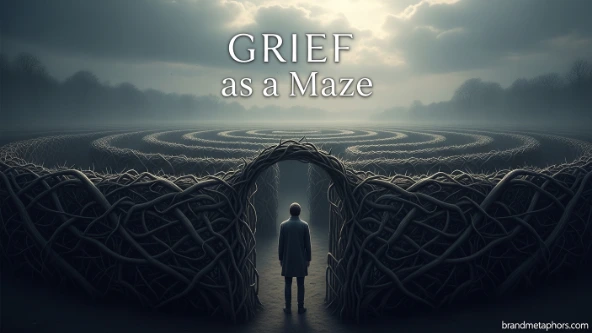
Grief as a Maze
Meaning and Symbolism
A maze represents confusion and uncertainty.
People often feel lost while grieving.
Example Sentence
“I wandered through grief like someone trapped in a maze.”
Alternative Expressions
- Labyrinth of sorrow
- Confusing pathway
- Emotional puzzle
Practical Insight
There is rarely a straight path through grief. Progress often includes setbacks and unexpected turns.
Grief as a Deep Wound
Meaning and Symbolism
This metaphor highlights pain and healing.
Just as physical wounds need time, emotional wounds require patience and care.
Example Sentence
“Grief was a wound that slowly learned how to heal.”
Alternative Expressions
- Scar of loss
- Emotional injury
- Healing cut
Emotional Detail
The wound may close, but the scar often remains as a reminder of love and memory.
Grief as a Changing River
Meaning and Symbolism
A river never stays exactly the same.
Similarly, grief changes shape over time.
Example Sentence
“My grief became a river, flowing differently with each passing year.”
Alternative Expressions
- Current of emotion
- Flowing sadness
- Stream of remembrance
Hopeful Perspective
Unlike storms or wounds, the river metaphor emphasizes movement and adaptation.
Three Powerful Metaphors for Grief You Can Use Today
1. Grief Is an Ocean
Meaning: Emotions come in waves.
Example: “The waves still come, but I have learned how to float.”
Alternative: “Grief is a tide that rises and falls.”
2. Grief Is a Shadow
Meaning: Loss remains part of life.
Example: “My shadow of grief follows me quietly.”
Alternative: “Loss walks beside me.”
3. Grief Is Winter
Meaning: Healing takes time.
Example: “I survived the winter of sorrow.”
Alternative: “The cold season eventually gave way to spring.”
Interactive Exercise: Create Your Own Grief Metaphor
Step 1: Identify the Feeling
Ask yourself:
- Does grief feel heavy?
- Does it feel cold?
- Does it feel endless?
Step 2: Compare It to Something Physical
Think about objects, places, weather, or journeys.
Examples:
- A mountain
- A river
- A forest
- A storm
Step 3: Write a Sentence
Complete this prompt:
“Grief is like __________ because __________.”
Creative Challenge
Write three different metaphors for the same experience and compare how each one changes the emotional impact.
Bonus Tips for Using Metaphors for Grief
In Creative Writing
Use sensory details to strengthen imagery.
Instead of saying:
“I felt sad.”
Try:
“The storm inside me refused to pass.”
In Social Media Posts
Short metaphors often create strong emotional connections.
Example:
“Grief is love with nowhere to go.”
In Personal Journaling
Metaphors help uncover emotions that may be difficult to identify directly.
In Conversations
Gentle metaphors can communicate feelings without needing lengthy explanations.
In Poetry
Combine multiple metaphors to create layered emotional meaning.
Example:
“My winter became an ocean, and every wave carried your memory.”
Conclusion
Grief is one of the most universal human experiences, yet it often feels impossible to describe. Metaphors offer a way to express the inexpressible. Whether grief feels like an ocean, a storm, a shadow, a wound, or a winter, these images help transform complex emotions into something understandable and shareable.
The beauty of metaphors for grief lies in their flexibility. No single metaphor fits every person or every loss. Your grief may be a river, a maze, a mountain, or an unfinished book. What matters is finding language that honors your experience.
As you explore these metaphors, remember that grief is not a sign of weakness. It is evidence of connection, love, and meaning. And just as every metaphor evolves, so does the journey through loss.
Frequently Asked Questions
What is a metaphor for grief?
A metaphor for grief is a figurative comparison that helps describe the experience of loss, such as comparing grief to an ocean, storm, shadow, or winter.
Why are metaphors useful when talking about grief?
Metaphors make complex emotions easier to understand, communicate, and process by turning abstract feelings into vivid images.
What is the most common metaphor for grief?
The ocean metaphor is one of the most common because it captures the unpredictable waves of emotion that often accompany loss.
Can metaphors help with healing?
Yes. Many people find that metaphors provide language for difficult emotions, making reflection and communication easier.
How can I create my own metaphor for grief?
Think about how grief feels physically or emotionally, then compare that feeling to an object, place, season, journey, or natural force that shares similar qualities.