
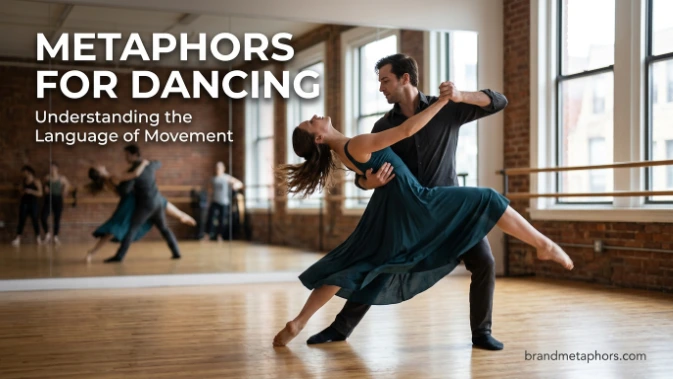
Imagine a dancer stepping onto a quiet floor. At first, there is only a beat. Then a shoulder moves, a foot glides, and suddenly the entire room seems to breathe with the music. The dancer is not simply moving; they are telling a story without saying a word. That is why Metaphors for Dancing can make descriptions far more powerful. Instead of saying that someone moved beautifully, you can compare their motion to flowing water, a flickering flame, or a bird riding the wind. As a result, readers can almost see, hear, and feel the movement. Whether you are writing poetry, stories, essays, captions, or school assignments, creative comparisons can turn ordinary descriptions into memorable images. Moreover, they help communicate rhythm, emotion, energy, freedom, and personality in a way that simple adjectives often cannot.
What Are Metaphors for Dancing?

A metaphor is a comparison that says one thing is another, creating a deeper connection between ideas. When applied to dancing, metaphors allow us to describe movement in emotional, symbolic, or imaginative ways.
Instead of saying:
- “She danced beautifully”
You might say:
- “She danced like a flame refusing to be extinguished”
Now, the image carries emotion, intensity, and story.
Metaphors for dancing matter because:
- They add depth to writing
- They evoke emotion and imagery
- They help readers feel rather than just understand
- They transform simple description into art
Why Metaphors Matter in Describing Dance
Dance itself is already a form of expression without words. Ironically, that makes it harder to describe with words. Metaphors bridge this gap.
They:
- Translate physical motion into emotional meaning
- Capture fleeting moments in vivid language
- Make writing more memorable and shareable
Think about how often dance appears in storytelling—romance, celebration, grief, rebellion. Metaphors amplify those moments.
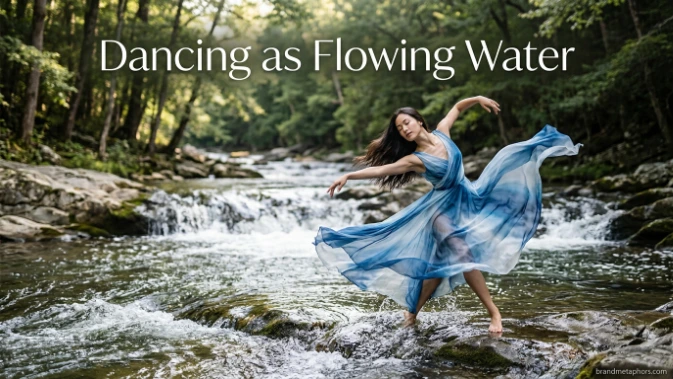
Dancing as Flowing Water
Meaning and Explanation
Comparing dancing to water suggests fluidity, grace, adaptability, and continuous motion. Water never resists—it moves around obstacles, changes form, and finds rhythm naturally.
Example Sentence
- “She moved across the stage like a river, bending and gliding without effort.”
Alternative Expressions
- “He danced like waves folding into the shore”
- “Their movements poured into each other like streams merging”
- “Her body rippled like water under moonlight”
Sensory & Emotional Details
You can almost hear the soft rush, feel the coolness, see the shimmer. This metaphor evokes calm, elegance, and natural beauty.
Mini Story
Imagine a dancer performing alone in a dimly lit room. No sharp movements, no breaks—just continuous motion. Each step melts into the next. Watching her feels like watching rain slide down a windowpane. Quiet. Mesmerizing.
Dancing as Fire
Meaning and Explanation
Fire symbolizes passion, intensity, danger, and transformation. When dancing is compared to fire, it suggests energy that cannot be contained.
Example Sentence
- “He danced like wildfire, fierce and impossible to control.”
Alternative Expressions
- “Her steps sparked like embers in the dark”
- “They burned through the floor with every movement”
- “His body flickered like a restless flame”
Sensory & Emotional Details
Heat. Flickering light. Urgency. Fire metaphors often convey boldness, rebellion, or desire.
Mini Story
In a crowded wedding hall, one dancer steps into the center. The music shifts. Suddenly, every movement is sharp, fast, alive. People stop talking. Eyes follow. It’s not just dancing—it’s ignition.
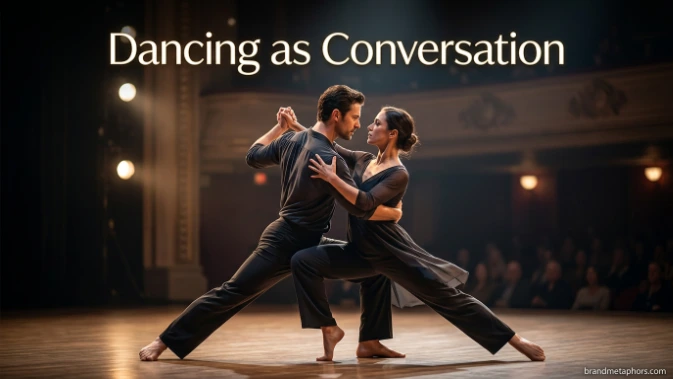
Dancing as Conversation
Meaning and Explanation
This metaphor emphasizes communication. Dancing becomes a dialogue between partners, between body and music, or even between dancer and audience.
Example Sentence
- “They danced like two voices in perfect conversation, responding without words.”
Alternative Expressions
- “Their steps whispered secrets to each other”
- “The rhythm asked questions, and her body answered”
- “Each movement spoke louder than words”
Sensory & Emotional Details
Soft exchanges, pauses, responses. This metaphor evokes intimacy, connection, and understanding.
Mini Story
Two strangers meet on a dance floor. No introductions. No words. Yet within minutes, they are laughing, spinning, reacting—like old friends catching up. That is the language of movement.
How to Create Your Own Dance Metaphors
Creating metaphors doesn’t require poetic genius—just observation and imagination.
Try this process:
- Observe the movement
- Is it fast? Slow? Sharp? Smooth?
- Ask what it feels like
- Calm? Wild? Joyful? Sad?
- Match it with something similar
- Nature (wind, water, storm)
- Emotions (love, anger, freedom)
- Objects (clockwork, silk, thunder)
- Experiment with language
- Don’t settle for the first idea—play with variations.
Example:
- Movement: quick and unpredictable
- Feeling: chaotic but exciting
- Metaphor: “like lightning dancing across the sky”
Sensory Imagery in Dance Metaphors

To make metaphors more powerful, engage the senses:
- Sight: colors, light, shadows
- Sound: rhythm, silence, echoes
- Touch: softness, heat, pressure
- Emotion: tension, joy, longing
Example:
- “Her dance shimmered like golden light spilling across water at sunset”
The more senses you involve, the more immersive your writing becomes.
Interactive Exercise: Create Your Own Dance Metaphor
Try this:
Fill in the Blank
- “He danced like __________”
Choose something unexpected:
- A storm?
- A falling leaf?
- A ticking clock?
Emotion-Based Metaphor
Pick an emotion:
- Joy → “like sunlight bursting through clouds”
- Sadness → “like rain tapping against glass”
Rewrite a Basic Sentence
Original:
- “She danced beautifully”
Rewrite:
- “She danced like…”
Create 3 different versions using different moods.
Using Dance Metaphors in Writing and Storytelling
Metaphors can elevate:
- Poetry
- Short stories
- Novels
- Social media captions
- Speeches
Example (Before & After)
Before:
- “They danced together all night.”
After:
- “They danced like two stars orbiting each other, pulled by something invisible yet undeniable.”
Notice how the second version tells a story, not just an action.
Cultural and Literary Inspirations for Dance Metaphors
Dance metaphors appear across cultures and literature:
- In poetry, dance often represents freedom or rebellion
- In films, it symbolizes romance or transformation
- In folklore, it connects to ritual and spirituality
Think of traditional dances—each movement carries meaning. Metaphors help translate that meaning into words.
Bonus Tips: Using Dance Metaphors in Daily Life and Social Media
Want to sound more expressive in everyday communication?
Try:
- Captions:
- “Dancing through life like a breeze that refuses to settle”
- Messages:
- “Today felt like dancing in a storm—messy but alive”
- Journaling:
- Describe your day as a dance:
- Was it slow?
- Chaotic?
- Graceful?
- Describe your day as a dance:
Quick Tips
- Keep metaphors relatable
- Avoid overcomplicating
- Match tone with context
- Use sparingly for maximum impact
Common Mistakes to Avoid
- Overusing metaphors → Can feel overwhelming
- Mixing metaphors → Confusing imagery
- Using clichés → Less impactful
Instead of:
- “Danced like a butterfly”
Try:
- “Danced like a shadow slipping between moments”
Freshness matters.
Practice Prompts for Creative Growth
- Describe a dance using only nature metaphors
- Write a short paragraph where dancing represents:
- Love
- Fear
- Freedom
- Imagine a character who dances differently depending on mood—describe each style
FAQs About Metaphors for Dancing
1. What is the best metaphor for dancing?
There’s no single “best” metaphor—it depends on the mood. Water works for grace, fire for intensity, and conversation for connection.
2. Can beginners use metaphors effectively?
Yes. Start simple. Even basic comparisons can be powerful if they are clear and vivid.
3. How do I avoid clichés?
Think of unique comparisons. Observe real-life movements and connect them to unexpected ideas.
4. Are metaphors only for creative writing?
Not at all. They can enhance social media, speeches, journaling, and even everyday conversation.
5. How many metaphors should I use in one piece?
Use them sparingly. A few strong metaphors are more effective than many weak ones.
What are metaphors for dancing?
Metaphors for dancing are creative comparisons that describe movement, rhythm, emotion, or expression by connecting dance to something familiar, such as water, fire, birds, storms, or music.
What is a good metaphor for graceful dancing?
A river is an effective metaphor for graceful dancing because flowing water suggests smooth, continuous, and controlled movement. A feather, ribbon, or gentle breeze can create a similar effect.
What is a metaphor for energetic dancing?
Fire is a strong metaphor for energetic dancing because flames suggest movement, intensity, passion, and constant change. Lightning and storms can also describe fast or powerful movement.
How can I describe dance without repeating the word “dance”?
Focus on the movement itself. You can describe someone as gliding, spinning, flowing, leaping, floating, pulsing, or moving like water, wind, fire, or a bird.
Why are metaphors useful when describing dance?
Metaphors help readers visualize movement and understand emotion. Instead of simply stating that a performance is beautiful or energetic, a strong comparison allows readers to imagine how the movement looks and feels.
Conclusion
Dancing is more than movement—it is emotion in motion, a story told without language. And metaphors are how we translate that silent story into words that resonate.
When you describe dancing as water, fire, or conversation, you are doing more than decorating your writing—you are revealing meaning, inviting connection, and creating imagery that lingers.
So the next time you see someone dance—or feel the rhythm yourself—pause and ask:
What does this movement feel like?
Then let your answer flow into metaphor.
Because sometimes, the most powerful way to describe dancing… is to let your words dance too.