

Introduction: Looking Into the Mirror of Metaphor
Have you ever tried to describe yourself and found that ordinary words were not enough? Imagine standing beside a quiet lake at sunrise. The water reflects your face, but it cannot reveal your dreams, fears, strengths, and hidden stories. Human beings are far more complex than a simple reflection. That is why metaphors are such powerful tools. They allow us to compare ourselves to something vivid, meaningful, and memorable.
When we say, “I am a lighthouse” or “I am a growing tree,” we are not speaking literally. Instead, we are expressing deeper truths about who we are. Metaphors help us communicate personality, emotions, goals, and experiences in ways that plain descriptions cannot.
Whether you are writing a personal essay, creating a social media bio, preparing a speech, or simply exploring your identity, self-metaphors can help you understand yourself better. They turn abstract feelings into colorful images that others can easily connect with.
In this article, you will discover creative ways to use metaphors about yourself, learn what they mean, explore practical examples, and practice creating your own. By the end, you may find that describing yourself becomes less like filling out a form and more like telling a fascinating story.
Why Metaphors About Myself Matter
Understanding Personal Identity Through Comparison
Metaphors help us make sense of our experiences. When you compare yourself to something else, you reveal qualities that might otherwise stay hidden.
For example:
- A mountain suggests strength and resilience.
- A river suggests adaptability and movement.
- A candle suggests warmth and guidance.
These comparisons help people understand who you are in a more emotional and memorable way.
Building Stronger Communication
People remember images more than facts. Saying “I am determined” is clear, but saying “I am a train that never leaves the tracks” creates a stronger impression.
Metaphors make conversations, writing, and presentations more engaging.
Expressing Complex Emotions
Sometimes emotions are difficult to explain directly. A metaphor can capture feelings that ordinary language struggles to express.
Instead of saying “I feel confused,” you might say:
“I am a compass spinning in a storm.”
The image instantly communicates uncertainty and struggle.
The Power of Self-Metaphors in Everyday Life
Turning Experiences Into Stories
Every person carries unique experiences. Metaphors transform those experiences into stories.
Think about someone who has overcome hardship. They might describe themselves as:
“I am a tree that learned to grow through cracks in the concrete.”
This comparison tells a story of persistence and survival.
Making Personal Branding More Memorable
Writers, students, professionals, and content creators often use metaphors to create a unique identity.
Examples:
- “I am a bridge connecting ideas.”
- “I am a spark for innovation.”
- “I am a compass guiding teams forward.”
Such descriptions stand out more than standard introductions.
Creating Emotional Connections
People connect with stories and images. Metaphors invite others into your world and help them understand your perspective.
Metaphor Example #1: I Am a Lighthouse
Meaning and Explanation
A lighthouse stands strong against storms while helping others find their way.
When you describe yourself as a lighthouse, you suggest:
- Reliability
- Wisdom
- Guidance
- Stability
You remain steady even when life becomes difficult.
Example Sentence
“I am a lighthouse, standing firm through rough seas and helping others navigate uncertainty.”
Alternative Ways to Express It
- I am a beacon in the darkness.
- I am a guiding star.
- I am a lantern along a lonely road.
Emotional and Sensory Details
Imagine crashing waves, roaring winds, and dark skies. Yet the lighthouse continues shining.
This image creates feelings of safety, hope, and trust.
Mini Storytelling Example
A teacher who encourages students through challenges might see themselves as a lighthouse. Year after year, they guide young minds toward brighter futures.
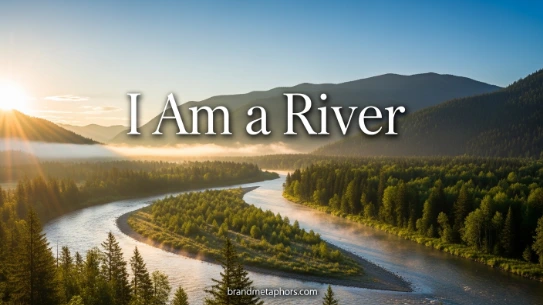
Metaphor Example #2: I Am a River
Meaning and Explanation
A river constantly moves forward. It adapts to obstacles rather than stopping.
This metaphor suggests:
- Flexibility
- Growth
- Persistence
- Change
Example Sentence
“I am a river, flowing around obstacles and finding new paths toward my destination.”
Alternative Ways to Express It
- I am an endless stream.
- I am flowing water.
- I am a winding current.
Emotional and Sensory Details
Picture cool water gliding over smooth stones. Hear its gentle movement. The image evokes calmness and resilience.
Real-Life Example
Someone who has changed careers, moved cities, or overcome major life transitions may identify strongly with this metaphor.
The river reminds us that growth often requires movement.
Metaphor Example #3: I Am a Garden
Meaning and Explanation
A garden symbolizes development, patience, and care.
Describing yourself as a garden suggests:
- Continuous growth
- Creativity
- Self-improvement
- Potential
Example Sentence
“I am a garden, growing stronger and more colorful with every season.”
Alternative Ways to Express It
- I am a field of possibilities.
- I am a blooming landscape.
- I am fertile soil for new ideas.
Emotional and Sensory Details
Imagine colorful flowers, fresh rain, and warm sunlight. This metaphor creates a feeling of hope and renewal.
Cultural Reference
Many cultures use gardens as symbols of personal growth and wisdom. Philosophers and poets have long compared human development to nurturing plants.
How to Choose the Right Metaphor for Yourself
Identify Your Core Qualities
Ask yourself:
- What strengths define me?
- What challenges have shaped me?
- What values matter most?
Your answers can guide your metaphor choice.
Think About Your Life Journey
Consider your experiences.
Someone who has overcome adversity may relate to:
- A phoenix
- A mountain
- A survivor tree
Someone focused on creativity may prefer:
- A canvas
- A garden
- A spark
Match the Image to the Message
Choose a metaphor that supports the story you want to tell.
Different situations may call for different comparisons.
Metaphors About Myself for Confidence
Strong Images for Personal Strength
Confidence often appears through powerful symbols.
Examples include:
- I am a mountain.
- I am a fortress.
- I am an oak tree.
- I am a lion.
These images communicate stability and courage.
Example Scenario
Imagine preparing for a job interview.
Instead of thinking, “I hope I do well,” picture yourself as a mountain.
The metaphor can influence your mindset and boost confidence.
Bonus Tip
Use confidence metaphors in affirmations and journal writing to reinforce positive self-belief.
Metaphors About Myself for Growth and Change
Celebrating Personal Development
Growth-focused metaphors emphasize progress rather than perfection.
Popular examples:
- I am a seed becoming a tree.
- I am a butterfly emerging from a cocoon.
- I am a sunrise after a long night.
Why These Images Work
They remind us that growth takes time.
Every stage of development has value, even when progress feels slow.
Literary Connection
Many classic stories feature transformation themes. Heroes often evolve through challenges, much like seeds becoming mighty trees.
Creative Self-Metaphors for Writing and Social Media
Making Profiles More Interesting
Instead of writing:
“I am creative and hardworking.”
Try:
“I am a painter filling blank spaces with possibility.”
Social Media Bio Ideas
- A traveler collecting stories like seashells.
- A dreamer chasing horizons.
- A spark searching for new adventures.
- A bridge connecting people and ideas.
Writing Exercise
Create three self-metaphors:
- One for your strengths.
- One for your dreams.
- One for your current challenge.
Notice how each reveals a different side of your personality.
Interactive Exercises to Create Your Own Self-Metaphors
Exercise 1: Finish the Sentence
Complete the following:
- I am a __________ because __________.
- My mind is a __________ because __________.
- My future is a __________ because __________.
Write quickly without overthinking.
Exercise 2: Nature Inspiration
Choose one element:
- Ocean
- Forest
- Mountain
- River
- Sky
Describe how it reflects your personality.
Exercise 3: Storytelling Challenge
Write a short paragraph beginning with:
“I am a traveler crossing an unknown map.”
Continue the story and see what it reveals about your goals and fears.
Exercise 4: Memory Reflection
Think of a significant moment in your life.
Ask:
“What object, place, or force of nature best represents that experience?”
Turn your answer into a metaphor.
Bonus Tips for Using Self-Metaphors Effectively
Keep Them Authentic
The best metaphors feel true to your experiences.
Avoid choosing images simply because they sound impressive.
Use Specific Details
Specific images create stronger impressions.
Instead of:
“I am a bird.”
Try:
“I am an eagle riding powerful winds above uncertainty.”
Adapt Metaphors to Different Audiences
Professional settings may benefit from:
- Bridge
- Compass
- Lighthouse
Creative settings may welcome:
- Firework
- Canvas
- Symphony
Combine Metaphors Carefully
You can blend images when they support each other.
Example:
“I am both a river and a bridge—always moving forward while helping others cross.”
Practice Regularly
Create new metaphors as your life changes.
Your identity is not fixed. Your metaphors can evolve too.
Using Metaphors About Myself for Self-Discovery
Looking Beyond Surface Descriptions
Metaphors often reveal truths we did not know were there.
A person who sees themselves as a lantern may value helping others.
Someone who identifies as a storm may recognize their intense emotions and energy.
Journaling With Metaphors
Try writing:
- Today I feel like…
- My biggest challenge is…
- My greatest strength is…
Complete each sentence with a metaphor.
Building Self-Awareness
The metaphors you choose often reveal your beliefs, values, and aspirations.
Over time, they become a map of personal growth.
Conclusion
Metaphors about yourself are more than creative expressions. They are windows into identity, emotion, and personal growth. A simple comparison can communicate resilience, hope, creativity, confidence, or transformation in ways that ordinary descriptions cannot.
Whether you see yourself as a lighthouse guiding others, a river adapting to change, a garden growing through every season, or something entirely unique, self-metaphors help tell your story with color and meaning. They transform introductions into narratives, reflections into discoveries, and ordinary words into memorable images.
As you continue exploring who you are, remember that your metaphor does not have to stay the same forever. Just as people grow and evolve, the images that represent them can evolve as well. Keep experimenting, writing, and reflecting. You may discover that the most powerful metaphor is the one that captures the person you are becoming.
FAQs
What are metaphors about myself?
Metaphors about yourself are creative comparisons that describe your personality, emotions, strengths, or experiences through symbolic images rather than literal statements.
Why should I use self-metaphors?
Self-metaphors help express complex ideas, improve communication, strengthen writing, and encourage deeper self-reflection.
What is a good metaphor for personal growth?
A seed growing into a tree, a butterfly emerging from a cocoon, or a sunrise after darkness are all powerful metaphors for growth and transformation.
Can I use self-metaphors in professional settings?
Yes. Professional metaphors such as a bridge, compass, lighthouse, or architect can effectively communicate leadership, guidance, and vision.
How do I create my own metaphor about myself?
Think about your qualities, experiences, and goals. Then identify an object, place, animal, or natural element that shares those characteristics and build your comparison around it.