
Introduction
Good writing is more than using correct grammar. It also includes choosing the right words, using figurative language, and expressing ideas clearly. Literary devices such as metaphors, similes, idioms, and descriptive language make writing more interesting and easier to remember. Whether you are writing a school essay, a story, a poem, or a professional email, the words you choose can change the meaning of your message.
Many English learners struggle with words that sound the same but have different meanings. These words are called homophones. One common pair is dual vs duel. Since both words are pronounced almost the same, many students accidentally use one instead of the other. However, their meanings are completely different.
In this guide, you will learn what each word means, when to use it, how to remember the difference, common mistakes to avoid, and plenty of sentence examples. You will also explore figurative language connections, creative writing tips, comparison tables, practice exercises, and frequently asked questions. By the end of this article, you will confidently know which word belongs in every sentence.
What Do These Words Mean?
Although these two words sound alike, they describe completely different ideas.
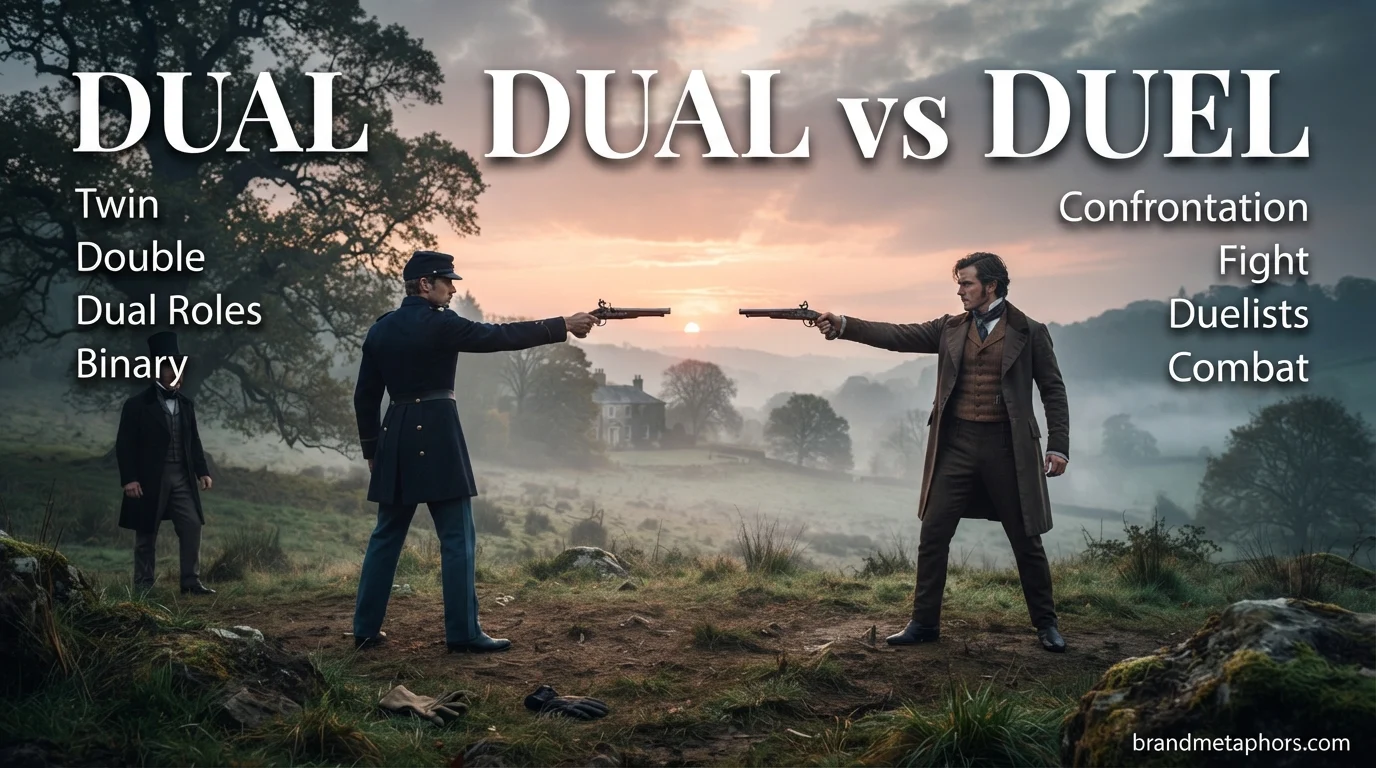
WordMeaningPart of SpeechExampleDualHaving two parts or two purposesAdjectiveShe has dual citizenship.DuelA fight or contest between two peopleNoun or VerbThe knights fought a duel.
The easiest way to remember them is:
- Dual = Two
- Duel = Fight
These meanings never overlap.
Understanding “Dual”
The word dual describes something that has two parts, two roles, two functions, or two purposes.
It often appears in everyday conversations, education, business, technology, science, and law.
Common Uses
- Two functions
- Two personalities
- Two languages
- Two responsibilities
- Two identities
- Two purposes
Sentence Examples
- She plays a dual role in the school play.
- This phone has a dual camera.
- He holds dual citizenship.
- The building has a dual purpose as a library and museum.
- Our teacher has a dual responsibility of teaching and counseling.
Common Phrases
- Dual personality
- Dual purpose
- Dual language
- Dual role
- Dual system
- Dual control
- Dual identity
These phrases are common in academic and professional writing.
Understanding “Duel”
A duel is a formal fight or competition between two people.
Historically, people sometimes fought duels using swords or pistols to defend their honor. Today, the word is often used in stories, movies, sports, games, and figurative language.
As a Noun
A duel is the contest itself.
Examples:
- The movie ends with a dramatic duel.
- The prince won the duel.
- Their duel lasted only a few minutes.
As a Verb
To duel means to fight or compete.
Examples:
- The knights dueled at sunrise.
- The rivals dueled for the championship.
- Two magicians dueled using powerful spells.
Quick Comparison Table
FeatureDualDuelMeaningHaving two partsA fight between two peopleWord TypeAdjectiveNoun and VerbRelated IdeaTwoBattleUsed InEducation, science, technologyHistory, fiction, sportsExampleDual purposeSword duelRememberDual = DoubleDuel = Fight
Why People Confuse These Words
These words create confusion because they are homophones.
Homophones are words that:
- Sound the same
- Have different spellings
- Have different meanings
Examples include:
- There, Their, They’re
- Pair, Pear
- Right, Write
- Dual, Duel
Since pronunciation is almost identical, many writers accidentally choose the wrong spelling.
For example:
❌ He has duel citizenship.
Correct:
✅ He has dual citizenship.
Another example:
❌ The knights fought a dual.
Correct:
✅ The knights fought a duel.
Reading your writing carefully helps catch these mistakes.
Using These Words in Creative Writing
Creative writing becomes stronger when vocabulary is accurate.
Using “Dual”
This word often describes characters or situations with two sides.
Examples:
- The hero lived a dual life.
- She struggled with dual emotions.
- The story explored the character’s dual identity.
- His dual responsibilities caused stress.
These examples help readers understand complexity.
Using “Duel”
This word creates excitement and conflict.
Examples:
- The final duel decided the kingdom’s future.
- Two wizards prepared for a magical duel.
- The brothers dueled for the throne.
- The movie ended with an unforgettable duel.
Stories become more dramatic when conflict is clearly described.
Figurative Language Connections
Although these words are literal, they also appear in figurative language.
Metaphor Examples
- His heart was a battlefield in a duel between hope and fear.
- Her dual personality became two sides of the same coin.
- Success often begins with a duel against self-doubt.
- Life presents a dual path of challenge and opportunity.
Simile Examples
- Their argument was like a duel without swords.
- She balanced two careers like a performer juggling two balls.
- His thoughts were like two rivers flowing together.
- The debate felt like a duel between brilliant minds.
Idiom Meaning Connections
Some idioms express ideas similar to these words.
Examples:
- Face off
- Head-to-head
- Two sides of the same coin
- At odds
- Neck and neck
These expressions add color to writing.
Tone Usage and Style
Choosing the correct tone improves communication.
Formal Writing
Use dual in:
- Academic papers
- Business reports
- Research
- Government documents
- Technology articles
Example:
The software provides dual authentication.
Informal Writing
Use both words naturally.
Examples:
I have dual monitors.
The heroes fought an exciting duel.
Storytelling
Use duel to create action.
Example:
The warriors stepped into the arena for their final duel.
Poetry
Both words can appear in symbolic writing.
Example:
The soul faced a silent duel between love and fear.
Common Mistakes and How to Avoid Them
Mistake 1
❌ Dual fight
Correct:
✅ Duel
Mistake 2
❌ Duel citizenship
Correct:
✅ Dual citizenship
Mistake 3
Thinking both words mean “two.”
Only dual relates to the number two.
Mistake 4
Using duel for technology.
Incorrect:
The phone has duel speakers.
Correct:
The phone has dual speakers.
Mistake 5
Using dual for competitions.
Incorrect:
The knights entered a dual.
Correct:
The knights entered a duel.
Vocabulary Enhancement
Learning related vocabulary improves writing skills.
Words Related to Dual
- Double
- Twin
- Pair
- Combined
- Twofold
- Bipartite
- Shared
- Parallel
Words Related to Duel
- Battle
- Contest
- Fight
- Competition
- Combat
- Challenge
- Face-off
- Conflict
Using a variety of words makes writing richer and avoids repetition.
Descriptive Language and Comparison Examples

Descriptive language paints pictures for readers.
Examples Using Dual
- The bridge served a dual purpose by connecting two towns and carrying water pipes.
- The actress impressed everyone with her dual performance.
- The building has dual entrances.
- He managed dual careers successfully.
Examples Using Duel
- The sword duel echoed through the castle walls.
- The duel lasted until sunset.
- Their debate became a verbal duel.
- The championship felt like a duel between legends.
Notice how one group talks about two functions, while the other describes competition.
Practice Exercises
Exercise 1
Choose the correct word.
- The phone has _____ cameras.
Answer:
Dual
- The pirates prepared for a _____.
Answer:
Duel
- She has _____ citizenship.
Answer:
Dual
- The two champions will _____ tomorrow.
Answer:
Duel
- This building serves a _____ purpose.
Answer:
Dual
Exercise 2
Correct the mistakes.
- They fought a dual.
Correct:
They fought a duel.
- She has duel responsibilities.
Correct:
She has dual responsibilities.
- Our laptop has duel screens.
Correct:
Our laptop has dual screens.
- The kings prepared for a dual.
Correct:
The kings prepared for a duel.
Exercise 3
Fill in the blanks.
- The detective lived a ______ life.
- The rivals fought an exciting ______.
- This machine has a ______ function.
- The final ______ determined the winner.
Answers:
Dual
Duel
Dual
Duel
Tips to Remember the Difference
Here are some simple memory tricks.
Think of “Double”
The word dual starts with du, just like double.
Dual = Double = Two.
Think of “Enemy”
A duel happens between opponents.
Duel = Fight.
Picture It
Imagine:
- Two doors for dual
- Two swords for duel
Visual memory makes learning easier.
When to Use and When to Avoid
Use “Dual” When
- Talking about two roles
- Describing two functions
- Mentioning two identities
- Discussing two systems
- Explaining two purposes
Avoid “Dual” When
- Describing battles
- Talking about competitions
- Referring to sword fights
Use “Duel” When
- Talking about contests
- Describing fights
- Writing historical stories
- Creating fantasy novels
- Discussing dramatic conflicts
Avoid “Duel” When
- Talking about technology
- Describing two functions
- Mentioning double responsibilities
Real-Life Examples
Here are examples you may hear every day.
School
Our teacher has dual responsibilities.
Technology
This laptop supports dual displays.
Travel
He holds dual citizenship.
Movies
The film ends with a thrilling duel.
Sports
The championship became a duel between two great players.
Literature
The hero faced an emotional duel between duty and love.
These examples show how naturally each word fits different situations.
Frequently Asked Questions
1. What is the main difference between these two words?
One means having two parts or purposes, while the other refers to a fight or contest between two people.
2. Which word is used with citizenship?
Use dual because citizenship refers to having two nationalities.
3. Can “duel” be a verb?
Yes. It can describe the action of fighting or competing.
Example:
The warriors dueled all afternoon.
4. Why do students confuse these words?
Because they sound almost identical, making them common homophones in English.
5. How can I remember the difference?
Remember:
- Dual = Double = Two
- Duel = Fight = Battle
This simple trick works almost every time.
Conclusion
Understanding the difference between these commonly confused words helps you write with greater accuracy and confidence. One describes something with two parts, functions, or identities, while the other refers to a contest or fight between two opponents. Although they sound alike, their meanings are completely different, making careful word choice essential in essays, stories, emails, and everyday communication.
As you continue improving your writing skills, pay attention to context before choosing a word. Reading regularly, practicing with sentence examples, and exploring figurative language, metaphors, similes, idioms, and descriptive expressions will strengthen both your vocabulary and creative writing abilities. With regular practice, you will avoid common mistakes and communicate your ideas more clearly in every piece of writing.