
Have you ever looked at a map and noticed that the straight-line distance between two places is much shorter than the driving distance? English has a popular expression for this idea. It describes the shortest possible distance between two points without following roads, rivers, mountains, or other obstacles.
This phrase is common in everyday conversations, travel, geography, navigation, and writing. Whether you are reading a novel, using a map, planning a trip, or improving your English vocabulary, understanding this expression will help you communicate more clearly.
In this guide, you’ll learn its meaning, history, practical uses, examples, common mistakes, similar expressions, and tips for using it correctly. By the end, you’ll know exactly when and how to use this well-known idiom with confidence.
What Does This Expression Mean?
This expression means the shortest and most direct distance between two places in a straight line, without considering roads, buildings, rivers, hills, or other obstacles.
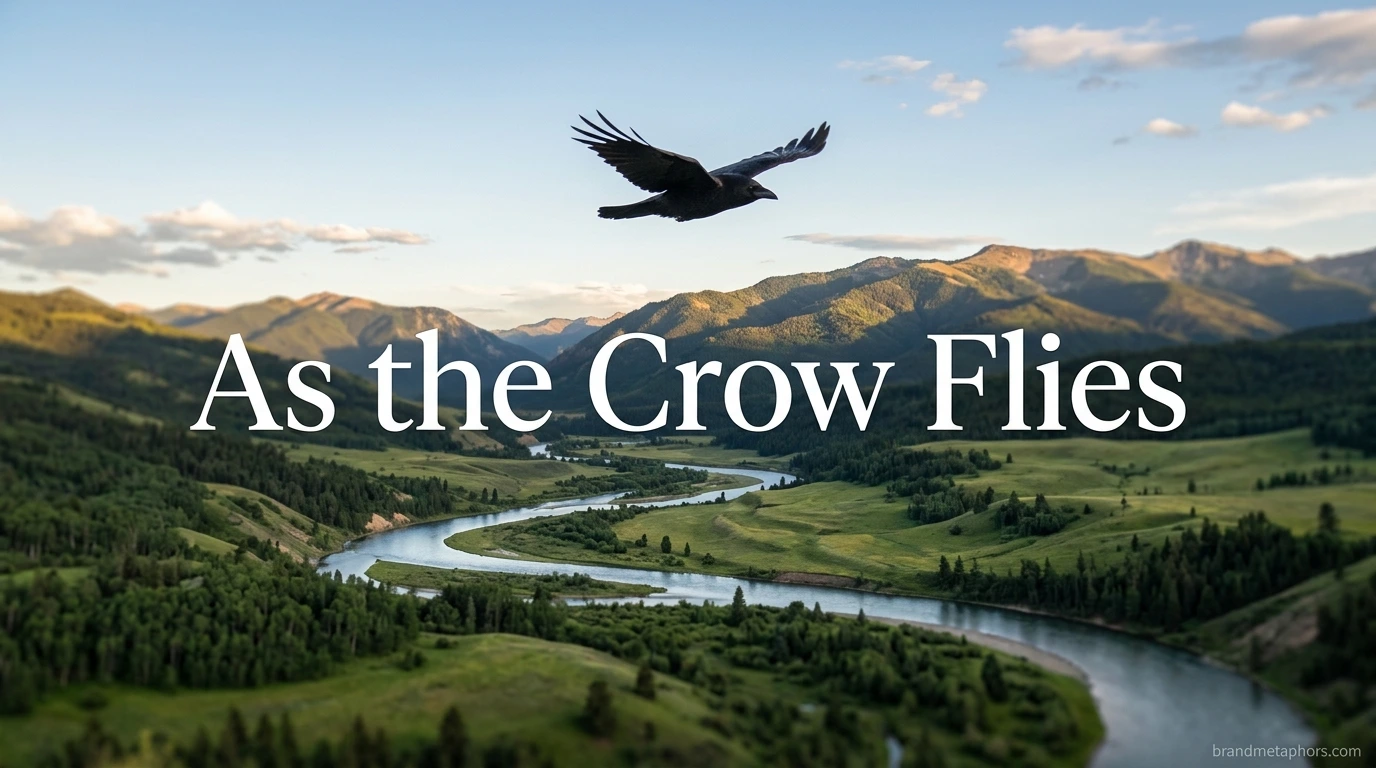
Imagine a crow flying from one tree to another. The bird does not have to follow roads or sidewalks. It simply flies straight to its destination. That is the idea behind the expression.
Simple Definition
The direct distance between two locations measured in a straight line.
Easy Example
- The two villages are only five miles apart in a straight line.
- The drive takes twelve miles because the road curves around the hills.
The direct measurement is much shorter than the driving distance.
Where Did This Expression Come From?
The phrase has been used in English for hundreds of years.
People noticed that birds, especially crows, fly directly toward their destination instead of following human roads or paths. Since crows travel through the air, they often take the shortest route possible.
Over time, people began using this image to describe direct distance between two places.
Although crows inspired the saying, the idea applies to many birds that fly in straight paths.
Interesting Facts
- It became popular in Britain many centuries ago.
- It is still widely used today.
- Surveyors, mapmakers, hikers, pilots, and travelers often use the concept.
Why People Use This Expression
This idiom helps explain distance quickly and clearly.
Instead of saying:
“The straight-line distance between these two points is six kilometers.”
People simply say:
“They’re six kilometers apart in a straight line.”
Common Reasons
- Giving directions
- Discussing maps
- Comparing travel routes
- Talking about hiking
- Describing property
- Planning outdoor trips
- Explaining GPS measurements
It makes conversations shorter and easier to understand.
Straight-Line Distance vs Road Distance
Many people confuse these two measurements.
Straight-Line DistanceRoad DistanceMeasures the shortest routeFollows actual roadsIgnores buildings and riversIncludes turns and curvesUsually shorterUsually longerUsed on mapsUsed for drivingDirect measurementPractical travel measurement
Example
Suppose your friend’s house is only two miles away directly across a river.
However:
- Straight-line distance: 2 miles
- Driving distance: 6 miles
The bridge makes the journey much longer.
Everyday Situations Where People Use It
You may hear this phrase in many different situations.
Travel Planning
Travelers compare locations before choosing transportation.
Example:
- The hotel is only one mile away directly, but walking takes twenty minutes.
Hiking
Hikers often estimate how far mountains or lakes are.
Example:
- The lake looks close, but the hiking trail is much longer.
Real Estate
Property advertisements sometimes mention direct distance to schools or parks.
Example:
- The beach is only three miles away directly.
Maps and GPS
Digital maps often calculate both direct distance and driving distance.
Education
Teachers use the expression in geography lessons when discussing maps and measurements.
Examples in Everyday Sentences

Here are many examples to help you understand the meaning.
- Our school is only two miles away directly.
- The airport looks close, but driving takes forty minutes.
- The island is ten miles from the shore in a straight line.
- The mountain is visible from here, but reaching it takes several hours.
- Their house is nearby directly, but the river blocks the path.
- The hospital isn’t far away in a direct measurement.
- Birds reach the lake much faster than people.
- The castle appears close on the map, but the roads wind through the hills.
- We measured the distance using a map.
- The campsite is nearby, but there is no direct road.
Common Mistakes to Avoid
Many English learners misunderstand this expression.
Mistake 1: Thinking It Means Driving Distance
Wrong:
“The supermarket is three miles away by car.”
Correct:
It describes only the direct measurement.
Mistake 2: Using It for Time
Wrong:
“The meeting is ten minutes away.”
Correct:
The expression talks about distance, not time.
Mistake 3: Forgetting Obstacles
Remember that rivers, forests, buildings, and mountains make actual travel longer.
Mistake 4: Taking It Literally
The saying does not mean a crow actually flew there.
It is simply an idiom.
Similar Expressions and Related Terms
English has several phrases with similar meanings.
In a Straight Line
The simplest alternative.
Example:
“The park is two miles away in a straight line.”
Direct Route
Means the shortest practical path.
Example:
“We found the most direct route.”
Point-to-Point Distance
Often used in mapping and science.
Linear Distance
Common in geography and surveying.
Air Distance
Frequently used by airlines and navigation systems.
Beeline
This means moving directly toward something.
Example:
“She made a beeline for the exit.”
Although similar, this focuses on movement rather than measuring distance.
Why Understanding This Expression Is Useful
Learning this idiom improves both your English and your general knowledge.
Benefits
- Expands vocabulary
- Improves reading skills
- Makes travel discussions easier
- Helps understand maps
- Improves listening comprehension
- Useful in geography lessons
- Makes writing sound more natural
- Common in books and movies
For English learners, mastering everyday expressions helps conversations sound more fluent.
Tips for Remembering the Meaning
Here are easy memory tricks.
Picture a Bird
Imagine a crow flying directly across a field without following roads.
That picture makes the meaning easy to remember.
Think About Maps
Whenever you see two points connected by a straight line, remember this expression.
Compare Roads
Driving routes often twist and turn.
Birds simply fly over everything.
Practice with Sentences
Try making your own examples.
For instance:
- My friend’s house is close directly, but the highway makes the trip longer.
- The school looks nearby on the map.
The more you practice, the easier it becomes.
Fun Real-Life Examples
Let’s see how the idea works in everyday life.
Example 1: Visiting Grandma
Your grandmother lives across a lake.
- Direct measurement: 2 miles
- Driving distance: 8 miles
Example 2: Hiking
A waterfall appears nearby.
However, the trail goes around cliffs.
- Direct measurement: 1 mile
- Hiking distance: 3 miles
Example 3: Flying
An airplane travels almost directly between cities.
Cars must follow highways.
Example 4: Delivery Services
Delivery drivers cannot always take the shortest line because they must use roads.
Example 5: Emergency Services
Helicopters often travel directly to emergencies, saving valuable time.
How This Expression Appears in Books, Maps, and Daily Conversation

You may find it in many places.
Books
Authors use it when describing landscapes and travel.
News Reports
Journalists compare disaster areas with nearby cities.
Navigation Apps
Some mapping tools show direct distance along with travel distance.
Classroom Lessons
Teachers explain map reading using straight-line measurements.
Everyday Speech
Friends often use it when talking about nearby places.
Example:
“Our houses are only a mile apart directly, but driving takes fifteen minutes.”
Frequently Asked Questions
1. What does this expression mean?
It means the shortest possible distance between two places measured in a straight line.
2. Does it describe driving distance?
No. It ignores roads, bridges, and other travel routes.
3. Why is a crow mentioned?
Crows fly directly toward their destination instead of following roads.
4. Is this an idiom?
Yes. It is a common English idiom describing direct distance.
5. Can I use it in everyday conversation?
Yes. Native English speakers use it often when discussing locations and maps.
6. Is it used only in English?
The exact wording is English, but many languages have similar expressions about birds flying directly.
7. Is direct distance always shorter?
Almost always. Roads usually include curves, intersections, and obstacles that increase travel distance.
8. When should I avoid using this expression?
Avoid using it when talking about travel time rather than physical distance.
Conclusion
Understanding this popular English expression makes it easier to discuss maps, travel, geography, and everyday locations. It describes the shortest possible distance between two points, ignoring roads and other obstacles. The image of a bird flying directly to its destination makes the meaning simple to remember.
Whether you’re learning English, planning a trip, reading a book, or studying geography, knowing the difference between direct distance and actual travel distance will improve your communication. Practice using this idiom in your own sentences, compare map distances with road routes, and you’ll quickly become comfortable using one of the most useful location-based expressions in everyday English.